Facts
The Haryana Police issued an advertisement dated 8 November 2003 for recruitment to 740 Constable posts. The petitioner applied under the Scheduled Caste (B) category and was placed first in the waiting list. Although he was declared medically fit and his antecedents were verified, he was not appointed on the ground that the notified vacancies had been filled.
Source reference: p. 2, para. 2He challenged the non-appointment before the High Court of Punjab and Haryana in C.W.P. No. 12059/2005, which was dismissed on 17 October 2006.
Source reference: p. 2, para. 12In January 2026, the petitioner obtained information under the Right to Information Act from the Commandant, 2nd Indian Reserve Battalion, Bhondsi, Gurugram, alleging that candidates placed below him in the waiting list had subsequently been appointed.
Source reference: p. 2, para. 2He thereafter filed a complaint before the National Commission for Scheduled Castes (NCSC), seeking reconsideration, action and compensation. The NCSC rejected the complaint on 27 April 2026 under paragraph 7.4.1(f) of its Rules of Procedure, 2009, which bars consideration of cases pending before courts or cases in which a court has already delivered a final verdict.
Source reference: pp. 2–3, para. 2The petitioner challenged the rejection before the Delhi High Court, asserting that the NCSC and the impugned order were situated in Delhi.
Source reference: p. 3, para. 4Issues
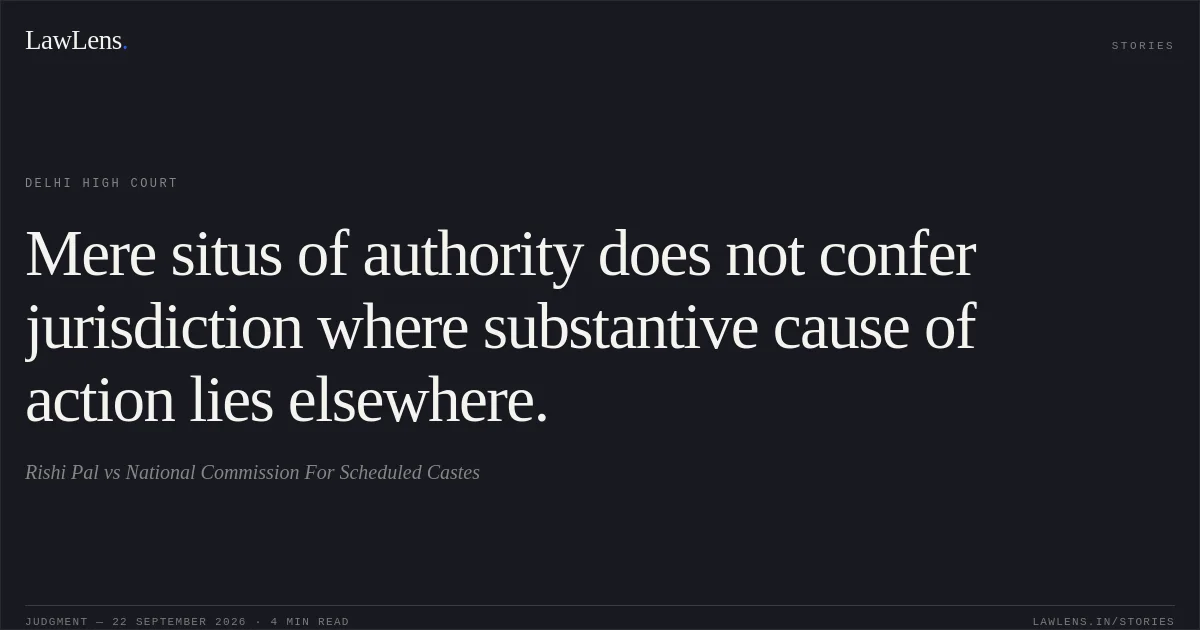
Whether the Delhi High Court had territorial jurisdiction under Article 226(2) of the Constitution to entertain a writ petition challenging an order passed by the NCSC in Delhi, when the substantive dispute arose from a Haryana Police recruitment process conducted in Haryana?
Source reference: pp. 3–4, paras. 7–8Whether, even assuming that the passing of the impugned order in Delhi constituted part of the cause of action, the Delhi High Court should decline to exercise jurisdiction on the basis of the doctrine of forum conveniens?
Source reference: pp. 6–7, paras. 15–18Law Applied
Article 226(2) permits a High Court to exercise writ jurisdiction where the cause of action arises wholly or in part within its territorial limits; “cause of action” comprises the bundle of material, essential and integral facts necessary to obtain relief, and not every fact pleaded by the petitioner.
Source reference: p. 4, para. 8The Court relied on State of Rajasthan v. Swaika Properties, (1985) 3 SCC 217; Oil and Natural Gas Commission v. Utpal Kumar Basu, (1994) 4 SCC 711; Union of India v. Adani Exports Ltd., (2002) 1 SCC 567; Kusum Ingots & Alloys Ltd. v. Union of India, (2004) 6 SCC 254; Alchemist Ltd. v. State Bank of Sikkim, (2007) 11 SCC 335; and Nawal Kishore Sharma v. Union of India, (2014) 9 SCC 329, for the requirement of a real and material nexus between the pleaded facts and the dispute.
Source reference: p. 4, para. 9The Court further applied the doctrine of forum conveniens, under which the mere existence of a slender or insignificant part of the cause of action within a High Court’s territory does not compel that Court to exercise jurisdiction where another forum has a substantially closer connection with the dispute, as recognised in Kusum Ingots and State of Goa v. Summit Online Trade Solutions (P) Ltd., (2023) 7 SCC 791.
Source reference: pp. 6–7, paras. 16–17Reasoning
The Court held that the material facts underlying the petitioner’s grievance were entirely connected with Haryana: the recruitment advertisement was issued by the Haryana Police; the petitioner participated in the recruitment and was placed on the waiting list in relation to that process; the alleged non-appointment concerned the Haryana Police; the subsequent appointments relied upon by the petitioner were made by the Haryana Police; and the RTI information was supplied by an authority located at Bhondsi, Gurugram.
Source reference: pp. 4–5, paras. 10–11The petitioner had also previously challenged the same non-appointment before the High Court of Punjab and Haryana, whose order formed the basis of the NCSC’s rejection.
Source reference: p. 5, para. 12Although the NCSC was located in Delhi and had passed the impugned order there, that circumstance was insufficient in isolation because the substantive cause of action and the factual foundation of the dispute lay in Haryana.
Source reference: pp. 5–6, paras. 14–15Applying forum conveniens, the Court concluded that the High Court of Punjab and Haryana had the more direct and substantial territorial connection with the dispute, and that Delhi was not the appropriate forum even if the NCSC’s order constituted a part of the cause of action.
Source reference: pp. 6–7, paras. 16–18Holding
The Delhi High Court declined to entertain the writ petition for want of territorial jurisdiction and on the ground of forum conveniens.
The petitioner was granted liberty to pursue any remedy available in law before the appropriate forum, including the High Court of Punjab and Haryana.
Source reference: p. 8, para. 20The Court expressly clarified that it had not examined or expressed any opinion on the merits of the petitioner’s grievance or the NCSC’s order.
Source reference: p. 8, para. 21The writ petition was accordingly dismissed, and pending applications, if any, were disposed of.
Source reference: p. 8, para. 22Original Court PDF
Rishi PalvsNational Commission For Scheduled Castes
Click to open original judgment
Original judgment, available to read, download and summarize on LawLens.in