Facts
On 4 March 2012 at approximately 7:30 p.m., Taufiq was walking with PW3 towards the Jamaat-e-Islami Hind Mosque near the Union Bank ATM/Jamia University area when motorcycle No. DL-3SBW-9340 allegedly struck him from behind. Taufiq sustained serious head injuries and subsequently died. His statement was recorded at the hospital and formed the basis of FIR No. 137/2012 under Sections 279 and 304A IPC.
Source reference: pp. 2–3, 5–6; paras. 2–3, 13PW3 claimed to have witnessed the accident and identified the respondent as the motorcycle rider. The registered owner stated that the respondent had taken the motorcycle on the date of the incident.
Source reference: pp. 6–8, 10; paras. 14, 17After trial, the Metropolitan Magistrate acquitted the respondent under Section 255(1) Cr.P.C., holding that the prosecution had not established rash or negligent driving. The State challenged the acquittal under Section 378(1) Cr.P.C.
Source reference: pp. 1, 4; paras. 1, 8Issues
Whether the prosecution proved beyond reasonable doubt that the respondent drove the motorcycle on a public way in a rash or negligent manner so as to attract liability under Sections 279 and 304A IPC.
Source reference: pp. 10–13; paras. 18, 21Whether the deceased’s statement recorded at the hospital and the site plan sufficiently established the rash or negligent manner of driving.
Source reference: pp. 13–18; paras. 22–27Whether the trial court’s acquittal disclosed any infirmity warranting appellate interference under Section 378(1) Cr.P.C.
Source reference: p. 4; paras. 8, 12Law Applied
Section 279 IPC requires proof that the accused drove a vehicle on a public way in a manner so rash or negligent as to endanger human life or cause injury. Section 304A IPC requires proof that death was directly caused by the accused’s rash or negligent act, without culpable homicide.
Source reference: p. 10; para. 18In Naresh Giri v. State of Madhya Pradesh, (2008) 1 SCC 791, the Supreme Court held that rashness and negligence are essential ingredients of Section 304A IPC and that the act must be the direct cause of death.
Source reference: p. 11; para. 19Criminal rashness involves recklessly running a risk with indifference to consequences, while criminal negligence requires gross and culpable failure to exercise the requisite care, as explained in Alister Anthony Pareira v. State of Maharashtra, (2012) 2 SCC 648.
Source reference: pp. 11–12; para. 20Under Section 32(1) of the Evidence Act, a statement by a person concerning the cause or circumstances of the transaction resulting in that person’s death is relevant as a dying declaration; no particular format or mandatory Magistrate-recording requirement applies.
Source reference: pp. 16–17; para. 25A site plan is admissible only to the extent it records the investigating officer’s personal observations; markings based solely on a witness’s police statement are affected by Sections 161 and 162 Cr.P.C., as recognised in Tori Singh v. State of U.P., AIR 1962 SC 399, and Jagdish Narain v. State of U.P., (1996) 8 SCC 199.
Source reference: pp. 13–15; para. 22Reasoning
The Court held that PW3’s evidence established the occurrence and the respondent’s identity but did not specify any particular act constituting rashness or negligence.
Source reference: pp. 8–9, 12–13; paras. 14.1, 21PW3 admitted that he and the deceased were walking on or close to the main road, on a kaccha path rather than a footpath, and that one of them would necessarily have been near the main carriageway.
Source reference: pp. 8–9, 12–13; paras. 14.1, 21His assertion that the motorcycle was travelling at 80–90 kmph, without reliable evidence regarding the road conditions, lane deviation, positioning of the parties, or other circumstances, was insufficient by itself to establish criminal rashness or negligence.
Source reference: p. 13; para. 21The site plan neither depicted the alleged kaccha path nor clarified the relevant positions of the motorcycle and pedestrians; moreover, the prosecution did not properly examine PW3 regarding the features relied upon.
Source reference: pp. 13–16; paras. 22–24Although the deceased’s hospital statement was admissible as a dying declaration under Section 32(1) of the Evidence Act, it merely stated that the motorcycle struck him from behind and did not describe any negligent manner of driving. It therefore corroborated the occurrence but did not conclusively prove the statutory element of rashness or negligence.
Source reference: pp. 16–18; paras. 25–27The resulting evidentiary doubt supported the trial court’s acquittal.
Source reference: no citationHolding
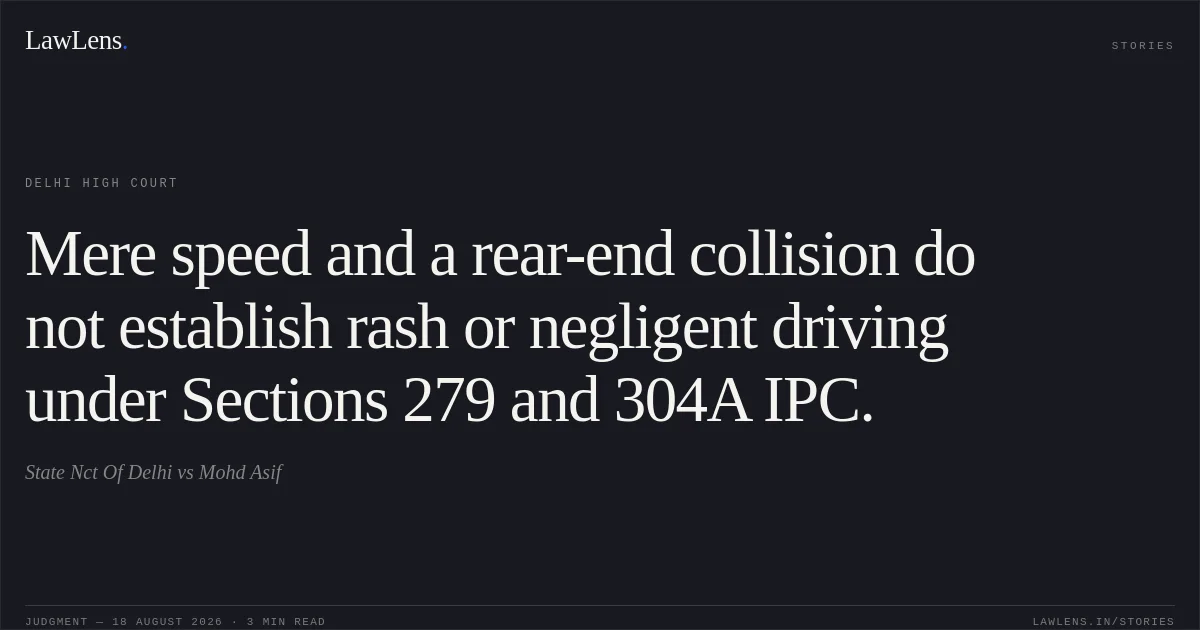
The Court answered the issues against the State, holding that the prosecution failed to prove beyond reasonable doubt that the respondent drove the motorcycle rashly or negligently so as to attract Sections 279 and 304A IPC.
The deceased’s statement was admissible but insufficient to establish the requisite criminal negligence, and the site plan did not cure the evidentiary deficiencies.
Source reference: pp. 17–19; paras. 26–28Finding no infirmity in the acquittal, the High Court dismissed the State’s appeal as meritless and closed any pending applications.
Source reference: p. 19; paras. 28–30Acts & Sections Cited
11 provisions across 3 statutes referred to in this judgment. Each provision opens on LawLens.
Code of Criminal Procedure, 19737
Indian Penal Code, 18603
Motor Vehicles Act, 19881
Original Court PDF
State Nct Of DelhivsMohd Asif
Click to open original judgment
Original judgment, available to read, download and summarize on LawLens.in