Facts
The complainant, an employee of Shree Sainath Industries since 2011, alleged that on 17 November 2017 he visited the company office and requested reinstatement after repeated absence from work.
Source reference: para. 3; para. 4, pp. 1–2He alleged that petitioner No. 1 pressurised him to resign, abused him, and threatened to kill him; petitioners Nos. 2 to 4 allegedly thereafter joined in scolding him.
Source reference: para. 3; para. 4, pp. 1–2The complainant subsequently consumed phenyl within the company premises and lodged FIR CR-II No. 3176 of 2017 at Krishnanagar Police Station, Ahmedabad, for offences under Sections 294(B), 506(2), read with Section 114 of the Indian Penal Code.
Source reference: para. 3; para. 4, pp. 1–2The accused invoked Section 482 of the Code of Criminal Procedure, 1973, seeking quashing of the FIR and consequential proceedings.
Source reference: para. 3, p. 1During the proceedings, petitioner No. 3 died on 28 October 2022, and the petition against him abated.
Source reference: paras. 1–2, p. 1Issues
Whether the allegations of abusive or obscene language allegedly uttered inside the company office disclosed an offence under Section 294(B) of the IPC, which requires the words or acts to occur in or near a public place.
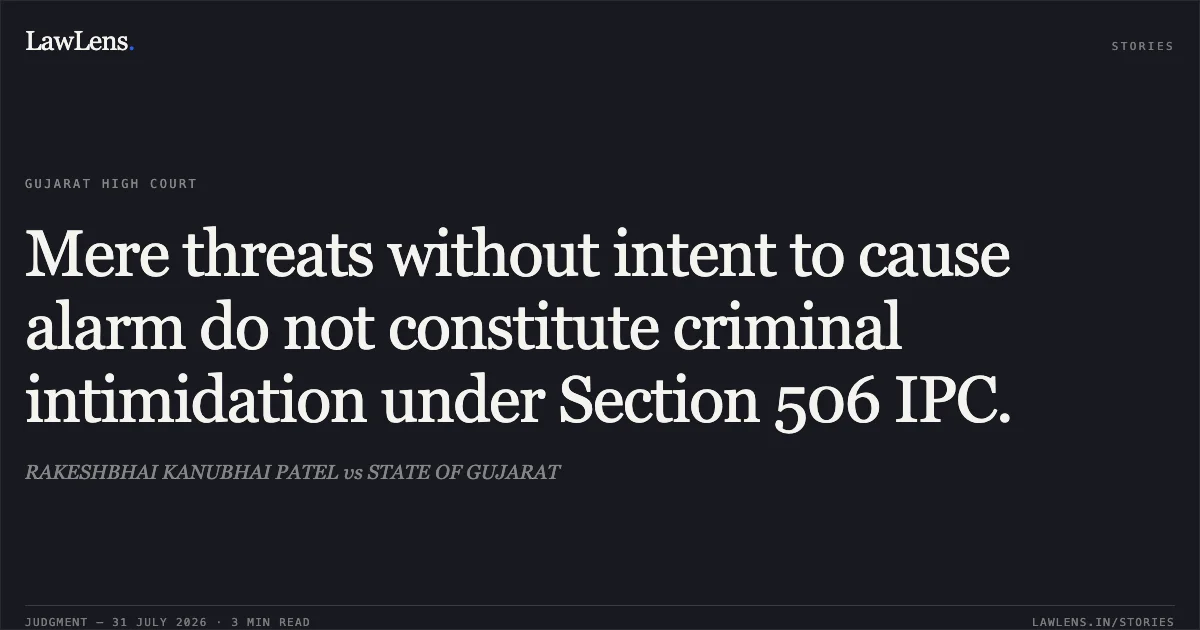
Source reference: para. 9, p. 4Whether the allegation that the complainant was threatened with being killed, without specific material showing an intention to cause alarm, constituted criminal intimidation under Section 506(2) of the IPC.
Source reference: para. 10.2, pp. 6–7Whether the FIR and consequential proceedings against petitioners Nos. 1, 2 and 4 were liable to be quashed in exercise of the High Court’s inherent jurisdiction under Section 482 CrPC.
Source reference: para. 3, p. 1; para. 11, p. 7Law Applied
The Court exercised its inherent jurisdiction under Section 482 CrPC to prevent abuse of the process of law where the allegations, taken at face value, did not satisfy the statutory ingredients of the offences alleged.
Source reference: para. 3, p. 1Section 294(B) IPC requires the utterance of obscene words or performance of an obscene act in or near a public place; an incident confined within the four corners of a private office does not satisfy this requirement.
Source reference: para. 9, p. 4For criminal intimidation under Section 506 IPC, the prosecution must establish a threat of injury to the person, reputation or property of the complainant, coupled with an intention to cause alarm or to compel or prevent the complainant from doing an act legally permissible to him.
Source reference: para. 10, pp. 4–6Relying on Vikram Johar v. State of Uttar Pradesh, (2019) 14 SCC 207, the Court held that the statutory ingredients must be specifically disclosed.
Source reference: para. 10, pp. 4–6The Court also relied on Mohammad Wajid v. State of U.P., 2023 LiveLaw (SC) 624, for the principle that criminal intimidation requires an intention to cause alarm and that vague allegations of abusive language, without stating the words used, may not establish the requisite offence.
Source reference: para. 10.1, pp. 6–7Reasoning
The FIR itself placed the alleged incident inside the company office. Accordingly, even assuming that abusive or obscene language was used, the essential requirement of occurrence in or near a public place under Section 294(B) IPC was absent.
Source reference: para. 9, p. 4Regarding Section 506(2), the Court held that the mere assertion that the complainant was threatened with death did not, by itself, establish the accused’s intention to cause alarm. The FIR lacked sufficient factual allegations demonstrating the necessary mental element of criminal intimidation.
Source reference: para. 10.2, pp. 6–7Since the allegations, taken as they stood, did not disclose the essential ingredients of Sections 294(B) and 506(2) IPC, continuation of the criminal proceedings against petitioners Nos. 1, 2 and 4 would amount to abuse of process.
Source reference: no citationThe Court therefore considered it unnecessary to conduct a factual mini-trial on the parties’ competing claims regarding employment records, presence at the premises, or CCTV footage.
Source reference: no citationHolding
The Gujarat High Court allowed the application and quashed FIR CR-II No. 3176 of 2017 dated 27 November 2017, registered at Krishnanagar Police Station, Ahmedabad, together with all consequential proceedings, insofar as petitioners Nos. 1, 2 and 4 were concerned.
The proceedings against petitioner No. 3 had already abated due to his death.
Source reference: paras. 1–2, p. 1The Rule was made absolute to that extent, with direct service permitted.
Source reference: para. 12, p. 7Acts & Sections Cited
5 provisions across 2 statutes referred to in this judgment. Each provision opens on LawLens.
Code of Criminal Procedure, 19731
Indian Penal Code, 18604
Original Court PDF
RAKESHBHAI KANUBHAI PATELvsSTATE OF GUJARAT
Click to open original judgment
Original judgment, available to read, download and summarize on LawLens.in


