Facts
Ansuyaben, married to accused No.1 for approximately four years, died from burn injuries after allegedly pouring kerosene on herself and setting herself ablaze on 22 March 2006.
Source reference: no citationThe prosecution alleged that accused No.1—her husband—and accused Nos.2 and 3—her father-in-law and mother-in-law—subjected her to mental and physical cruelty, demanded money, and that accused Nos.2 and 3 instigated accused No.1.
Source reference: no citationShe was treated in hospital for 10–12 days and died on 5 April 2006; the post-mortem attributed death to septicemic shock caused by extensive burns.
Source reference: p.6 / para.10A dying declaration was recorded by the Executive Magistrate, and a complaint was also relied upon as a dying declaration.
Source reference: p.7 / paras.10, 18The Trial Court acquitted all accused of offences under Sections 306, 498-A and 114 of the IPC.
Source reference: p.7 / para.10During the pendency of the appeal, accused No.1 died by suicide and the proceedings against him abated; the appeal therefore concerned accused Nos.2 and 3.
Source reference: p.7 / para.10Issues
Whether the prosecution proved beyond reasonable doubt that accused Nos.2 and 3 subjected the deceased to cruelty or harassment punishable under Section 498-A IPC.
Source reference: p.8 / para.13Whether accused Nos.2 and 3 abetted the deceased’s suicide within the meaning of Sections 107 and 306 IPC.
Source reference: p.12 / para.17Whether the Trial Court’s order of acquittal disclosed perversity, manifest illegality, or misappreciation of evidence warranting appellate interference.
Source reference: pp.15–18 / paras.20–26Law Applied
The Court applied Sections 306, 498-A, 107 and 114 of the IPC, requiring proof of abetment, instigation, or intentional aid and legally cognisable cruelty or harassment.
Source reference: no citationIt considered the presumptions under Sections 113-A and 113-B of the Indian Evidence Act but held that foundational facts, including cruelty and abetment, still had to be established.
Source reference: p.12 / para.17Under Laxman v. State of Maharashtra, (2002) 6 SCC 710, a dying declaration is not inadmissible merely because it lacks a doctor’s certification regarding the declarant’s mental fitness.
Source reference: p.10 / para.15Irfan alias Naka v. State of Uttar Pradesh, AIR 2023 SC 4129, requires assessment of a dying declaration in light of its voluntariness, consistency, timing, reliability and surrounding circumstances.
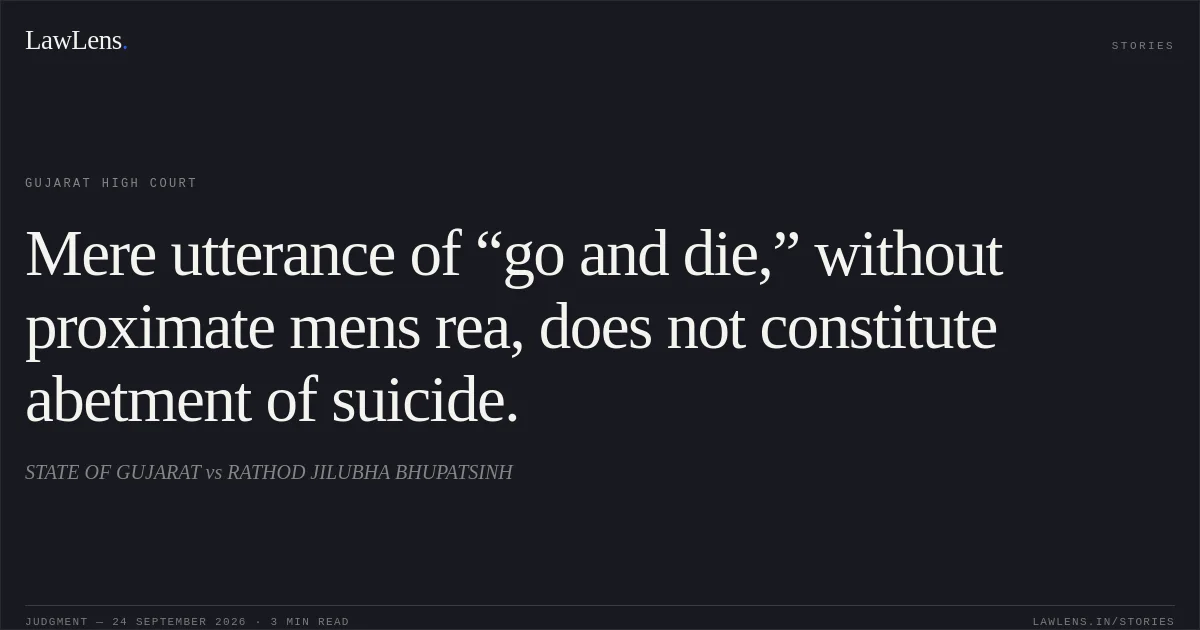
Source reference: pp.10–12 / para.16Following Sanju @ Sanjay Singh Sengar v. State of Madhya Pradesh, (2002) 5 SCC 371, the words “go and die,” without more, do not necessarily constitute instigation under Section 107 IPC.
Source reference: pp.13–15 / para.19In an appeal against acquittal, the principles in Chandrappa v. State of Karnataka, (2007) 4 SCC 415, and subsequent decisions recognise the appellate power to reappreciate evidence but require due regard to the double presumption of innocence; where two reasonable views are possible, acquittal should not be disturbed.
Source reference: pp.15–18 / paras.20–24Reasoning
The Court found that the principal evidence against accused Nos.2 and 3 consisted of general allegations by related witnesses, with material omissions and contradictions regarding the alleged cruelty, harassment, residence of the accused, and their participation in the incident.
Source reference: pp.8–10 / paras.13–14The prosecution did not satisfactorily establish that accused Nos.2 and 3 lived with the deceased or subjected her to mental or physical cruelty.
Source reference: pp.8–10 / paras.13–14Defence evidence indicated that they resided separately, were away at the agricultural field when the incident occurred, and thereafter helped transport the deceased to hospital.
Source reference: p.9 / para.14The dying declaration established that the deceased herself poured kerosene and ignited the fire, but the Court held that the allegation that she had been told to “go and die” did not, in the circumstances, prove the requisite mens rea or proximate instigation under Section 107 IPC.
Source reference: pp.12–15 / paras.18–19Since the prosecution failed to prove the foundational facts of cruelty or abetment, the presumptions under Sections 113-A and 113-B could not justify conviction.
Source reference: no citationApplying the heightened restraint applicable to an appeal against acquittal, the Court held that the Trial Court’s view was a reasonable one and was neither perverse nor legally infirm.
Source reference: pp.15–18 / paras.20–26Holding
The Court answered the issues against the prosecution.
It held that accused Nos.2 and 3 were not proved beyond reasonable doubt to have committed cruelty under Section 498-A IPC or abetted the deceased’s suicide under Section 306 IPC.
Source reference: no citationFinding no manifest illegality or perversity in the Trial Court’s acquittal, the High Court dismissed the State’s appeal and confirmed the judgment and order of acquittal.
Source reference: p.19 / para.27The bail bonds were cancelled, and the record and proceedings were directed to be returned to the Trial Court.
Source reference: p.19 / para.27Acts & Sections Cited
6 provisions across 2 statutes referred to in this judgment. Each provision opens on LawLens.
Code of Criminal Procedure, 19733
Indian Penal Code, 18603
Original Court PDF
STATE OF GUJARATvsRATHOD JILUBHA BHUPATSINH
Click to open original judgment
Original judgment, available to read, download and summarize on LawLens.in