Facts
The respondents issued an advertisement in March 2019 for the post of Constable in two Border Battalions of the J&K Police.
Source reference: p. 2-3The applicant, an ST category candidate from District Rajouri, secured 74 marks in the written examination but was placed at Serial No. 2 in the waiting list, as the cut-off for the main select list was 75 marks.
Source reference: p. 4, 6Following the non-joining of several selected candidates, the respondents operated the waiting list on February 26, 2024.
Source reference: p. 7Amjid Ali (Serial No. 1 in the ST waiting list) was selected but relinquished his claim as he had been appointed as a Sub-Inspector.
Source reference: p. 5The applicant subsequently submitted representations requesting appointment against the resultant vacancy, supported by an affidavit from Amjid Ali.
Source reference: p. 5The respondents refused, citing S.O. 533 of 2018, arguing that a waiting list cannot be operated for vacancies caused by non-joining after a candidate from the waiting list has already been selected.
Source reference: p. 8Issues
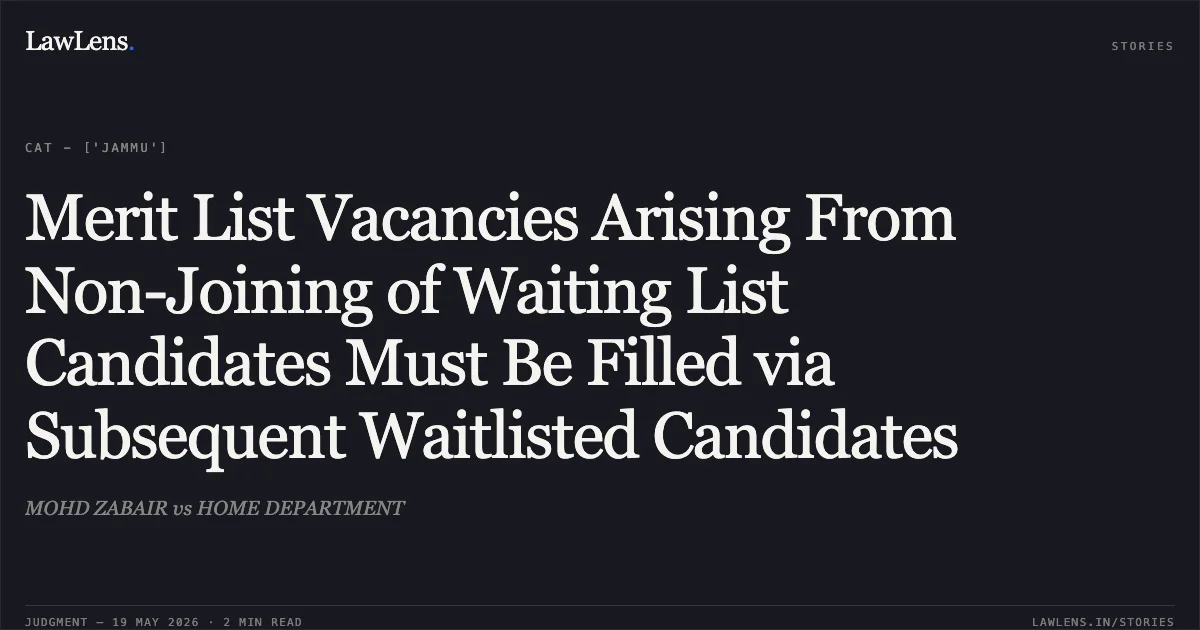
1. Whether the respondents were legally justified in refusing to consider the applicant, who was next in merit on the waiting list, for a vacancy arising from the non-joining of a previously selected waiting-list candidate.
Source reference: p. 11Law Applied
The principles of Article 14 and 16 of the Constitution of India regarding fairness and non-arbitrariness in public employment.
Source reference: p. 6The doctrine that while a wait-listed candidate has no indefeasible right to appointment, the state must act in a transparent and non-arbitrary manner when vacancies remain unfilled during the currency of the selection process.
Source reference: p. 12S.O. 533 dated 29.11.2018, which governs the operation of waiting lists for "drop-out vacancies".
Source reference: p. 7-8Executive instructions must be interpreted to fulfill the objective of filling notified vacancies rather than frustrating legitimate recruitment through hyper-technicality.
Source reference: p. 13-14Reasoning
The primary purpose of a waiting list is to ensure that notified public vacancies do not remain unfilled due to the non-joining of selected candidates.
Source reference: p. 12-13The respondents’ refusal to consider the applicant—based on the logic that the vacancy had already been "offered" to the first wait-listed candidate—was deemed a "hyper-technical interpretation" of S.O. 533.
Source reference: p. 13Because Amjid Ali never joined the service, the vacancy remained a "drop-out" vacancy and did not constitute a "future vacancy" or a vacancy caused by resignation after joining.
Source reference: p. 8, 13-14Since the applicant was next in order of merit and the recruitment process had not attained absolute finality, the respondents were under an obligation to act fairly rather than leaving a notified post vacant despite the availability of an eligible candidate.
Source reference: p. 14-15Holding
The Tribunal allowed the Original Application, holding that the respondents' rigid interpretation resulted in an unjust denial of consideration.
The court directed the respondents to consider the applicant for appointment to the post of Constable under the ST Category for District Rajouri against the vacancy created by Amjid Ali’s non-joining, provided the post is still available and not otherwise lawfully filled.
Source reference: p. 15The exercise must be completed within 12 weeks; if the post is unavailable, a reasoned speaking order must be issued to the applicant.
Source reference: p. 15-16Acts & Sections Cited
1 provisions across 1 statute referred to in this judgment. Each provision opens on LawLens.
Administrative Tribunals Act, 19851
Original Court PDF
MOHD ZABAIRvsHOME DEPARTMENT
Click to open original judgment
Original judgment, available to read, download and summarize on LawLens.in