Facts
The petitioner, a senior citizen and former railway employee, filed a contempt petition alleging non-compliance with the Tribunal's order dated May 27, 2025
Source reference: para 2-3In the original proceedings (OA No. 452/2025), the Tribunal had directed the competent authority to decide the petitioner's representation dated May 30, 2024, through a reasoned and speaking order within three months
Source reference: para 2The petitioner contended that the direction was not followed in its true letter and spirit
Source reference: para 3Conversely, the respondents filed a compliance affidavit asserting that a reasoned and speaking order was passed on March 02, 2026, and duly communicated to the petitioner
Source reference: para 4Issues
1. Whether the respondents’ actions constituted "wilful or deliberate disobedience" of the Tribunal’s directions sufficient to sustain contempt proceedings
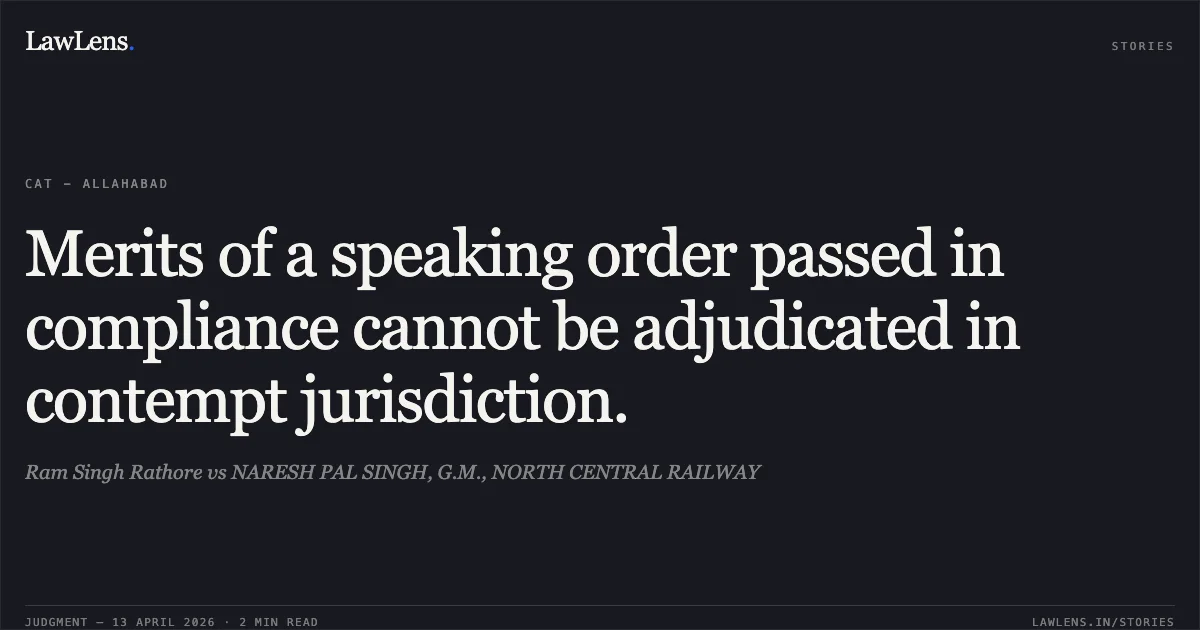
Source reference: para 72. Whether the Tribunal, in exercising its contempt jurisdiction, can adjudicate upon the merits or correctness of a speaking order passed in purported compliance with its directions
Source reference: para 7Law Applied
The Tribunal applied the principles governing contempt jurisdiction, emphasizing that it has a limited scope to examine only whether directions have been complied with, not the merits of the resulting decision
Source reference: para 7It relied on the landmark precedent of J.S. Parihar v. Ganpat Duggar, which established that once an order is passed in purported compliance of a court's directions, the merits of that order cannot be examined in contempt proceedings
Source reference: para 7Furthermore, it applied the principle from Rama Narang v. Ramesh Narang (2021), which mandates that the power to punish for contempt must be exercised with caution and only in cases of clear and wilful disobedience
Source reference: para 8Reasoning
The Tribunal examined whether the "limited scope" of its direction—to decide the representation—had been met
Source reference: para 7It observed that the respondents produced a speaking order dated March 02, 2026, which addressed the petitioner’s representation
Source reference: para 4, 7The Tribunal reasoned that once a decision is taken and communicated, the cause for invoking contempt jurisdiction ceases to exist, as the specific direction of the court stands complied with
Source reference: para 7The court noted that any grievance regarding the correctness of the respondents' decision constitutes a fresh cause of action and cannot be adjudicated within the narrow confines of contempt law, as no "wilful" or "deliberate" defiance was evident
Source reference: para 7-8Holding
The Tribunal held that the directions had been substantially complied with and that no case of contempt survived
The contempt proceedings were dropped, and the notices issued to the respondents were discharged
Source reference: para 9However, the Tribunal granted the petitioner liberty to avail appropriate legal remedies to challenge the merits of the speaking order dated March 02, 2026, if still aggrieved
Source reference: para 10No order as to costs was made
Source reference: para 11Original Court PDF
Ram Singh RathorevsNARESH PAL SINGH, G.M., NORTH CENTRAL RAILWAY
Click to open original judgment
Original judgment, available to read, download and summarize on LawLens.in