Facts
The applicant applied for the post of Primary School Teacher (PST) in the Education Department of Puducherry pursuant to a 2015 recruitment notification
Source reference: p.2She claimed eligibility under the OBC category, having secured 83% in the Teacher Eligibility Test (TET) and 83.425% in the National Eligibility Test (NET)
Source reference: p.2She was provisionally selected and placed at Serial No. 1 in the OBC category list and Serial No. 2 in the combined merit list
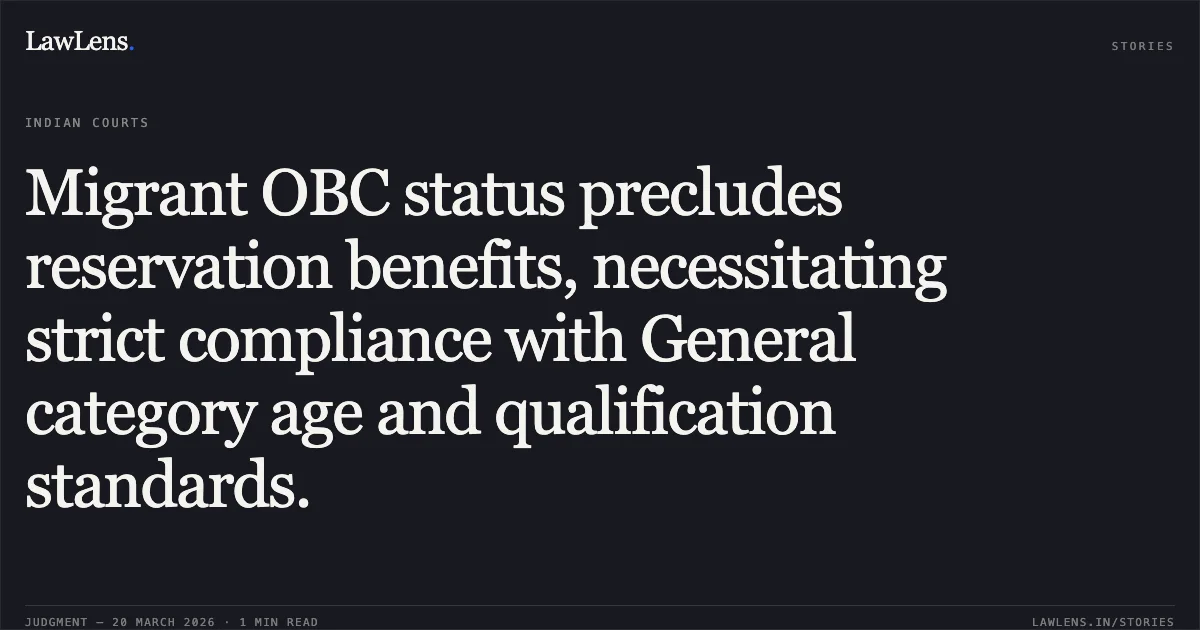
Source reference: p.3However, during certificate verification on October 19, 2015, the respondents determined she was a “Migrant OBC” candidate, making her ineligible for reservation benefits in the Union Territory of Puducherry
Source reference: p.3, 6Consequently, she was considered under the General category.
Source reference: p.6On the crucial eligibility date (June 17, 2015), the applicant was 32 years and 10 days old, exceeding the 32-year age limit for General candidates
Source reference: p.6Furthermore, she secured 83 marks in the TET, while the minimum qualifying mark for the General category was 90 (60%)
Source reference: p.6-7The applicant challenged her non-selection, seeking appointment under either the OBC or General category
Source reference: p.2Issues
1. Whether a "Migrant OBC" candidate is entitled to reservation benefits under the OBC category in the Union Territory of Puducherry
Source reference: p.62. Whether the applicant was eligible for appointment under the General category regarding age limits and minimum qualifying marks in the TET
Source reference: p.6-7Law Applied
The Tribunal applied the recruitment criteria stipulated in the Notification dated May 26, 2015, which mandated an age limit of 18–32 years for General candidates and prescribed minimum TET qualifying marks of 60% (90 marks) for General and 55% (82 marks) for OBC candidates
Source reference: p.5-6The court relied on G.O. Ms. No. 76 dated March 18, 2015, regarding qualifying standards
Source reference: p.7It further applied the legal principle that reservation benefits in a Union Territory are restricted to residents holding valid local community certificates, excluding migrants
Source reference: p.6Additionally, the Tribunal invoked the doctrine of estoppel, asserting that a candidate who participates in a selection process without protest cannot challenge the criteria after being found unsuccessful
Source reference: p.7Reasoning
The Tribunal reasoned that since the applicant possessed only a Migrant OBC Certificate, she failed to meet the residency-based reservation requirements of the UT of Puducherry and was rightly excluded from the OBC quota
Source reference: p.6In evaluating her status as a General category candidate, the Tribunal found her ineligible on two counts: first, she was over-aged by 10 days as of the cutoff date; and second, her TET score of 83 was insufficient to meet the 90-mark qualifying threshold required for General applicants
Source reference: p.6, 7The Tribunal rejected the applicant's argument regarding the selection of candidates with lower marks, noting that TET marks were an eligibility criterion rather than a merit-weightage factor, and the compared candidates were selected under the OBC category for which the applicant did not qualify
Source reference: p.7The Tribunal also observed that the recruitment process concluded years prior and subsequent recruitment cycles had already commenced, making any retroactive adjustment unfeasible
Source reference: p.7Holding
The Tribunal held that the applicant was ineligible for consideration under the OBC category due to her migrant status and ineligible under the General category due to her age and failure to secure the minimum qualifying marks
The direct answer to the issues was that the applicant failed to meet the statutory eligibility requirements for the post. The Original Application was dismissed, and no relief was granted
Source reference: p.8Original Court PDF
J AVILA NANETTEvsUt Of Pondicherry
Click to open original judgment
Original judgment, available to read, download and summarize on LawLens.in