Facts
The Respondent was commissioned into the Indian Air Force on July 21, 1989, and took premature retirement on July 31, 2012, in a Low Medical Category.
Source reference: para. 2The Release Medical Board (RMB) diagnosed him with ‘Moderately Severe Conductive Hearing Loss (RT) Ear,’ assessing it at 20% for life but classified it as "Neither Attributable to Nor Aggravated" (NANA) by military service.
Source reference: para. 3The primary reason for the NANA classification was that the onset occurred while the Respondent was serving at a peace station.
Source reference: para. 3The Respondent's claim and subsequent first appeal were rejected by the Petitioners.
Source reference: para. 4The Armed Forces Tribunal (AFT) later allowed the Respondent’s Original Application, granting him the disability element of pension rounded off to 50%.
Source reference: para. 1The Union of India challenged this order via the present writ petition, filed approximately two years after the AFT’s decision.
Source reference: para. 1, 17Issues
Whether the Entitlement Rules for Casualty Pensionary Awards, 2008, shift the onus of proving attributability of a disability from the administration to the officer.
Source reference: para. 6.1, 7Whether the onset of a disease at a "peace station" constitutes a sufficient medical reason to deny the causal connection between military service and disability.
Source reference: para. 14Whether the writ petition was barred by the doctrine of delay and laches.
Source reference: para. 17Law Applied
The court applied the Entitlement Rules for Casualty Pensionary Awards to Armed Forces Personnel, 2008, which govern disability claims for personnel retiring after their notification.
Source reference: para. 7It relied on the Supreme Court precedents in Dharamvir Singh v. Union of India and Union of India v. Ram Avtar regarding the presumption of attributability.
Source reference: para. 5Furthermore, it applied the principles from Bijender Singh v. Union of India and Rajumon T.M. v. Union of India, which mandate that the Medical Board must provide cogent, reasoned opinions to sustain a NANA finding.
Source reference: para. 8The court also invoked Regulation 423 of the Regulations for the Medical Services of the Armed Forces, 2010, asserting that the location of service (peace vs. field) is not a sole criterion for denying disability pension.
Source reference: para. 12, 14Reasoning
The Court rejected the Petitioner's argument that the 2008 Rules removed the presumption of service connection.
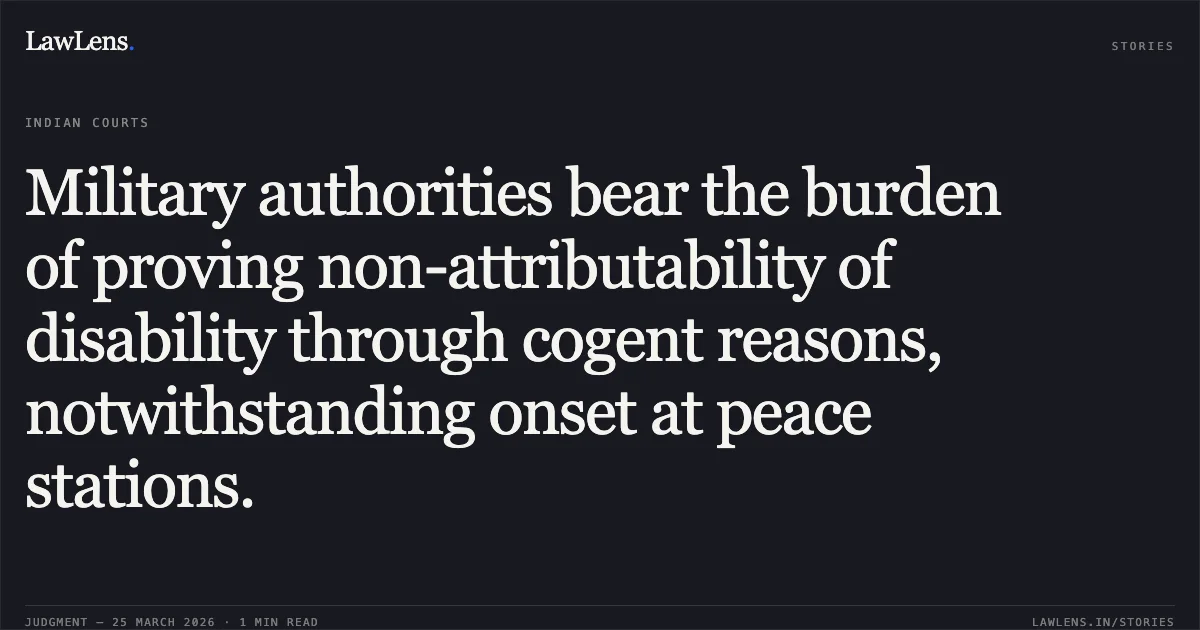
Source reference: para. 7, 9It held that even under the 2008 regime, the burden of proof remains on the military administration to establish, with cogent reasons, that a disability arising during service is not related to military conditions.
Source reference: para. 7, 9The Court observed that the RMB provided no specific reasons for the NANA classification other than the "onset in peace station".
Source reference: para. 11, 14Relying on the Respondent's 21-year career as a pilot, the Court noted his continuous exposure to high-decibel noise in aircraft like Mig-21 and Mig-29, which directly linked his hearing loss to his service conditions.
Source reference: para. 12The Court found the "peace station" argument legally invalid under established judicial precedents.
Source reference: para. 14Additionally, the Court noted that the RMB itself admitted the Respondent was fit upon entry and that the disability was not due to negligence.
Source reference: para. 15Holding
The High Court dismissed the writ petition, upholding the AFT’s order.
The Court held that the Respondent is entitled to the disability element of pension at 20% for life, rounded off to 50%, with arrears limited to three years prior to the filing of the O.A.
Source reference: para. 1, 15The Court further ruled that the petition was barred by delay and laches, as it was filed nearly two years after the impugned order without explanation.
Source reference: para. 17, 18The Petitioners were directed to comply with the AFT's directions without further delay.
Source reference: para. 18Original Court PDF
Union Of India & Ors.vs20119 Gp Capt Sk Singh (Retd.)
Click to open original judgment
Original judgment, available to read, download and summarize on LawLens.in