Facts
The Respondent, enrolled in the Army Medical Corps on 14.11.1981, was prematurely released at his request on 17.07.2011
Source reference: p. 1-2The Release Medical Board (RMB) assessed his Primary Hypertension at 30% for life but classified it as "Neither Attributable to Nor Aggravated by military service" (NANA) because it originated in a "peace station"
Source reference: p. 2His claim for disability pension was rejected by the Petitioners in 2011
Source reference: p. 2The Respondent approached the Armed Forces Tribunal (AFT), which, via an order dated 29.11.2023, granted him the disability element of pension rounded off to 50% for life
Source reference: p. 2-3The Union of India challenged this order before the High Court, arguing that the Entitlement Rules, 2008 (which govern this case) do not permit the same presumption of service-connection as the earlier 1982 Rules
Source reference: p. 3Issues
1. Whether the Respondent is entitled to the disability element of pension under the Entitlement Rules, 2008, despite the RMB's classification of the ailment as NANA
Source reference: p. 42. Whether the burden of proving the causal connection between the disability and military service shifts to the officer under the Entitlement Rules, 2008
Source reference: para. 113. Whether "onset in a peace station" constitutes a valid medical ground to deny attributability of a disease to military service
Source reference: para. 16Law Applied
The court primarily applied the Entitlement Rules for Casualty Pensionary Awards to Armed Forces Personnel, 2008, and Regulation 53 of the Pension Regulations, 2008
Source reference: p. 3-4It relied on the Supreme Court precedents in Dharamvir Singh v. Union of India and Union of India v. Ram Avtar, which establish the principles for disability pension entitlement
Source reference: p. 2It further applied Bijender Singh v. Union of India and Rajumon T.M. v. Union of India, which mandate that the Medical Board must furnish cogent reasons to prove a disease is NANA, shifting the burden of proof to the Military Establishment
Source reference: p. 5Additionally, Regulation 423(a) of the Regulations for the Medical Services of the Armed Forces, 2010, was applied to establish that service in peace conditions does not inherently preclude disability entitlement
Source reference: p. 7Reasoning
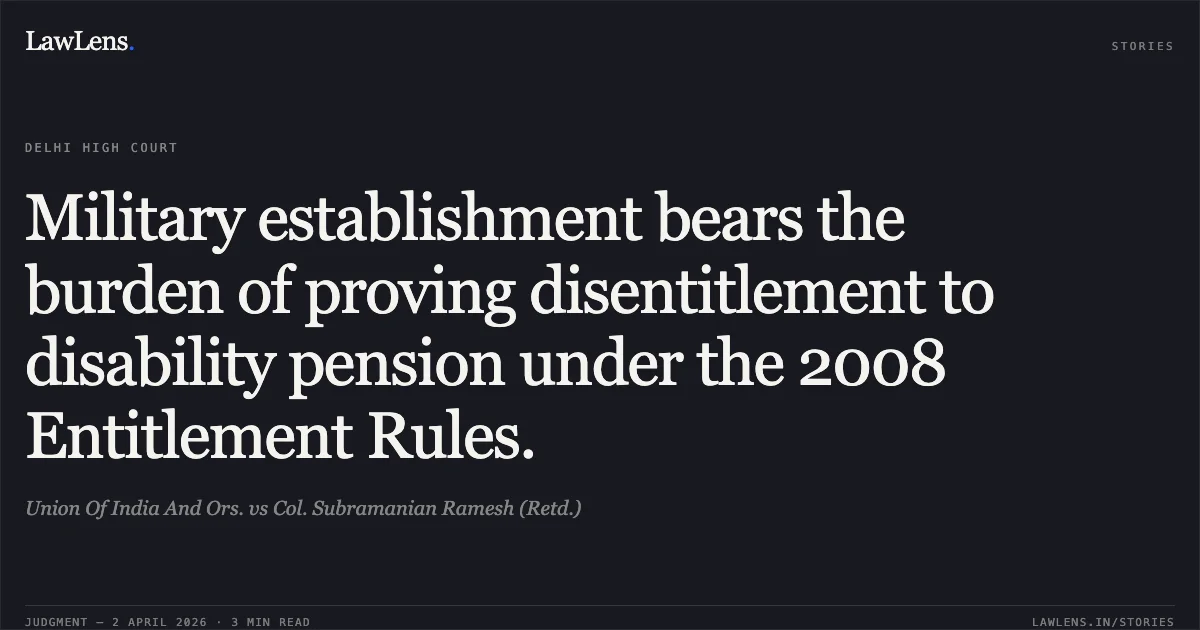
The Court rejected the Petitioners' argument that the Entitlement Rules, 2008, removed the presumption in favor of the claimant. It held that even under the 2008 regime, the onus remains on the administration to prove the lack of a causal connection between the service and the disability
Source reference: para. 11The Court found that since the Respondent’s hypertension was discovered after 24 years of service, it is indisputably service-related
Source reference: para. 14The Court criticized the RMB’s findings as "unreasoned" and "contradictory," noting that merely stating a disease had its "onset in a peace station" is an invalid ground for denial
Source reference: para. 16-17The Court emphasized that for a NANA classification to stand, the Medical Board must provide specific causative factors other than military service, which the Petitioners failed to do
Source reference: para. 11, 12Furthermore, the RMB itself noted no negligence or misconduct by the officer, reinforcing the claim for pension
Source reference: para. 17Holding
The High Court dismissed the writ petition, upholding the AFT's order
It held that the Respondent is entitled to the disability element of pension for Primary Hypertension at 30%, rounded off to 50% for life, effective from his retirement date of 17.07.2011
Source reference: p. 1, 8The Court also noted that the petition was grossly barred by delay and laches, as it was filed over three years after the impugned order without explanation, though it ultimately dismissed the case on its lack of merit. No costs were awarded
Source reference: para. 21-22Original Court PDF
Union Of India And Ors.vsCol. Subramanian Ramesh (Retd.)
Click to open original judgment
Original judgment, available to read, download and summarize on LawLens.in