01Facts
The petitioner, a company running a hospital ("Cloud Nine"), engaged the second respondent, a contractor, to provide security services at the hospital.
¶ 2On 05.09.2019, the first respondent (Senior Labour Inspector) found that minimum wages under the Minimum Wages Act, 1948 had not been paid. A show-cause notice issued on 09.09.2019.
¶ 2The first respondent then applied under Section 20 of the Act to the third respondent (Assistant Labour Commissioner), registered as Case No. CR-126/2019-20.
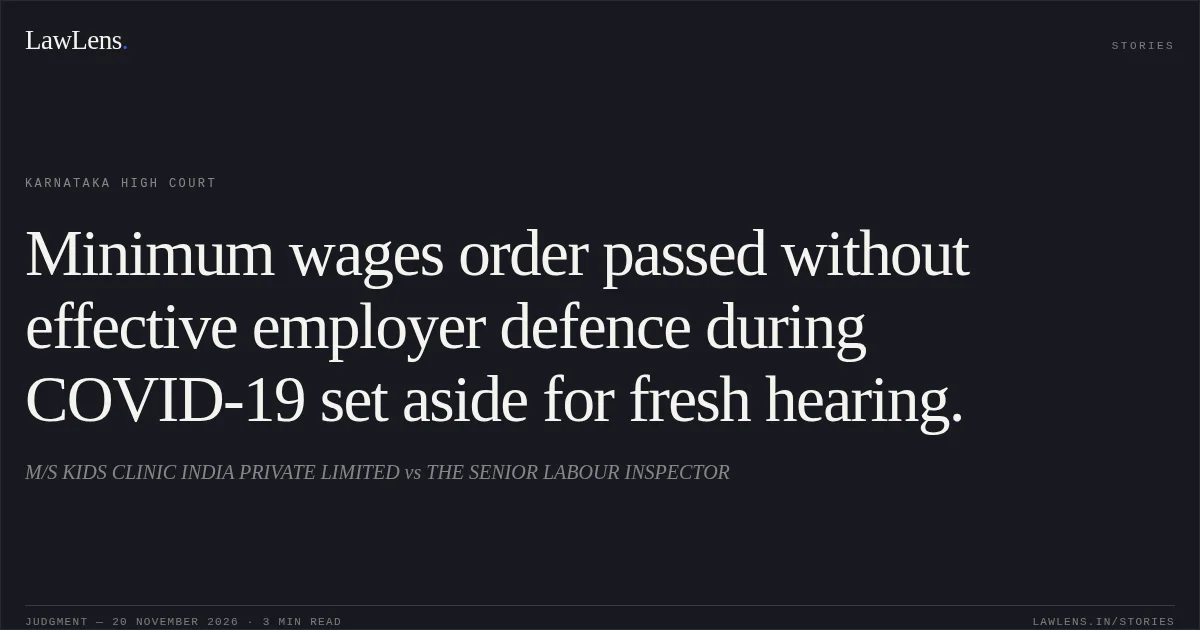
¶ 2On 13.03.2020, the petitioner's representative appeared and sought time. Thereafter, the petitioner remained unrepresented. It attributed this to the COVID-19 pandemic and the lockdown from March 2020.
¶ 3–4The third respondent then passed the impugned order dated 06.05.2024 (Annexure-H), directing the petitioner to pay the differential minimum wages with compensation to 36 employees, based on the first respondent's documents.
¶ 1, 3The petitioner challenged this order under Article 226 of the Constitution.
¶ 102Issues
i.1. Whether the impugned order dated 06.05.2024 is liable to be set aside where the employer, after a single appearance on 13.03.2020, did not effectively contest the proceedings before the authority.
¶ 4–5ii.2. Whether, in view of the pendency of proceedings during the COVID-19 pandemic, the employer is entitled to a further opportunity to present its case, warranting remand.
¶ 5iii.3. Whether the court should examine the merits of the differential wage and compensation liability in the writ jurisdiction.
¶ 603Law Applied
The court's reasoning rests on the constitutional writ jurisdiction under Article 226 of the Constitution.
¶ 1The principle of natural justice requires that all concerned parties must be afforded a reasonable opportunity of being heard before a decision is made.
¶ 5 · order (iii)The statutory framework is the Minimum Wages Act, 1948, under which the Assistant Labour Commissioner adjudicates claims for differential wages on an application by the Inspector under Section 20.
¶ 2The judgment does not expressly quote the statutory text or cite any precedent, and it does not state a rule on the scope of the power of remand.
Provisions in the judgment · 1
Companies Act, 1956 Section 20
04Reasoning
The court held that the petitioner had appeared before the third respondent, sought time, and then remained unrepresented, leaving the impugned order passed without effective contest.
¶ 4The court considered the petitioner's explanation that COVID-19 restrictions impeded its defence.
¶ 4–5Because the proceedings were pending during the pandemic, the court found it in the interest of justice to grant one more opportunity.
¶ 5The court therefore remitted the matter for fresh consideration rather than deciding the wage liability itself. It expressly declined to express any opinion on the merits of the differential wage or compensation claims, keeping all contentions open before the third respondent.
¶ 605Holding
The writ petition is allowed, and the impugned order dated 06.05.2024 (Annexure-H) is set aside.
order (i)–(ii)The matter is remitted to the third respondent for fresh consideration after affording a reasonable opportunity of hearing to all concerned parties.
order (iii)The third respondent must decide the matter as expeditiously as possible, and no later than six months from receipt of a copy of the order.
order (iv)The petitioner-Management must extend full cooperation and must not seek unnecessary adjournments.
order (v)All contentions on merits are kept open. On Issue 3, the court declined to examine the merits.
order (vi) · ¶ 6Original Court PDF
M/S KIDS CLINIC INDIA PRIVATE LIMITEDvsTHE SENIOR LABOUR INSPECTOR
Click to open original judgment
Original judgment, available to read, download and summarize on LawLens.in