Facts
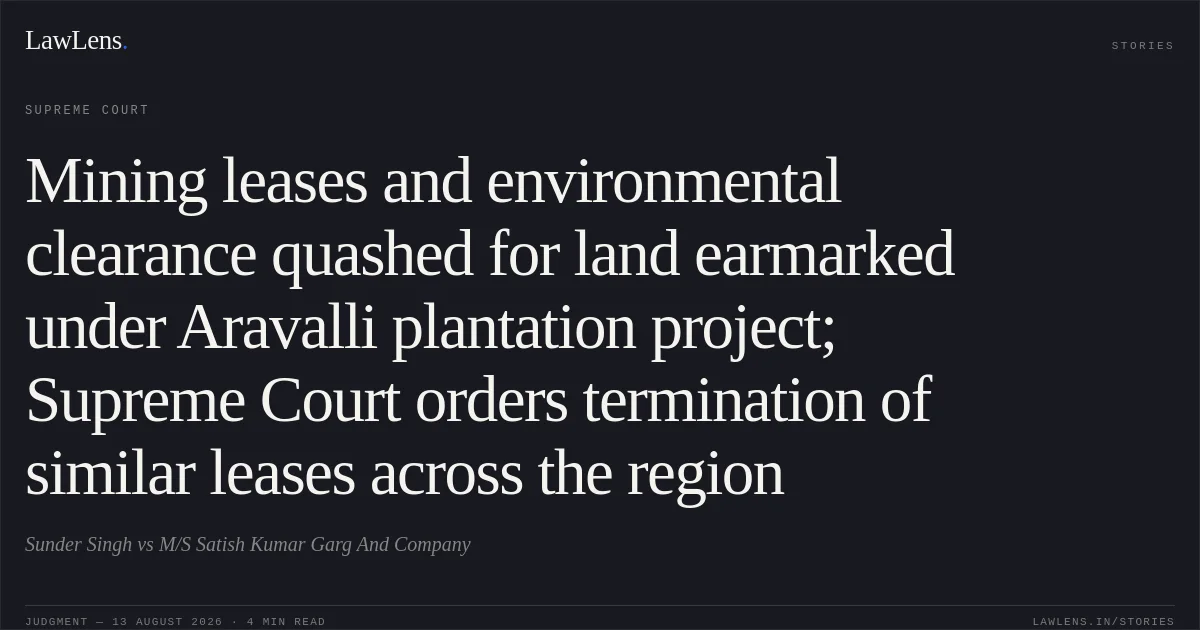
M/s Satish Kumar Garg & Company obtained a 20-year mining lease on 29.04.2002 for extracting minerals, including quartz, felspar and barytes, from 79.32 hectares in Village Musnota, District Mahendergarh, Haryana, under Section 10 of the Mines and Minerals (Development and Regulation) Act, 1957 and the Mineral Concession Rules, 1960.
Source reference: paras. 5.1–5.2The Forest Department initially issued an NOC on 16.09.2002 stating that the relevant khasra numbers were not forest land.
Source reference: para. 5.3Subsequently, during proceedings concerning the Aravalli Project and pursuant to this Court’s directions in M.C. Mehta v. Union of India, the Deputy Commissioner identified the same khasra numbers as forming part of land earmarked for Aravalli plantation.
Source reference: para. 5.5When the lessee sought a fresh NOC in 2016 pursuant to the environmental appraisal process, the Forest Department refused it on the ground that the subject land fell within the Aravalli Plantation area.
Source reference: paras. 5.6–5.7The High Court allowed the lessee’s writ petition, set aside the refusal to grant the NOC, permitted mining in accordance with the lease, and directed payment of dead rent once mining operations were permitted.
Source reference: paras. 4, 5.9–5.10During the pendency of the appeals, the State Environment Impact Assessment Authority granted environmental clearance on 08.08.2023, but this Court restrained tree-felling and further action pursuant to the clearance.
Source reference: para. 6The appeals were filed by residents concerned about the ecological consequences of mining in the Aravalli region.
Source reference: para. 5.13Issues
Whether the subject land, having been earmarked for plantation under the Aravalli Project, could lawfully be made available for mining merely because actual plantation over the entire area was not conclusively established?
Source reference: paras. 12–24Whether the Forest Department was justified in refusing the fresh NOC and whether the High Court erred in directing its grant?
Source reference: paras. 4, 5.7, 12–25Whether the environmental clearance granted on the basis of the proposed mining activity could survive once the refusal of the NOC was upheld?
Source reference: para. 25Whether the mining lease and other mining-related rights over land earmarked for Aravalli plantation were liable to be cancelled or terminated?
Source reference: paras. 26, 28(iv)–(v)Law Applied
The Court considered Section 10 of the Mines and Minerals (Development and Regulation) Act, 1957, governing the grant of mining leases, and Section 3 of the Environment (Protection) Act, 1986, under which the environmental-permissibility regime for mining was revised through the notification dated 14.09.2006.
Source reference: paras. 5.1, 5.4It applied the environmental-protection principle that land identified and earmarked for afforestation or reforestation must receive protection equivalent to land on which plantation has already been carried out, since afforestation is a continuing, long-term process.
Source reference: paras. 17–21The Court also relied on the directions in M.C. Mehta v. Union of India, (2004) 12 SCC 118, and M.C. Mehta v. Union of India, (2006) 11 SCC 582, recognising the ecological importance of the Aravalli region and restricting mining activities affecting Aravalli plantations.
Source reference: paras. 20, 27The Court further took note of the continuing orders in In Re: Definition of Aravalli Hills and Ranges and Ancillary Issues, Suo Motu W.P. (C) No. 10 of 2025, requiring prior permission of this Court for mining in the Aravalli Hills and Ranges.
Source reference: para. 27Reasoning
The Court held that the High Court’s reasoning incorrectly treated the absence of conclusive proof of actual plantation as sufficient justification for permitting mining.
Source reference: paras. 14–16, 23Afforestation projects require identification of land in advance, followed by protection, plantation and the passage of time; therefore, land earmarked for plantation cannot lose its protective character merely because plantation has not yet been completed or because the extent of actual plantation is uncertain.
Source reference: paras. 17–21The subject land was expressly included in the Deputy Commissioner’s report as land identified for Aravalli plantation, and allowing mining would permit the lessee to undermine the State’s afforestation efforts by removing trees and excavating minerals.
Source reference: paras. 22–24In light of this finding, the Forest Department’s refusal to issue the fresh NOC was valid, while the High Court’s direction to grant it was legally unsustainable.
Source reference: para. 25Since the environmental clearance was consequential upon the proposed mining activity and could not operate in the absence of a valid NOC, it too was liable to be quashed.
Source reference: para. 25The Court also criticised the conflicting positions of the State’s Mines and Geology Department and Forest Department, and held that continuation of the mining lease after the land’s identification for Aravalli plantation was impermissible.
Source reference: para. 26Holding
The appeals were allowed and the High Court’s judgment was set aside.
The refusal of the NOC dated 28.10.2016 was upheld, while the earlier NOC dated 16.09.2002 and its consequences were effaced.
Source reference: para. 28(ii)The SEIAA decision dated 02.08.2023 and the environmental clearance dated 08.08.2023 were quashed.
Source reference: para. 28(iii)The subject land and all other lands identified in the Deputy Commissioner’s report as earmarked for Aravalli plantation were declared unavailable for mining; subsisting mining leases or mining-related rights over such lands were directed to be terminated forthwith, subject to the final directions in the pending suo motu proceedings.
Source reference: para. 28(iv)The State Government was directed to conduct a comprehensive survey, identify subsisting mining rights over Aravalli plantation lands, terminate them in accordance with law, and file a compliance report before this Court.
Source reference: para. 28(v)The States of Haryana, Rajasthan and Gujarat and the NCT of Delhi were directed to comply strictly with the Court’s ecological-protection orders, with violations liable to invite appropriate action.
Source reference: paras. 29–31Acts & Sections Cited
2 provisions across 2 statutes referred to in this judgment. Each provision opens on LawLens.
Mines and Minerals (Development and Regulation) Act, 19571
Environment (Protection) Act, 19861
Original Court PDF
Sunder SinghvsM/S Satish Kumar Garg And Company
Click to open original judgment
Original judgment, available to read, download and summarize on LawLens.in