Facts
The appellant challenged an order passed by a Single Judge on 23.04.2015, which dismissed a writ petition against the Additional Director of Education’s order dated 07.09.2009
Source reference: para. 5The dispute involved the validity of the induction of 500 members into the General Body of Nehru Rashtriya Inter College, Manglore, between 2002 and 2005
Source reference: para. 5-6The Additional Director (Respondent No. 3) had ruled that these inductions were invalid
Source reference: para. 6The appellant contended that Respondent No. 3 (Mr. N.S. Rana) was disqualified from deciding the matter because he had previously issued an order regarding the same dispute on 28.05.2004 while serving as the District Education Officer (DEO)
Source reference: para. 7, 9Procedurally, the Court condoned a one-day delay in filing a restoration application and restored the appeal, which had previously been dismissed as infructuous
Source reference: para. 1-3Issues
1. Whether the communication dated 28.05.2004 issued by Respondent No. 3 in his capacity as District Education Officer constituted a prior independent adjudication that precluded him from deciding the matter subsequently as Additional Director
Source reference: para. 7-82. Whether the High Court should interfere in a membership dispute involving contested questions of fact under writ jurisdiction
Source reference: para. 13Law Applied
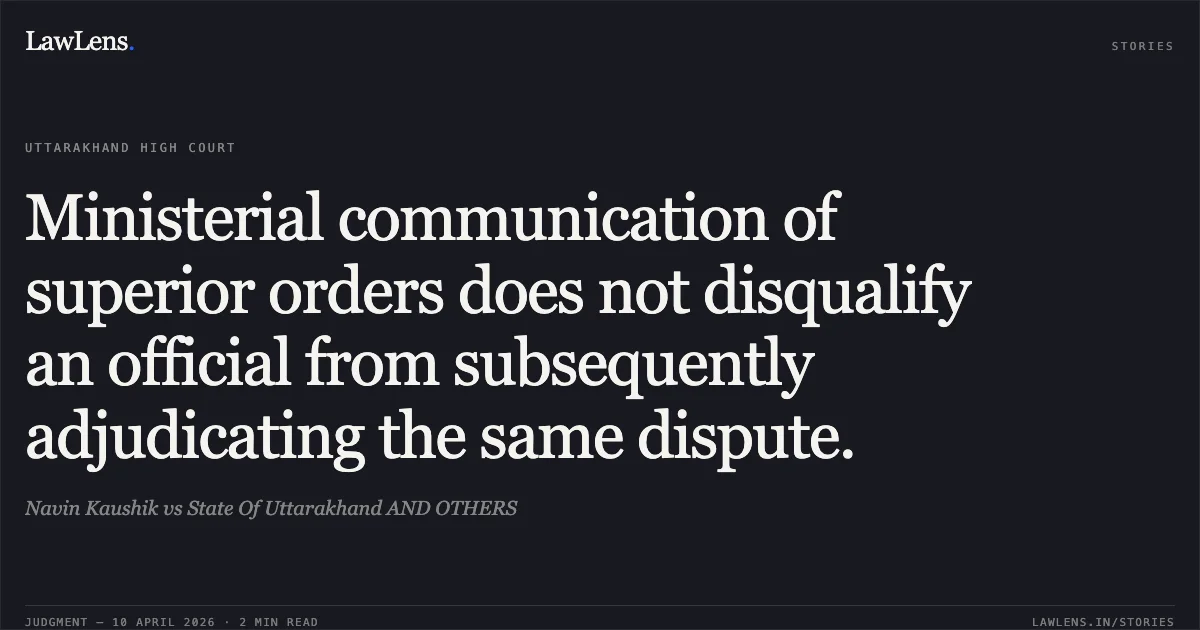
The court applied the principle that ministerial communications intended to implement directions from higher authorities do not constitute an independent application of mind or a quasi-judicial "order"
Source reference: para. 8, 11The court relied on the principle that educational authorities exercise summary jurisdiction over membership disputes; where such disputes involve complex questions of fact and appreciation of evidence, the proper recourse is a civil remedy rather than a writ petition
Source reference: para. 13Reasoning
The Division Bench examined the text of the DEO’s communication dated 28.05.2004
Source reference: para. 10It observed that the DEO was merely acting as a conduit to ensure compliance with directions issued by the Joint Director of Education, Garhwal Region
Source reference: para. 11The court found that Respondent No. 3 had not exercised independent judgment or applied his mind to the merits of the case in 2004; such independent application only occurred when he passed the impugned order in 2009
Source reference: para. 8, 11Thus, the court rejected the allegation of bias, agreeing with the Single Judge that the officer did not "sit over his own judgment"
Source reference: para. 12Regarding the validity of membership, the court determined that the controversy required a detailed appreciation of evidence, which is outside the scope of summary proceedings by educational authorities
Source reference: para. 13Holding
The High Court dismissed the appeal and upheld the order of the Single Judge
The court held that the Additional Director was not disqualified from passing the order as his previous involvement was purely administrative/ministerial
Source reference: para. 11-12The court further held that since the decision of educational authorities on membership is summary in nature, the appellant is at liberty to seek a final determination of the dispute through civil remedies
Source reference: para. 13All pending applications were disposed of accordingly
Source reference: para. 16Acts & Sections Cited
4 provisions across 2 statutes referred to in this judgment. Linked provisions open on LawLens.
Intermediate Education Act, 19211
Administration of Estates3
Original Court PDF
Navin KaushikvsState Of Uttarakhand AND OTHERS
Click to open original judgment
Original judgment, available to read, download and summarize on LawLens.in