Facts
The petitions concerned entitlement to perform Archaka duties at the main Sannidhi of Sri Cheluvanarayana Swamy Temple, Melkote, and a separate challenge to the exoneration of Narasaraja Bhattar in a domestic enquiry concerning Temple ornaments.
Source reference: no citationVaradaraja Bhattar challenged the 2013 order removing him from the duties and appointing temporary in-charge Archakas; Anand Alwar challenged that temporary appointment and later consequential communications.
Source reference: no citationThe Court found that an official order of 7 May 1981 recognised Varadaraja as a joint Archaka of the main Sannidhi from 30 May 1981, while Anand Alwar’s recorded appointment was to the Ramanujacharya Sannidhi.
Source reference: para. 23–29, 36–39The challenged exoneration followed a fact-finding exercise and criminal investigations that resulted in ‘B’ and ‘C’ reports.
Source reference: para. 2(g)–(h), 49–56Issues
1. Whether Varadaraja Bhattar had a legally recognisable basis to claim duties as joint Archaka of the main Sannidhi, and whether the interim orders conferred a fresh substantive right.
Source reference: para. 17(i)–(iii)2. Whether Anand Alwar’s appointment to the Ramanujacharya Sannidhi gave him an enforceable right to appointment at the main Sannidhi, and whether ministerial notes could confer such a right.
Source reference: para. 17(iv), (vi)3. Whether the challenges to Krishna Swamy’s temporary appointment and to the consequential communications warranted relief.
Source reference: para. 17(v); paras. 40–434. Whether the order exonerating Narasaraja Bhattar was legally infirm and whether the complainant had locus to challenge it.
Source reference: para. 17(vii)–(viii)5. Whether the fact-finding report and criminal investigation reports determined the disciplinary charge.
Source reference: para. 17(ix)Law Applied
The Court exercised judicial-review jurisdiction under Articles 226 and 227 of the Constitution.
Source reference: no citationIt applied the principle that a court exercising such jurisdiction does not reappreciate evidence in a domestic enquiry as an appellate authority; interference is justified where the decision is based on no evidence, ignores vital material, considers irrelevant matters, violates natural justice, or is perverse.
Source reference: para. 57A complainant does not, merely by initiating or prompting disciplinary proceedings, acquire a right to dictate their outcome or appeal an exoneration absent an independent legally enforceable right.
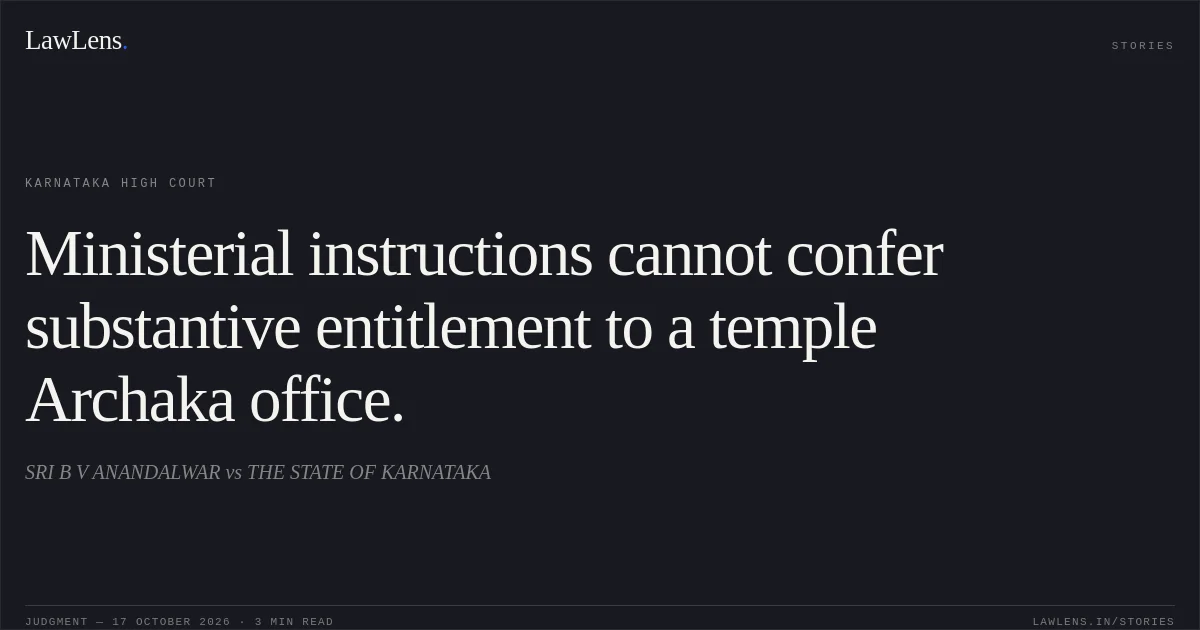
Source reference: paras. 61–65Entitlement to a Temple Archaka office must be determined under the governing Temple records, applicable statutory or regulatory provisions, and lawful established arrangements; a ministerial note or interim judicial order does not itself create substantive entitlement.
Source reference: paras. 33–35, 45–47, 66No specific judicial precedent was cited in the supplied judgment.
Source reference: no citationReasoning
The 1981 official order supported Varadaraja’s recognised status as joint Archaka, so his claim could not be rejected solely because he was Narasaraja’s younger brother.
Source reference: paras. 31–35The 2013 interim orders preserved the existing arrangement but did not finally declare or create hereditary entitlement.
Source reference: paras. 31–35Anand Alwar’s recorded appointment related to a different Sannidhi and therefore did not establish a right to the main Sannidhi; ministerial notes could not alter that position without determination under the governing records and law.
Source reference: paras. 36–39, 44–47Krishna Swamy’s temporary appointment had ceased to have practical effect, while the consequential communications did not independently create substantive title.
Source reference: paras. 40–43As to Narasaraja, the reports disclosed some irregularities but did not establish the alleged theft or disappearance of the ornaments; the enquiry officer’s conclusion was a reasonably possible view, and no reviewable procedural or evidentiary defect was shown.
Source reference: paras. 50–60The complainant also established no independent right to challenge the disciplinary outcome.
Source reference: paras. 61–65Holding
W.P. No. 35902/2013 was disposed of: the interim orders created no fresh hereditary right, but Varadaraja’s claim could not be rejected contrary to the official record recognising him as joint Archaka.
W.P. No. 33153/2013 was dismissed as infructuous insofar as it challenged Krishna Swamy’s temporary appointment; W.P. No. 8691/2014 was dismissed.
Source reference: paras. 66–73W.P. No. 12291/2016 was allowed in part, with the ministerial notes held incapable of conferring substantive entitlement on Anand Alwar; any claim must be determined by the competent authority under the governing records and law.
Source reference: paras. 66–73W.P. No. 8228/2025 was dismissed, leaving the exoneration undisturbed.
Source reference: paras. 66–73The competent authority was directed to consider the official records and legal framework in any future arrangement; no order as to costs.
Source reference: paras. 66–73Acts & Sections Cited
4 provisions across 1 statute referred to in this judgment. Each provision opens on LawLens.
Indian Penal Code, 18604
Original Court PDF
SRI B V ANANDALWARvsTHE STATE OF KARNATAKA
Click to open original judgment
Original judgment, available to read, download and summarize on LawLens.in