Facts
By an interim order dated 17 August 2026, the father was granted Sunday, vacation and holiday access to the two minor children, and daily video interaction; he later said that a dispute with his in-laws prevented the children from being handed over and impeded meaningful contact.
Source reference: p.1The children, aged about seven and three, were living with their mother and maternal grandfather. The mother alleged harassment and cruelty and declined to resume cohabitation; the Court’s reconciliation effort was unsuccessful.
Source reference: pp.2–3The father sought custody and relied on an affidavit describing his income, property and residential accommodation. The mother stated that she was not employed and depended on her father, who disclosed his business activities but produced no evidence of his income.
Source reference: pp.11–12Issues
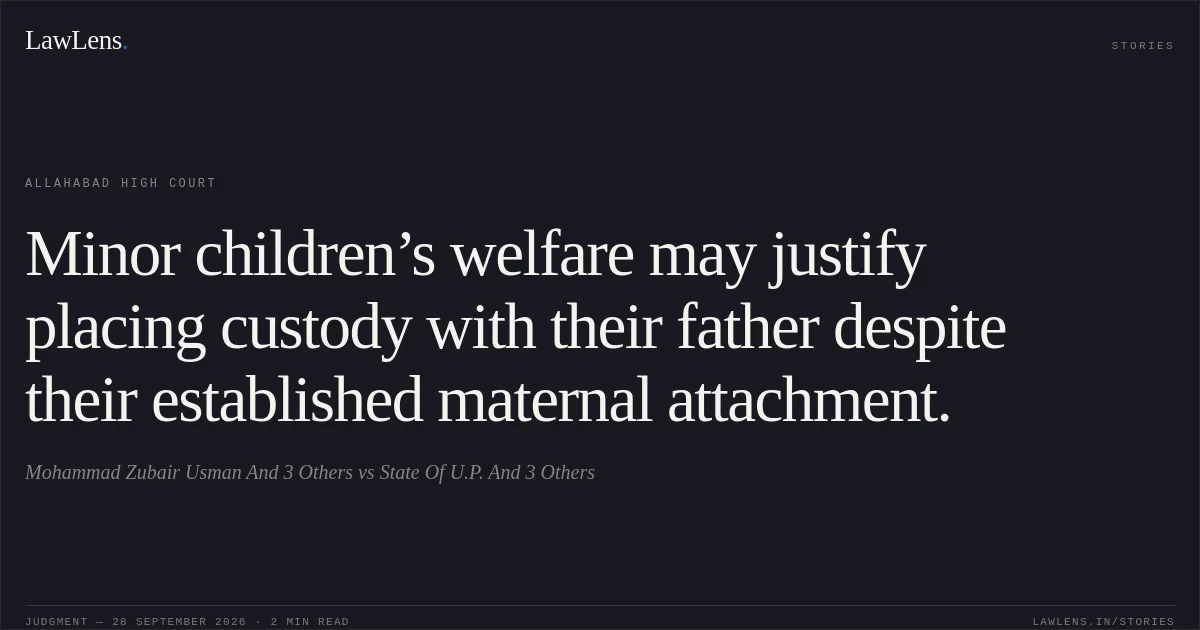
Whether the children’s custody should be transferred to their father, having regard to their welfare and best interests, rather than the competing claims of the parents.
Source reference: pp.11–13Whether the mother should retain meaningful visitation and communication rights following the transfer of custody.
Source reference: pp.12–14Law Applied
The Court applied the settled principle that, in custody proceedings—including a habeas corpus petition—the welfare and best interests of the child are paramount, while the rights of either parent are subordinate to that consideration.
Source reference: no citationIt relied on Yashita Sahu v. State of Rajasthan, (2020) 3 SCC 67, for the maintainability of habeas corpus to advance a child’s welfare.
Source reference: p.2Somprabha Rana v. State of Madhya Pradesh, (2024) 9 SCC 382, for the discretionary and child-welfare-centred nature of habeas corpus custody jurisdiction.
Source reference: pp.2–3Reshu v. State of U.P., 2021 SCC OnLine All 1065, for the principles governing custody and the broad assessment of welfare, including emotional ties, stability, care, education, development and material circumstances.
Source reference: pp.3–10The Court also recognised its parens patriae role and the importance of maintaining a child’s relationship with both parents where consistent with welfare.
Source reference: pp.11–13Reasoning
The Court weighed the children’s tender ages and established emotional attachment to their mother and maternal family against the father’s disclosed financial and residential capacity, willingness to provide for their education and upbringing, and the availability of support from his family.
Source reference: pp.11–13It noted that the mother’s lack of current income did not itself count against her, but considered the parties’ actual circumstances; the maternal grandfather’s income had not been substantiated, while the father had supplied details of his resources.
Source reference: pp.11–12The Court found no material showing that the father was disqualified from custody and concluded that the children’s welfare would presently be better served in his care, while preserving their maternal relationship through structured access.
Source reference: pp.12–14Holding
The Court allowed the custody claim and directed that Huren Zubair and Noor Zubair be placed in their father’s custody.
The mother was granted in-person visitation at the father’s residence every Sunday from 2:00 p.m. to 6:00 p.m. and daily video interaction from 6:00 p.m. to 9:00 p.m.; the father was directed to facilitate these rights and neither parent was to make adverse statements about the other in the children’s presence.
Source reference: pp.13–14The petition was disposed of with directions for the State authorities and respondents 2 and 3 to ensure compliance.
Source reference: p.14Acts & Sections Cited
2 provisions across 2 statutes referred to in this judgment. Each provision opens on LawLens.
Guardians and Wards Act, 18901
Hindu Minority and Guardianship Act, 19561
Original Court PDF
Mohammad Zubair Usman And 3 OthersvsState Of U.P. And 3 Others
Click to open original judgment
Original judgment, available to read, download and summarize on LawLens.in