Facts
The applicant was prosecuted along with co-accused persons for offences under Sections 354 and 323/34 of the Indian Penal Code arising from an allegation that, after calling the prosecutrix and her friend to a resort for a dance programme, he and the co-accused dragged the prosecutrix towards a room, assaulted her, and also assaulted her friend when she intervened.
Source reference: para. 2The prosecutrix lodged the FIR, following which a charge-sheet was filed.
Source reference: paras. 3–5The Trial Court examined five prosecution witnesses and convicted the applicant under Sections 354 and 323 IPC, sentencing him to one year’s rigorous imprisonment and a fine of ₹500 under Section 354 IPC, and fines of ₹500 each under Section 323 IPC, with default imprisonment.
Source reference: paras. 3–5The Appellate Court dismissed the applicant’s appeal and affirmed the conviction and sentence.
Source reference: para. 6The applicant therefore invoked the revisional jurisdiction of the High Court under Sections 438 and 442 of the Bharatiya Nagarik Suraksha Sanhita, 2023, contending that the prosecution evidence was unreliable due to the absence of independent witnesses and contradictions concerning the place of occurrence.
Source reference: paras. 1, 7Issues
Whether the concurrent findings of conviction under Sections 354 and 323 IPC were sustainable on the testimony of the prosecutrix, her friend, and the medical evidence, despite the absence of other independent eyewitnesses?
Source reference: paras. 7–13Whether the discrepancy between the prosecutrix’s and her friend’s descriptions of the name of the resort rendered their testimony unreliable?
Source reference: paras. 7, 10–12Whether the High Court, in exercise of its revisional jurisdiction, ought to interfere with the concurrent findings of fact recorded by the Trial Court and the Appellate Court?
Source reference: paras. 1, 6, 13–14Law Applied
The Court applied Sections 354 and 323 of the Indian Penal Code: Section 354 criminalises assault or criminal force against a woman with intent to outrage, or knowledge that such conduct is likely to outrage, her modesty, while Section 323 penalises voluntarily causing hurt.
Source reference: no citationThe Court also applied the principles governing appreciation of the testimony of an injured victim and an eyewitness, holding that such testimony cannot be discarded merely because the witness is known to the victim or because there is no independent corroboration, particularly where it remains substantially unshaken in cross-examination and receives medical support.
Source reference: paras. 10–12In revisional jurisdiction, interference with concurrent findings is warranted only where the findings are perverse, illegal, or unsupported by evidence; mere reappreciation of evidence or minor discrepancies does not justify interference.
Source reference: para. 13Reasoning
The Court found that the prosecutrix clearly deposed that the applicant and the co-accused caught hold of her, dragged her towards a room, and assaulted her, and that her account was supported by her friend, PW-3.
Source reference: para. 10The fact that PW-1 and PW-3 were friends did not make their testimony inherently unreliable, particularly since the allegation of molestation was not effectively discredited in cross-examination.
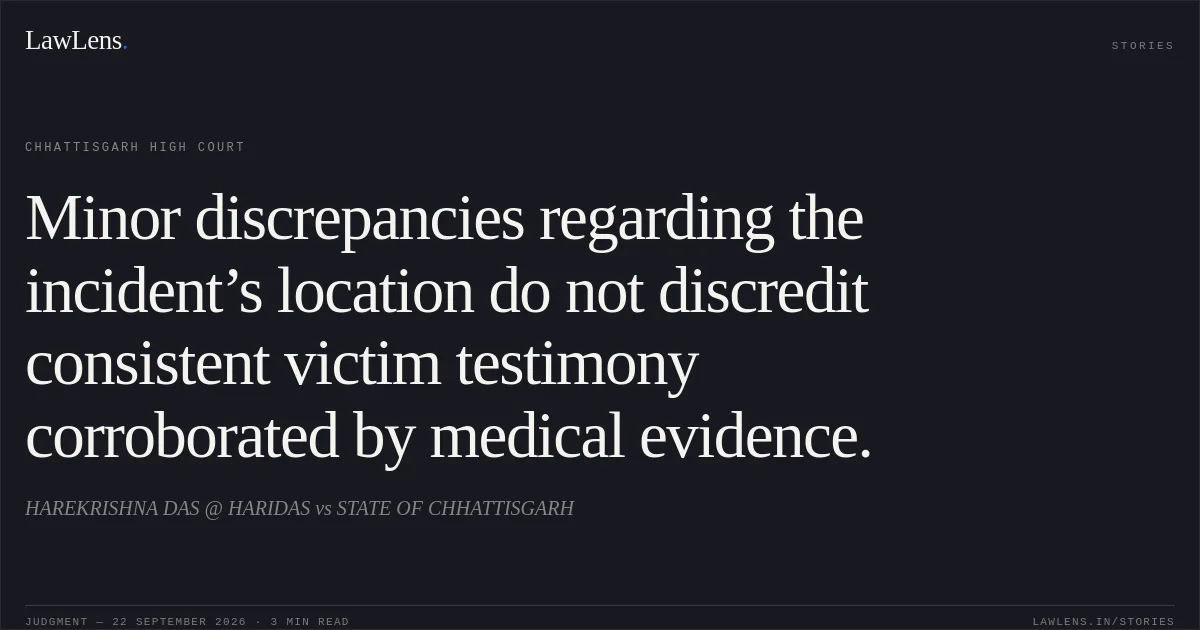
Source reference: para. 11The medical evidence of PW-4, who found swelling and abrasions on the prosecutrix’s cheeks and neck, corroborated the allegation of assault.
Source reference: para. 11The discrepancy regarding the name of the resort was treated as a minor inconsistency attributable to possible confusion about the place’s name and was not considered sufficient to discard the otherwise consistent account of the occurrence.
Source reference: para. 12Since both courts below had reached concurrent findings based on the victim’s testimony, corroborative eyewitness evidence, and medical evidence, the High Court found no perversity or legal infirmity warranting revisional interference.
Source reference: para. 13Holding
The High Court answered the issues against the applicant.
It held that the evidence sufficiently established the applicant’s guilt for molesting and assaulting the prosecutrix under Sections 354 and 323 IPC, and that the minor discrepancy concerning the resort did not undermine the prosecution case.
Source reference: paras. 11–13The criminal revision was dismissed, and the judgment of conviction and order of sentence passed by the Trial Court and affirmed by the Appellate Court were upheld.
Source reference: para. 14Pending interlocutory applications, if any, were disposed of, with no order as to costs.
Source reference: para. 15Acts & Sections Cited
6 provisions across 3 statutes referred to in this judgment. Each provision opens on LawLens.
Bharatiya Nagarik Suraksha Sanhita, 20232
Indian Penal Code, 18603
Code of Criminal Procedure, 19731
Original Court PDF
HAREKRISHNA DAS @ HARIDASvsSTATE OF CHHATTISGARH
Click to open original judgment
Original judgment, available to read, download and summarize on LawLens.in