Facts
The applicant, an Inspector in the Delhi Police, challenged a "Censure" punishment order dated 06.08.2014 and an appellate order dated 06.04.2016.
Source reference: p. 2The respondents alleged that he failed to take prompt action regarding a suspected gunshot incident on 31.05.2013, leading to an 11-month delay in registering FIR No. 272/2014.
Source reference: p. 3The applicant contended that on the date of the incident (31.05.2013), he was on sanctioned casual leave and had handed over charge.
Source reference: p. 2, 6The complainant initially reported the injury as a fall from a motorcycle and only alleged a gunshot months later following a separate monetary dispute.
Source reference: p. 5A Show Cause Notice was issued on 17.04.2014, which the applicant argued was pre-determined.
Source reference: p. 5-6Issues
1. Whether the disciplinary proceedings and the subsequent punishment of "Censure" were vitiated by a violation of the principles of natural justice and pre-determination.
Source reference: p. 2, 62. Whether the procedure adopted for imposing the minor penalty was in accordance with the Delhi Police Act and relevant rules.
Source reference: p. 7Law Applied
The court primarily applied Section 21 of the Delhi Police Act, 1978, and Rule 5, 6, and 8(f) of the Delhi Police (Punishment Appeal) Rules.
Source reference: p. 7-8Rule 6(ii) classifies "Censure" as a minor punishment and mandate that it be awarded only after serving a show cause notice and considering the officer's written reply and oral deposition if requested.
Source reference: Rule 6(ii)Reliance on State of U.P. v. Vijay Kumar Tripathi Anr. [1994], which establishes that an opportunity to show cause against a proposed penalty of censure is a constitutional requirement of natural justice, as censure carries adverse career consequences.
Source reference: p. 8Reference to Yoginath D. Bagde v. State of Maharashtra (1999) regarding the necessity of a fair hearing at all stages.
Source reference: p. 4Reasoning
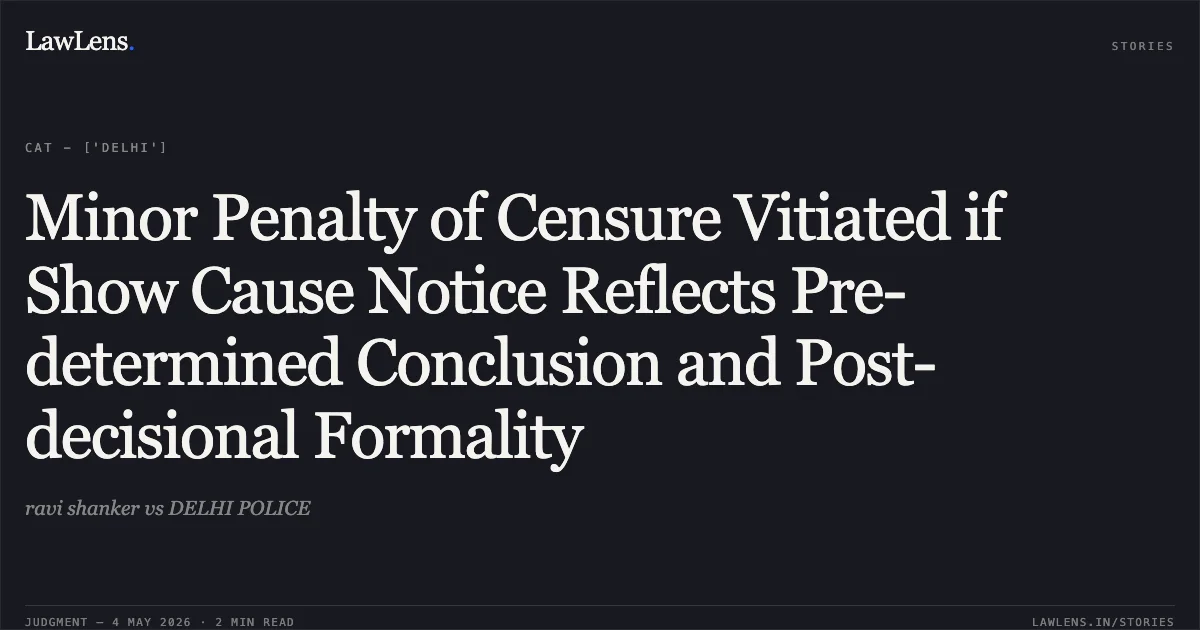
The Tribunal found that the Show Cause Notice issued by the respondents was a "post-decisional formality" because it called upon the applicant to explain "why he should not be censured" before seeking his version of the facts, indicating a pre-determined conclusion.
Source reference: p. 5-6The court noted that the respondents ignored material facts: the applicant was on sanctioned leave during the initial incident, and the complainant had significantly improved his version of events (from an accident to a gunshot) after a seven-month delay due to a civil monetary dispute.
Source reference: p. 5-6The Tribunal reasoned that the authorities failed to conduct a proper inquiry or recorded statements to verify these contradictions before fastening liability.
Source reference: p. 6The mechanical rejection of the applicant's defense by the appellate authority rendered the proceedings arbitrary and non-speaking.
Source reference: p. 3, 6Holding
The Tribunal held that the impugned orders were unsustainable as they were based on a pre-determined approach and failed to satisfy the principles of natural justice.
The Tribunal answered the issues in the affirmative for the applicant, ruling that the "Censure" was unjustified given his absence on leave and the complainant's delayed, improved testimony.
Source reference: p. 8The Original Application was allowed, and the orders dated 06.08.2014 and 06.04.2016 were quashed and set aside.
Source reference: p. 8Acts & Sections Cited
2 provisions across 2 statutes referred to in this judgment. Each provision opens on LawLens.
Indian Penal Code, 18601
Delhi Police Act, 19781
Original Court PDF
ravi shankervsDELHI POLICE
Click to open original judgment
Original judgment, available to read, download and summarize on LawLens.in