Facts
The appellants, a Junior Engineer and an Assistant Engineer, were accused of conspiring to misappropriating government funds during the repair of the Ghorasahan Branch Canal in 1986–87
Source reference: para 1, 4A Vigilance investigation found that while Rs. 62,113/- was paid against an estimate of Rs. 84,745/-, the actual work executed was valued at only Rs. 18,699/-, resulting in an excess payment of over Rs. 39,000/-
Source reference: para 4The trial court convicted the appellants for forgery, cheating, criminal conspiracy, and criminal misconduct
Source reference: para 2The appellants challenged the conviction on grounds of faulty measurement methodology (conducted 4 months later during monsoon), technical errors in the comparative chart (Ext. 6), and their prior exoneration in departmental proceedings
Source reference: para 5-7Issues
1. Whether the inflation of measurements in official books and subsequent excess payment constitutes criminal misconduct and conspiracy under the IPC and P.C. Act
Source reference: para 212. Whether mere violation of departmental procedures (codal violations) without proof of mens rea is sufficient for a criminal conviction
Source reference: para 26, 313. Whether the technical evidence (Ext. 6) and oral testimonies were sufficient to prove guilt beyond reasonable doubt despite certain procedural deficiencies
Source reference: para 34-35Law Applied
Sections 420 (Cheating), 467 (Forgery of valuable security), 468 (Forgery for cheating), 471 (Using forged document), and 120B (Conspiracy) of the Indian Penal Code
Source reference: para 17Section 13(1)(d) read with 13(2) of the Prevention of Corruption Act, 1988, regarding criminal misconduct by a public servant
Source reference: para 17-18The court cited Kehar Singh v. State (1988) and State (NCT of Delhi) v. Navjot Sandhu (2005) regarding the nature of criminal conspiracy and common design
Source reference: para 22, 24It also referenced C. Chenga Reddy v. State of A.P. (1996) to distinguish between mere "codal violations" and criminal acts requiring mens rea
Source reference: para 26Reasoning
The court observed that the Measurement Books (Ext. 1) were official records carrying a presumption of correctness, and the entries proved that quantities of work were systematically inflated
Source reference: para 37-38Although the defense argued that measurements were taken during the rainy season (leading to erosion), the court found the discrepancy (approx. Rs. 43,000 paid vs Rs. 18,000 work done) too substantial to be explained away by weather or "tolerance" factors
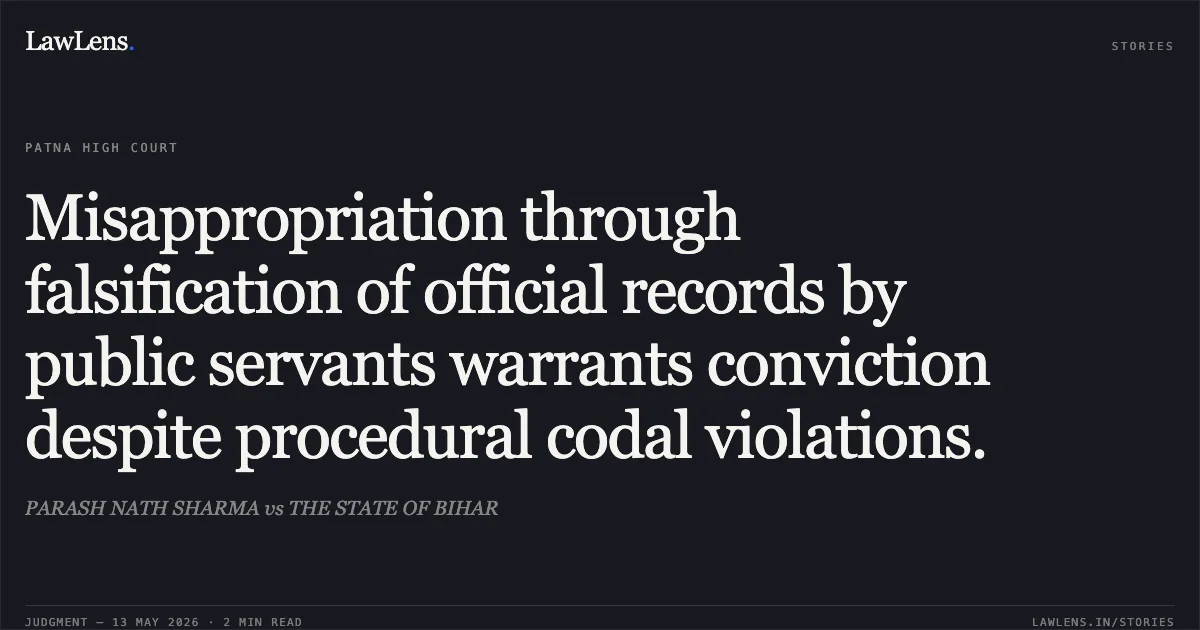
Source reference: para 4, 35The court rejected the "codal violation" defense, noting that the fabrication of official records (MB entries) for financial gain established the requisite mens rea
Source reference: para 28, 31While the court acknowledged minor procedural lapses in the technical report (Ext. 6), it held that the cumulative effect of the documentary and oral evidence (P.W.1 and P.W.3) established a clear chain of events pointing to a conspiracy between the engineers and the contractor
Source reference: para 35, 40Holding
The Court affirmed the conviction of the appellants under Sections 420, 467, 468, 471, and 120B of the IPC and Section 13(1)(d) of the P.C. Act
However, considering the relatively small amount defalcated (approx. Rs. 39,647/- after tolerance) and the time elapsed, the Court modified the sentence, reducing the rigorous imprisonment from ten years to two years. The appeals were partly allowed only to the extent of the sentence reduction.
Source reference: para 41, 42Acts & Sections Cited
10 provisions across 4 statutes referred to in this judgment. Each provision opens on LawLens.
Indian Penal Code, 18605
Prevention of Corruption Act, 19882
Code of Criminal Procedure, 19732
Bharatiya Nagarik Suraksha Sanhita, 20231
Original Court PDF
PARASH NATH SHARMAvsTHE STATE OF BIHAR
Click to open original judgment
Original judgment, available to read, download and summarize on LawLens.in