Facts
The applicant, a Constable in the Madhya Pradesh Police, filed a first application for anticipatory bail under Section 482 of the Bhartiya Nagrik Suraksha Sanhita (BNSS), 2023
Source reference: p.1He was charged under Sections 108 (abetment of suicide) and 3(5) (common intention) of the Bhartiya Nyaya Sanhita (BNS), 2023
Source reference: p.1The prosecution alleged that on 12.12.2025, the deceased, Mrityunjay Chauhan, discovered the applicant hiding in the kitchen of co-accused Preeti Jadon (a Sub-Inspector)
Source reference: p.2The applicant allegedly assaulted the deceased while the co-accused attempted to fire a pistol and threatened him
Source reference: p.2The deceased committed suicide on 15.12.2025
Source reference: p.2The applicant argued that the case was fabricated, he had no mens rea, and that the deceased had a history of criminal conduct
Source reference: p.3-4He further noted that the co-accused had received interim protection from the Supreme Court
Source reference: p.7Issues
1. Whether the applicant is entitled to the extraordinary discretionary relief of anticipatory bail under Section 482 of the BNSS given the gravity of the allegations
Source reference: p.92. Whether the alleged acts of assault and intimidation by a police official, followed by the victim's suicide three days later, prima facie constitute abetment under Section 108 of the BNS
Source reference: p.10-11Law Applied
The Court primarily considered Section 482 of the BNSS, 2023, regarding anticipatory bail, and Section 108 of the BNS, 2023, regarding abetment of suicide
Source reference: p.1, 9It relied on Kamaruddin Dastagir Sanadi v. State of Karnataka, Gangula Mohan Reddy v. State of Andhra Pradesh, and Sanju alias Sanjay Singh Sengar v. State of Madhya Pradesh.
Source reference: p.5-6These precedents establish that for an offence of abetment of suicide, there must be a positive act of instigation or intentional aid, a clear mens rea, and circumstances leaving the deceased with no option but to end their life
Source reference: p.5-6Reasoning
The Court distinguished the present case from the cited precedents, noting that the allegations were not limited to personal discord or emotional distress but involved specific acts of physical assault, criminal intimidation, and misuse of official police position
Source reference: p.11The Court observed that the applicant’s status as a public servant weighed against him, as he allegedly used his authority to instill fear in the deceased, suggesting no legal recourse was available
Source reference: p.10The Court found a prima facie nexus between the conduct on 12.12.2025 and the suicide on 15.12.2025, supported by CDRs, tower locations, and witness statements
Source reference: p.10It held that custodial interrogation was necessary for the recovery of the weapon and to prevent the applicant—an influential police official—from tampering with evidence or threatening witnesses
Source reference: p.12Holding
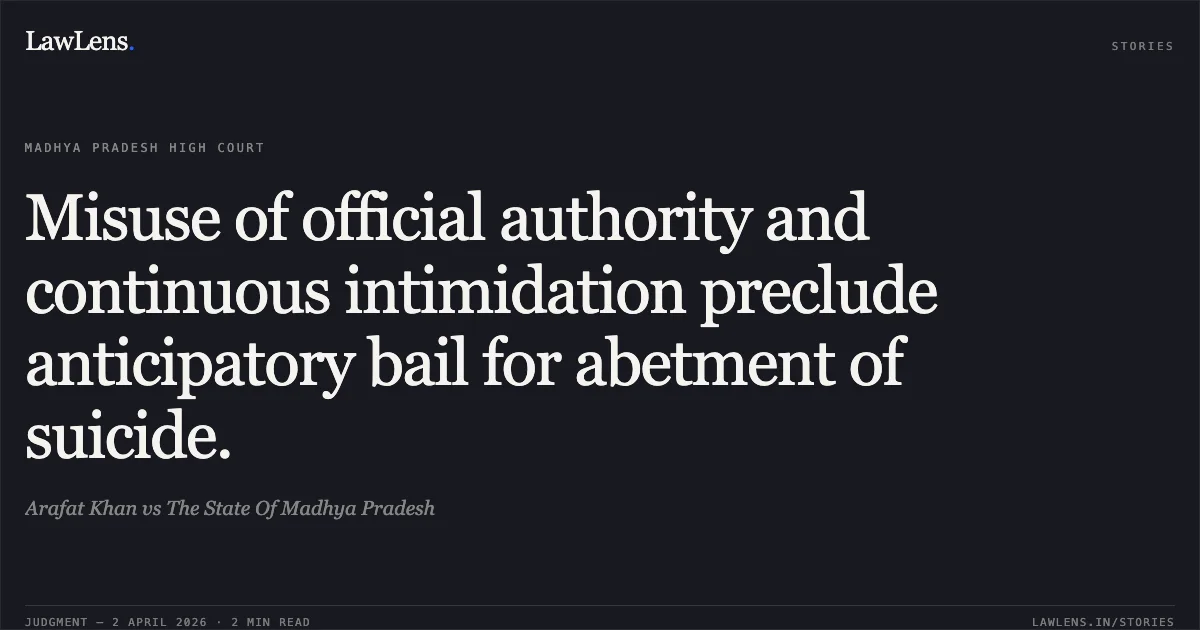
The Court answered the issues in the negative and dismissed the application for anticipatory bail
It held that the cumulative effect of the allegations, the role of the applicant as a police official, and the necessity of custodial interrogation disentitled him from discretionary relief
Source reference: p.13The Court further clarified that the interim protection granted to the co-accused by the Supreme Court did not serve as an absolute precedent for the applicant’s release
Source reference: p.13Acts & Sections Cited
17 provisions across 5 statutes referred to in this judgment. Each provision opens on LawLens.
Bharatiya Nagarik Suraksha Sanhita, 20233
Bharatiya Nyaya Sanhita, 20238
Indian Penal Code, 18604
Code of Criminal Procedure, 19731
Dowry Prohibition Act, 19611
Original Court PDF
Arafat KhanvsThe State Of Madhya Pradesh
Click to open original judgment
Original judgment, available to read, download and summarize on LawLens.in