Facts
The Plaintiffs, claiming to be the direct descendants of deceased Gulabibi (daughter of original owner Shaikh Mohammad Jamalbhai), filed a suit in 2016 for partition, declaration, and permanent injunction
Source reference: para. 9-10They challenged a series of registered transactions starting from a mortgage deed in 1969 and multiple sale deeds between 1975 and 2015, asserting that the suit land was "ancestral property" and their shares were not extinguished
Source reference: para. 9, 12The original owner died in 1952, and the property was mutated solely in his son’s name (Jamalbhai) via Promulgation Entry No. 74
Source reference: para. 10Gulabibi (who died in 1994) never challenged the revenue entries or the registered transactions during her lifetime, nor did her daughters
Source reference: para. 19.2, 29The Defendants filed applications under Order VII Rule 11 of the CPC to reject the plaint, arguing the suit was barred by limitation and based on a non-existent concept of "ancestral property" in Muslim Law
Source reference: para. 15-17.2The Trial Court refused to reject the plaint, leading to these Revision Applications
Source reference: para. 15Issues
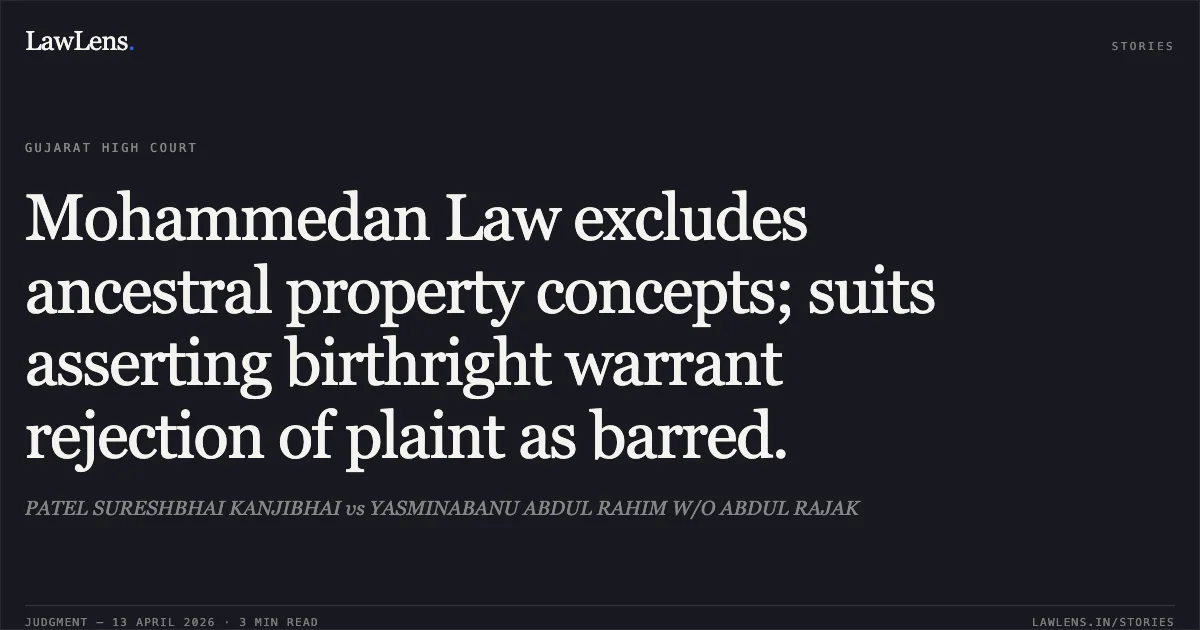
1. Whether the concept of "ancestral property" and "right by birth" is recognized under Mohammedan Law
Source reference: para. 17.2, 412. Whether the suit is barred by the law of limitation under Order VII Rule 11(d) of the CPC due to the long-standing registered transactions and revenue entries
Source reference: para. 31-333. Whether the plaint constitutes an abuse of the process of law through "clever drafting" to create an illusion of a cause of action
Source reference: para. 24-25, 32Law Applied
Order VII Rule 11 of the CPC, which mandates the rejection of a plaint that fails to disclose a cause of action or is barred by law
Source reference: para. 20-21the principle of nemo est heres viventis (a living person has no heir) under Mohammedan Law, affirming that the concept of "ancestral property," "joint family," or "right by birth" is entirely foreign to Muslim jurisprudence; inheritance only opens upon the death of the owner
Source reference: para. 41Section 3 of the Transfer of Property Act, 1882, regarding "constructive notice," holding that registration of a document serves as notice to the world
Source reference: para. 30, 43Articles 58 and 59 of the Limitation Act, 1963, which prescribe a three-year period for seeking declarations or cancelling instruments from the date the right to sue first accrues or the facts become known
Source reference: para. 37Reasoning
The Court observed that the Plaintiffs’ case was built on the erroneous premise of "ancestral property," a concept not recognized in Muslim Law, where heirs take as tenants-in-common only upon the owner's death
Source reference: para. 41-42The Court found that the Plaintiffs’ ancestors (Gulabibi and her daughters) had remained silent for over 50 years despite the property being mutated and sold to third parties via registered deeds
Source reference: para. 19.2, 34Under Section 3 of the Transfer of Property Act, the Plaintiffs were deemed to have constructive notice of the 1969 mortgage and 1975 sale deeds
Source reference: para. 31, 43The Court determined that the suit, filed 47 years after the first transaction, was a "sham litigation" designed to harass the current owners following a rise in land prices
Source reference: para. 31, 35, 42The Court criticized the "clever drafting" used to mask the bar of limitation and held that the Trial Court failed in its duty to "nip in the bud" a manifest abuse of the legal process
Source reference: para. 25, 42, 44Holding
The High Court allowed the Revision Applications, quashed the Trial Court’s orders, and allowed the applications under Order VII Rule 11, resulting in the rejection of the plaints
The Court held that the suit was hopelessly barred by the law of limitation and lacked a valid cause of action under the governing personal law
Source reference: para. 42, 46The Court further denied the Plaintiffs' request for a stay on the implementation of this judgment
Source reference: p. 60Acts & Sections Cited
21 provisions across 6 statutes referred to in this judgment. Each provision opens on LawLens.
Code of Civil Procedure, 19085
Muslim Personal Law (Shariat) Application Act, 19371
Transfer of Property Act, 18822
Specific Relief Act, 19632
Limitation Act, 19638
Registration Act, 19083
Original Court PDF
PATEL SURESHBHAI KANJIBHAIvsYASMINABANU ABDUL RAHIM W/O ABDUL RAJAK
Click to open original judgment
Original judgment, available to read, download and summarize on LawLens.in


