Facts
The petitioner was appointed as a daily-wage laborer in the Municipal Corporation, Gwalior
Source reference: para. 2He worked from September 1, 2015, to October 20, 2015, totaling approximately one year and two months of service before being terminated on July 13, 2015
Source reference: para. 11The Labour Court No.1, Gwalior, in its award dated September 12, 2019, found the termination to be illegal as the petitioner had completed 240 days of service and the respondent failed to produce contrary evidence
Source reference: para. 2, 5However, the Labour Court awarded a meager compensation of Rs. 50,000/- in lieu of reinstatement and back wages
Source reference: para. 1The petitioner challenged this award before the High Court seeking either reinstatement or higher compensation
Source reference: para. 2Issues
1. Whether the Labour Court was correct in drawing an adverse inference against the employer regarding the completion of 240 days of service when the employer failed to produce relevant records
Source reference: para. 52. Whether a daily-wage employee, upon a finding of illegal retrenchment, is automatically entitled to reinstatement with back wages or if monetary compensation is the appropriate relief
Source reference: para. 6, 83. Whether the compensation of Rs. 50,000/- awarded by the Labour Court was adequate given the facts and precedents
Source reference: para. 11Law Applied
The court applied the "best evidence" principle, holding that if a party in possession of evidence fails to produce it, an adverse inference is drawn
Source reference: para. 5Regarding relief, the court relied on Bharat Sanchar Nigam Limited v. Bhurumal (2014) 7 SCC 177, which establishes that for daily wagers whose termination is illegal due to procedural defects under Section 25-F of the Industrial Disputes Act, reinstatement is not automatic; rather, monetary compensation is preferred
Source reference: para. 6It further cited Hari Nandan Prasad v. Food Corporation of India (2014) 7 SCC 190 and Jagbir Singh v. Haryana State Agriculture Mktg. Board, confirming the shift in legal position toward granting compensation instead of reinstatement for short-term daily-wage workers
Source reference: para. 8Reasoning
The High Court upheld the Labour Court’s finding of illegal termination, noting that since the Municipal Corporation possessed the service records but failed to produce them, the adverse inference that the petitioner worked for 240 days was legally sound
Source reference: para. 5Applying the principles from BSNL v. Bhurumal, the court reasoned that because the petitioner was a daily wager with a relatively short tenure (approx. 14 months) and the termination occurred several years prior (2015), reinstatement was inappropriate
Source reference: para. 6, 11However, the court found the quantum of compensation (Rs. 50,000/-) to be insufficient and not in conformity with Supreme Court guidelines for such cases
Source reference: para. 2, 11Holding
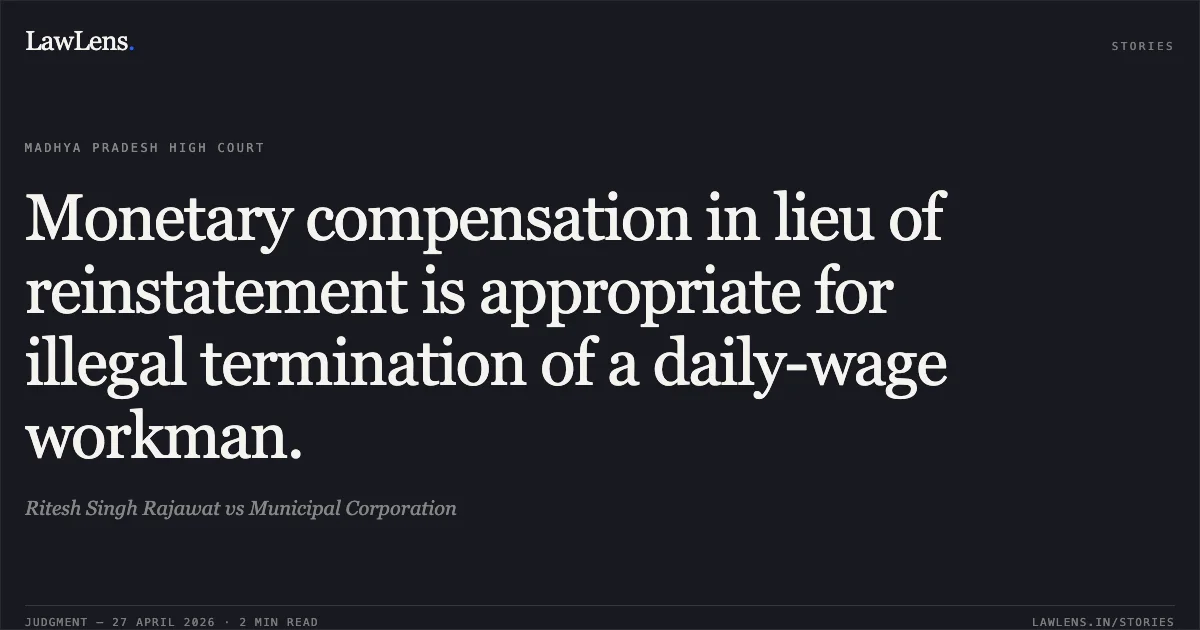
The High Court partly allowed the petition, answering that while reinstatement is not a matter of right for daily wagers, the compensation must be reasonable
The court modified the Labour Court’s award, enhancing the lump-sum monetary compensation from Rs. 50,000/- to Rs. 1,25,000/- in lieu of reinstatement and back wages. The respondent/Corporation was directed to pay the amount within three months
Source reference: para. 12Acts & Sections Cited
1 provisions across 1 statute referred to in this judgment. Linked provisions open on LawLens.
Industrial Disputes Act, 19471
Original Court PDF
Ritesh Singh RajawatvsMunicipal Corporation
Click to open original judgment
Original judgment, available to read, download and summarize on LawLens.in


