01Facts
Petitioner No. 1 (Company) and Petitioners 2-4 (Directors/Employees) were accused of offences under Section 138 of the Negotiable Instruments (NI) Act, 1881, following the dishonour of cheques presented in June 2020.
¶ 1, 7The cheques were issued to refund a booking amount of ₹85,00,000 for a residential project.
¶ 13Crucially, an Interim Resolution Professional (IRP) had taken over the Petitioner No. 1 Company on 19.09.2019 under the Insolvency and Bankruptcy Code (IBC).
¶ 7The Petitioners sought to quash the proceedings in C.C.No. 7456/2021, arguing that the moratorium under the IBC protected the company and its officers.
¶ 402Issues
i.1. Whether criminal proceedings under Section 138 of the NI Act can continue against a corporate debtor (company) after a moratorium has been imposed under Section 14 of the IBC.
¶ 8ii.2. Whether the directors/signatories of a company remain vicariously liable under Section 141 of the NI Act despite the company being under an insolvency resolution process.
¶ 8, 11iii.3. Whether vague and omnibus allegations in a complaint are sufficient to maintain a prosecution against directors who are not signatories to the cheque.
¶ 903Law Applied
The Court relied on Section 138 and 141 of the NI Act regarding dishonour of cheques and vicarious liability of officers.
¶ 1It applied Section 14 of the IBC, which mandates a moratorium on proceedings against a corporate debtor.
¶ 8The Court strictly followed the Supreme Court precedents in P. Mohanraj v. Shah Brothers Ispat Pvt. Ltd., which held that while a moratorium interdicts proceedings against the company, natural persons (directors) remain liable.
¶ 8Ajay Kumar Radheshyam Goenka v. Tourism Finance Corp. of India, confirming that the extinguishment of a company's debt under IBC does not terminate the personal penal liability of directors.
¶ 8Furthermore, it applied the principle from K.S. Mehta v. Morgan Securities and Credits Pvt. Ltd., stating that vicarious liability under Section 141 requires specific averments of a director's active role in day-to-day management.
¶ 904Reasoning
The Court observed that since Petitioner No. 1 was under a moratorium and managed by an IRP at the time of cheque presentation, proceedings against the entity were legally barred under Section 14 of the IBC.
¶ 8However, per P. Mohanraj, this statutory bar does not extend to the directors.
¶ 8Regarding Petitioners 3 and 4, the Court found that the complaint contained only "common and omnibus" allegations without specific instances of their involvement in the company’s daily affairs, failing the strict requirements for vicarious liability under Section 141.
¶ 9Conversely, Petitioner No. 2 was the actual signatory of the cheque.
¶ 10The Court reasoned that a signatory's liability is primary and is not absolved by the appointment of an IRP or the company's insolvency status.
¶ 1105Holding
The High Court partly allowed the petition.
¶ 12It quashed the proceedings in C.C.No. 7456/2021 against Petitioner No. 1 (Company) due to the IBC moratorium, and against Petitioner Nos. 3 and 4 due to the absence of specific allegations.
¶ 12However, it held that the proceedings against Petitioner No. 2 (the signatory) shall continue, as natural persons remain statutorily liable under the NI Act notwithstanding the corporate insolvency process.
¶ 11, 12Original Court PDF
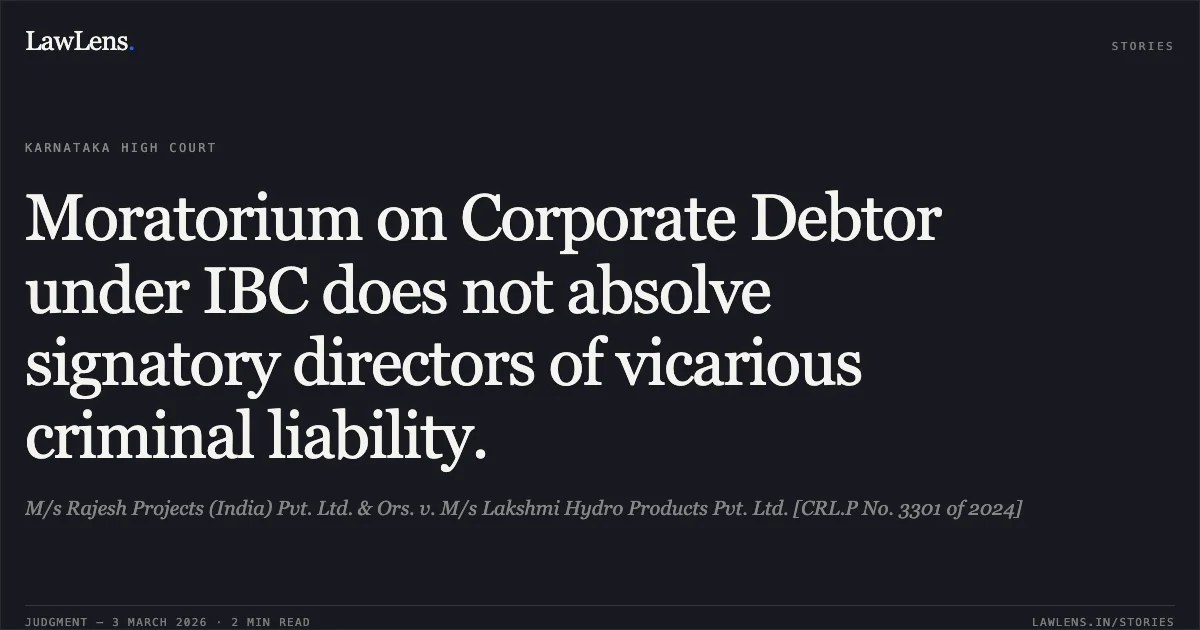
M/s Rajesh Projects (India) Pvt. Ltd. & Ors. v. M/s Lakshmi Hydro Products Pvt. Ltd. [CRL.P No. 3301 of 2024]
Click to open original judgment
Original judgment, available to read, download and summarize on LawLens.in