Facts
The petitioner executed a "Memorandum of Entry" on 11.01.2019 for the creation of a mortgage by deposit of title deeds to secure a loan for a third-party borrower, SMS Ltd.
Source reference: para. 1, 7The petitioner paid stamp duty under Article 6 of the Karnataka Stamp Act, 1957. However, Respondent No. 2 issued an order on 19.11.2020 (Annexure-H) demanding additional stamp duty of Rs. 6,75,00,000/-, reclassifying the document as a "simple mortgage" under Article 34(b) of the Act.
Source reference: para. 1The respondents argued that the petitioner created a charge over the property until the loan was satisfied, thus falling under Article 34(b).
Source reference: para. 4They also raised a preliminary objection regarding the maintainability of the writ petition due to the availability of an alternative remedy under Section 45A(3).
Source reference: para. 5Issues
1. Whether the document titled "Memorandum of Entry" for deposit of title deeds attracts stamp duty under Article 6 or Article 34(b) of the Karnataka Stamp Act, 1957.
Source reference: para. 1, 132. Whether the petitioner personally bound himself to pay the mortgage money so as to satisfy the definition of a "simple mortgage" under Section 58(b) of the Transfer of Property Act, 1882.
Source reference: para. 2, 10Law Applied
The court applied Section 58 of the Transfer of Property Act, 1882, specifically distinguishing between Section 58(b), which defines a "simple mortgage" requiring the mortgagor to bind himself personally to pay the mortgage money, and Section 58(f), which defines a "mortgage by deposit of title-deeds" as a delivery of documents with intent to create security.
Source reference: para. 9, 10, 11It further applied the Karnataka Stamp Act, 1957, noting that Article 6 governs agreements relating to the deposit of title deeds, while Article 34 applies to mortgage deeds not covered by Article 6.
Source reference: para. 1, 13The court also relied on the precedent Rashtrothana Parishat v. State of Karnataka (ILR 1992 KAR 565), which held that if an instrument falls under Article 6, Article 34 is automatically excluded.
Source reference: para. 3, 14Reasoning
The court examined the recitals of the document and found that the petitioner merely delivered title deeds to create security for a loan borrowed by SMS Ltd.
Source reference: para. 7, 8The court noted that for a document to be classified as a simple mortgage under Section 58(b) of the Transfer of Property Act (and thus Article 34(b) of the Stamp Act), there must be a personal undertaking by the mortgagor to repay the money and a specific clause regarding the mortgagee's right to sell the property upon failure.
Source reference: para. 10, 12Upon reviewing paragraphs 4 and 5 of the document, the court found these essential ingredients of a personal undertaking were absent; the petitioner had merely assured the trustee of his clear title to the property. Consequently, the court held that the transaction was a classic mortgage by deposit of title deeds under Section 58(f), which is expressly excluded from Article 34 and properly covered under Article 6.
Source reference: para. 8, 10, 13, 16Holding
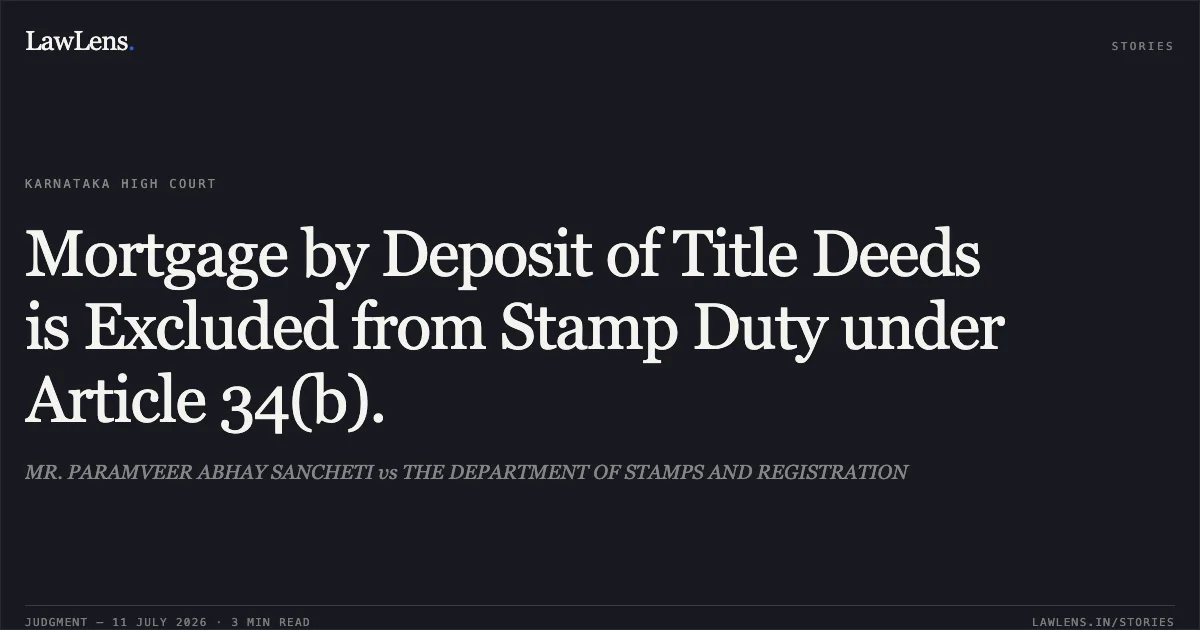
The court answered the issues in favor of the petitioner, holding that the document is an agreement relating to the deposit of title deeds taxable under Article 6, and is not a simple mortgage under Article 34(b).
The court quashed the impugned order dated 19.11.2020 passed by Respondent No. 2. The writ petition was allowed, effectively setting aside the demand for additional stamp duty of Rs. 6,75,00,000/-.
Source reference: para. 1, 17Acts & Sections Cited
3 provisions across 2 statutes referred to in this judgment. Each provision opens on LawLens.
KARNATAKA STAMP ACT, 19572
Transfer of Property Act, 18821
Original Court PDF
MR. PARAMVEER ABHAY SANCHETIvsTHE DEPARTMENT OF STAMPS AND REGISTRATION
Click to open original judgment
Original judgment, available to read, download and summarize on LawLens.in