Facts
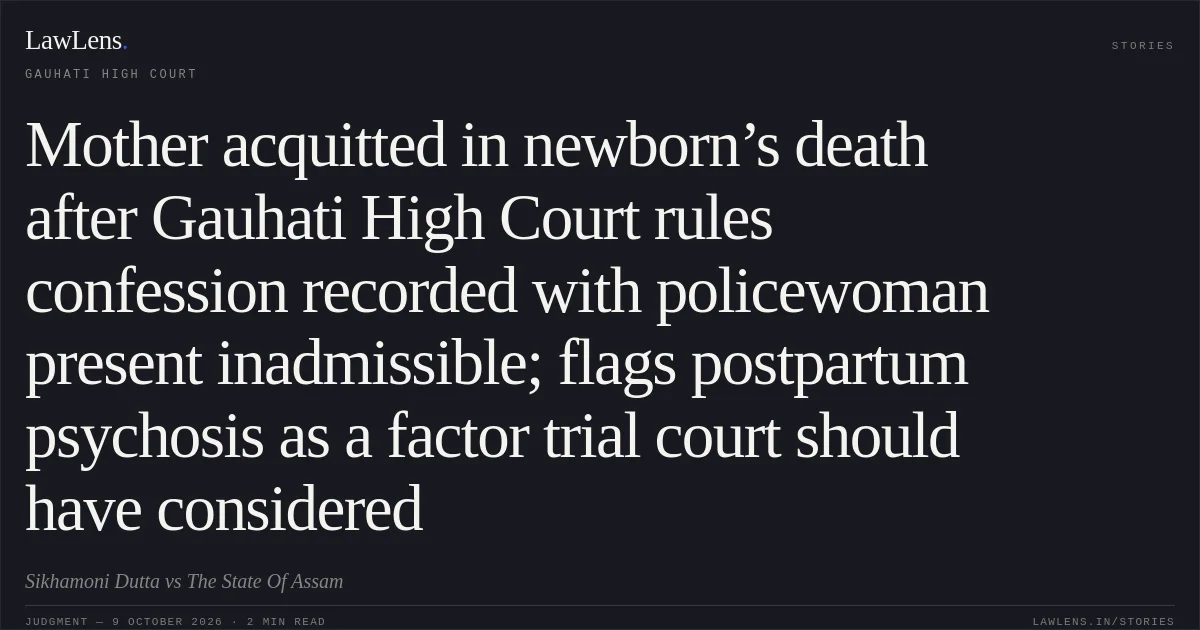
The appellant was convicted by the Sessions Judge, Sivasagar, under Sections 302 and 201 IPC for allegedly killing her 38-day-old daughter and disposing of the body in the Dikhow River.
Source reference: p.2–5The prosecution case rested principally on a confession recorded under Section 164 CrPC; the child’s body was never recovered, and the other witnesses did not provide independent evidence that the appellant committed the acts alleged.
Source reference: p.2–5The appellant appealed against her conviction and sentence.
Source reference: no citationOn appeal, the High Court considered the circumstances in which the confession was recorded and an admission made by the appellant during the hearing on sentence.
Source reference: p.7–9Issues
1. Whether the appellant’s Section 164 CrPC confession was admissible where the woman Head Constable’s signature on it indicated her presence during its recording.
Source reference: p.7–82. Whether the appellant’s statement during the hearing on sentence under Section 235(2) CrPC could be used as evidence to sustain her conviction.
Source reference: p.8–93. Whether the conviction under Sections 302 and 201 IPC could be sustained on the remaining evidence.
Source reference: p.8–9Law Applied
Sections 302 and 201 IPC prescribe offences of murder and causing disappearance of evidence, respectively; a conviction for those offences must be supported by admissible evidence proving guilt beyond reasonable doubt.
Source reference: p.2, p.9A confession recorded under Section 164 CrPC must be voluntary; the Court relied on Jiten Engti & Ors. v. State of Assam & Anr., 2026 Live Law (GAU) 75, for the principle that a police officer’s presence during the recording of a confession renders it inadmissible because voluntariness cannot be assured.
Source reference: p.7Section 235(2) CrPC provides for a hearing on sentence after conviction; relying on Muniappan v. State of Tamil Nadu, (1981) 3 SCC 11, the Court held that answers given in that distinct sentencing proceeding cannot be treated as additional evidence for determining guilt.
Source reference: p.8Reasoning
The High Court found that the appellant’s conviction was based on her Section 164 CrPC confession.
Source reference: p.7–8The woman Head Constable had signed that statement, which the Court treated as indicating that she was present when it was recorded; the confession therefore could not be regarded as voluntary or relied on as admissible evidence.
Source reference: p.7–8The appellant’s answer at the Section 235(2) hearing, in which she referred to committing the offence under severe emotional distress, could not cure that evidentiary deficiency because it was made during sentencing, not as evidence for deciding guilt.
Source reference: p.8–9The remaining evidence did not establish the appellant’s guilt beyond reasonable doubt.
Source reference: p.3–5, p.9The Court also noted that the possibility of postpartum psychosis should have been considered by the Trial Court, without deciding whether the appellant suffered from it.
Source reference: p.9–11Holding
The Court held that the Section 164 CrPC confession was inadmissible and that the appellant’s statement during the sentence hearing could not be used to prove guilt.
As the prosecution had failed to prove the charges beyond reasonable doubt, the appeal was allowed, the convictions and sentences under Sections 302 and 201 IPC were set aside, and the appellant was acquitted.
Source reference: p.9–11The Court directed her immediate release unless she was required in another case and ordered the trial-court record to be returned.
Source reference: p.9–11Acts & Sections Cited
6 provisions across 2 statutes referred to in this judgment. Each provision opens on LawLens.
Code of Criminal Procedure, 19734
Indian Penal Code, 18602
Original Court PDF
Sikhamoni DuttavsThe State Of Assam
Click to open original judgment
Original judgment, available to read, download and summarize on LawLens.in