01Facts
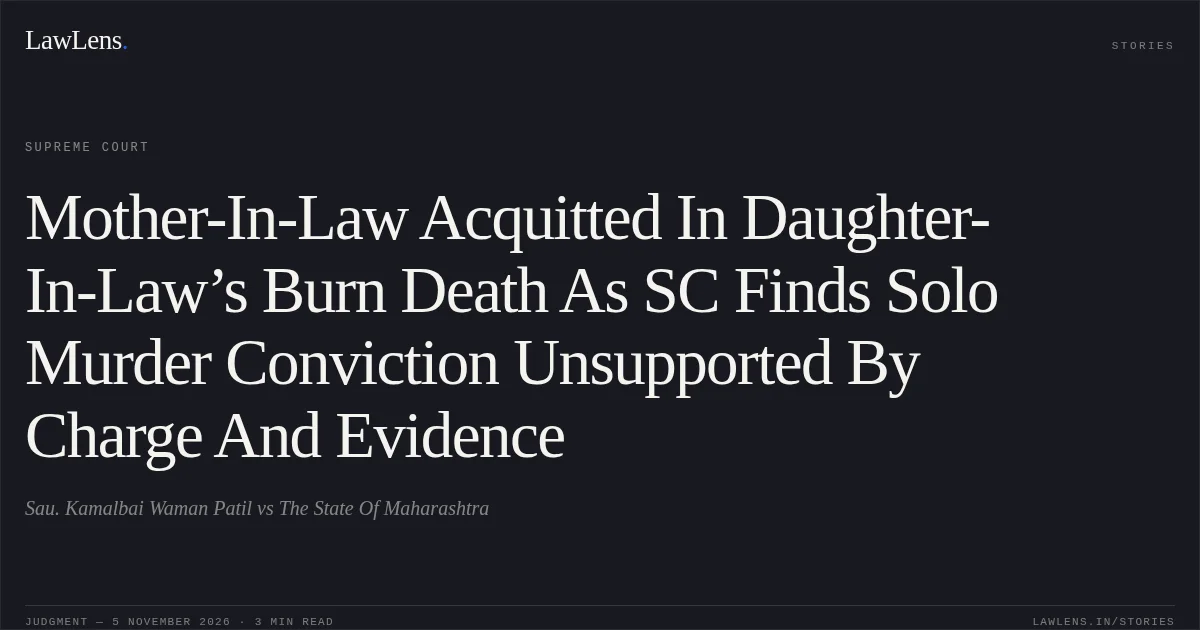
Sunita bai died after suffering extensive burn injuries.
The prosecution alleged that the appellant and three co-accused caused her death in furtherance of their common intention; all were charged under Section 302 read with Section 34 of the Indian Penal Code (IPC), among other offences.
The Sessions Court acquitted all four accused, finding inconsistencies among three dying declarations. On the State’s appeal, the High Court upheld the acquittals of the other accused but convicted the appellant under Section 302 IPC, relying principally on one dying declaration recorded in the hospital’s medico-legal papers and on her presence with the victim when the incident occurred.
¶ 2, 9–10, 14–15The appellant appealed to the Supreme Court.
¶ 1, 1102Issues
i.1. Whether the appellant could be convicted under Section 302 IPC when the charge against her was under Section 302 read with Section 34 IPC, and the other accused were acquitted.
¶ 14–18ii.2. Whether the hospital-recorded dying declaration, in light of the other inconsistent declarations and the evidence on record, was sufficient to reverse the appellant’s acquittal and sustain her conviction.
¶ 19–25, 29iii.3. Whether the appellant’s failure to explain the victim’s burns could support conviction under Section 106 of the Evidence Act, 1872.
¶ 26–2703Law Applied
Section 302 IPC prescribes the punishment for murder, while Section 34 IPC imposes joint liability where a criminal act is done by several persons in furtherance of their common intention.
¶ 16–18Under Krishna Govind Patil v. State of Maharashtra, where the prosecution case and charge are that named accused acted conjointly, the court cannot, absent an evidentiary basis and without prejudice to the accused, invent a case that an accused acted with unidentified others after the alleged co-participants are acquitted.
¶ 16–18A dying declaration must be voluntary, reliable, and made in a fit state of mind; where multiple declarations conflict, each must be assessed on its merits, with material inconsistencies and the need for corroboration considered in the surrounding circumstances. The Court relied on Abhishek Sharma v. State (Govt. of NCT of Delhi) and Jagbir Singh v. State (N.C.T. of Delhi).
¶ 19–20Section 106 of the Evidence Act does not displace the prosecution’s burden: it may be considered only after the prosecution establishes a prima facie case by proving circumstances pointing to the accused’s guilt.
¶ 27In an appeal against acquittal, the acquittal strengthens the presumption of innocence; reversal is not justified where the trial court’s view is neither perverse nor illegal.
¶ 29Provisions in the judgment · 7 · Linked ones open on LawLens
Indian Penal Code, 1860 Section 302Section 342Section 406Section 34Section 364
Code of Criminal Procedure, 1973 Section 161Section 386
04Reasoning
The charge alleged that all four accused caused the death in furtherance of their common intention; no separate charge under Section 302 IPC simpliciter had been framed against the appellant. After affirming the acquittals of the other accused, the High Court could not treat the appellant’s presence with the victim as a basis for convicting her alone under Section 302, effectively creating a new prosecution case.
¶ 14–18As to the dying declarations, the High Court rejected two declarations and the victim’s reported oral statements but relied on the hospital-recorded account. The first person to reach the scene, extinguish the fire, and take the victim to hospital was a material witness who was not examined; the Court considered his evidence important to corroborate the hospital account, particularly given the inconsistencies and the extent of the victim’s burns.
¶ 21–25The prosecution had not otherwise discharged its initial burden, so the appellant’s failure to explain the burns could not fill that evidentiary gap under Section 106.
¶ 26–27The Sessions Court’s view was therefore a reasonable one, not perverse or illegal.
¶ 2905Holding
The Supreme Court held that the High Court was not justified in reversing the acquittal or convicting the appellant.
¶ 29–30It quashed the High Court’s judgment, acquitted the appellant of the offence under Section 302 IPC, and directed that she be set free forthwith unless required in another case.
¶ 29–30Original Court PDF
Sau. Kamalbai Waman PatilvsThe State Of Maharashtra
Click to open original judgment
Original judgment, available to read, download and summarize on LawLens.in