Facts
The petitioner’s daughter, late Kiran Raikwar, and respondent no. 2 filed for divorce by mutual consent under Section 13-B of the Hindu Marriage Act.
Source reference: para. 3-4A decree was granted on April 23, 2024, with a settlement term requiring respondent no. 2 to pay ₹20 lakh to the wife.
Source reference: para. 4While ₹4 lakh was paid, the remaining ₹16 lakh was deposited with the Family Court. The wife moved a release application on May 24, 2024, and a cheque was prepared on July 6, 2024; however, she died on July 16, 2024, before receiving it.
Source reference: para. 5The petitioner, the deceased's mother and sole surviving family member, applied for the release of the funds. Respondent no. 2 objected, contending the money was personal maintenance meant only for the wife.
Source reference: para. 6-7Issues
Whether the mother of a deceased divorced daughter is entitled to receive the amount awarded to the daughter under a divorce decree?
Source reference: p.1 / Issue InvolvedWhether the legal representatives of a deceased divorced wife can claim settlement amounts if she dies after the decree but before receiving payment?
Source reference: para. 8Law Applied
Section 14 of the Hindu Succession Act, 1956, which establishes that property possessed by a female Hindu (including sums in lieu of maintenance or under a decree) is her absolute property.
Source reference: para. 9-10Section 15(1)(c) of the same Act, which prescribes that in the absence of children or husband, a female Hindu’s property devolves upon her mother and father.
Source reference: para. 11-12Section 2(11) of the CPC defining "legal representative" as one who represents the "estate" of the deceased, and Section 146 of the CPC, which allows proceedings to be continued by persons claiming under the original party.
Source reference: para. 15, 18The doctrine from Yallawwa v. Shantavva regarding the extinguishment of husband’s inheritance rights post-divorce and V. Tulasamma v. Sesha Reddy regarding absolute ownership of property acquired in lieu of maintenance.
Source reference: para. 20-21Reasoning
The court reasoned that since the divorce was finalized, the respondent no. 2 (ex-husband) lost all mutual rights of inheritance in the deceased's property.
Source reference: para. 13, 20Under Section 14 of the Hindu Succession Act, the ₹16 lakh became the absolute property ("estate") of the deceased wife the moment the decree was passed, regardless of whether it was labeled as maintenance.
Source reference: para. 10-11, 21Because the deceased died intestate without children and her status as a wife had legally ceased, the property devolved upon her parents under Section 15(1)(c).
Source reference: para. 13-14The petitioner, being the widowed mother and sole heir, qualifies as the "legal representative" under Section 2(11) CPC and under Section 146 CPC, the petitioner was legally entitled to pursue the release application originally filed by her daughter.
Source reference: para. 15-17, 19Holding
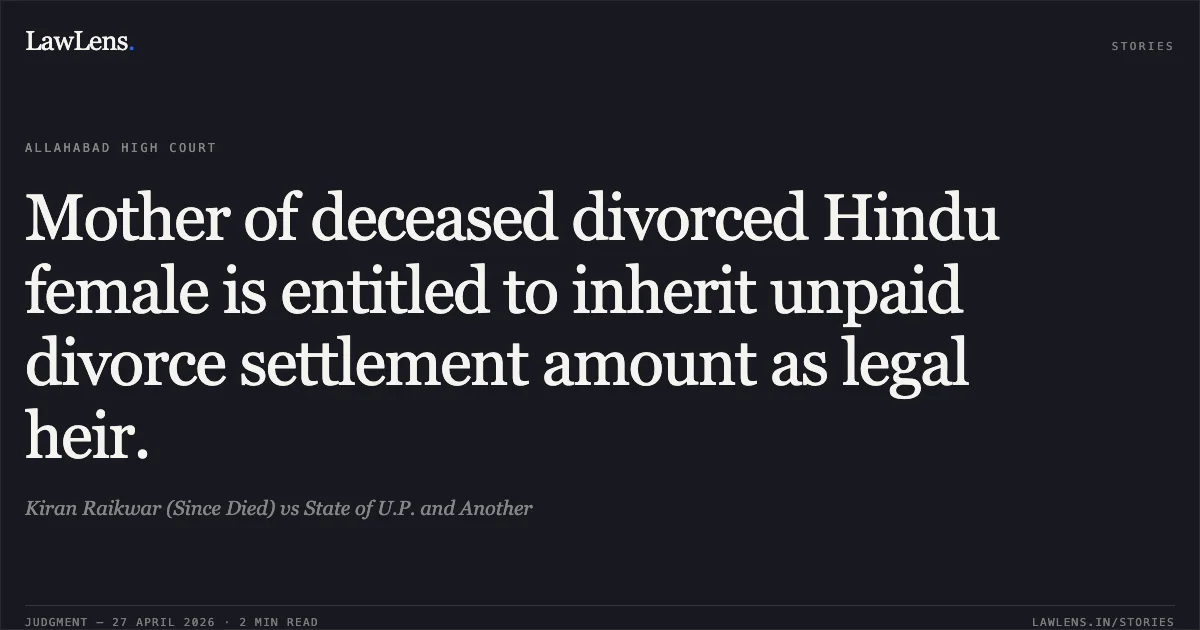
The Court held that the petitioner is the lawful successor and legal representative of her deceased daughter and is entitled to the deposited amount, ruling that the "estate" includes money lying in court.
The Court allowed the petition and directed the Principal Judge, Family Court, Banda, to release the sum of ₹16,00,000/- to the petitioner within two weeks.
Source reference: para. 24Acts & Sections Cited
7 provisions across 3 statutes referred to in this judgment. Each provision opens on LawLens.
Hindu Succession Act, 19563
Code of Civil Procedure, 19082
Indian Succession Act, 19252
Original Court PDF
Kiran Raikwar (Since Died)vsState of U.P. and Another
Click to open original judgment
Original judgment, available to read, download and summarize on LawLens.in


