01Facts
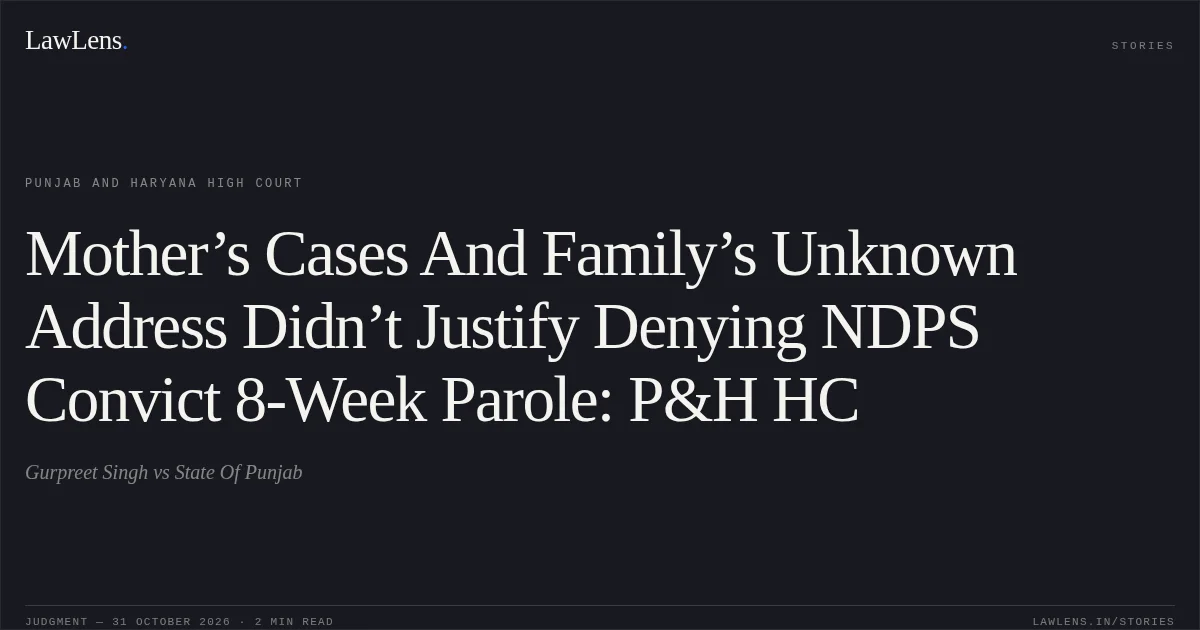
The petitioner was serving a 12-year sentence following conviction under the NDPS Act and sought eight weeks’ parole under Section 3 of the Punjab Good Conduct Prisoners (Temporary Release) Act, 1962.
¶ 2–6The District Magistrate again rejected the application, principally because three cases were registered against the petitioner’s mother, she was absconding in one, and the family had moved to an unknown address—giving rise to an apprehension that the petitioner might abscond.
¶ 9–11The petitioner challenged that rejection under Article 226 of the Constitution.
¶ 102Issues
i.Whether the District Magistrate’s refusal of parole, based on the petitioner’s mother’s alleged conduct and the family’s unknown address, was lawful and supported by cogent material.
¶ 10–14, 39–41ii.Whether the Court could grant parole directly where the refusal was arbitrary or based on conjecture, and whether appropriate conditions could address the stated risks.
¶ 33–34, 40–4203Law Applied
Section 3 of the Punjab Good Conduct Prisoners (Temporary Release) Act, 1962 authorises temporary release on specified grounds, including “any other sufficient cause,” subject to the statutory conditions and limits on duration.
¶ 7Parole is a discretionary privilege, not a vested right; however, its denial is reviewable under Article 226 where the decision is arbitrary, perverse, based on irrelevant considerations, ignores material evidence, or departs from the governing law.
¶ 14, 29–35T.C. Basappa v. T. Nagappa permits certiorari for jurisdictional error, procedural unfairness, or a manifest error of law.
¶ 13A parole refusal must rest on cogent, objective reasons; conjecture alone is insufficient.
¶ 38–39Provisions in the judgment · 6 · Linked ones open on LawLens
Bharatiya Nagarik Suraksha Sanhita, 2023 Section 528
Narcotic Drugs and Psychotropic Substances Act, 1985 Section 15Section 22Section 61Section 85
Conservation of Foreign Exchange and Prevention of Smuggling Activities Act, 1974 Section 12
04Reasoning
The impugned order relied on the mother’s alleged conduct and the family’s changed or unknown address, but identified no evidence that the petitioner had misused an earlier release, behaved indisciplinarily in custody, or was likely to abscond or offend.
¶ 40The mother’s antecedents could not, without more, justify denying the petitioner parole, and the apprehension arising from the family’s address was speculative.
¶ 40The Court also held that any concern about absconding could be addressed by requiring a fixed residential address, police notification, and bonds, rather than refusing release outright.
¶ 41The refusal therefore lacked a sufficient evidentiary basis and fell outside lawful administrative discretion.
¶ 39–4105Holding
The Court allowed the petition and quashed the District Magistrate’s order dated 27 July 2026.
¶ 42–48It granted the petitioner eight weeks’ parole from release, subject to personal and surety bonds and conditions including firearm deposit, abstention from offences and narcotics-related activity, non-contact with witnesses, disclosure and maintenance of his residential address, and timely surrender.
¶ 42–48The order was confined to parole in the case arising from the specified FIR and did not affect the merits of the petitioner’s appeal or operate as bail or suspension of sentence in any other matter.
¶ 49–51Original Court PDF
Gurpreet SinghvsState Of Punjab
Click to open original judgment
Original judgment, available to read, download and summarize on LawLens.in