01Facts
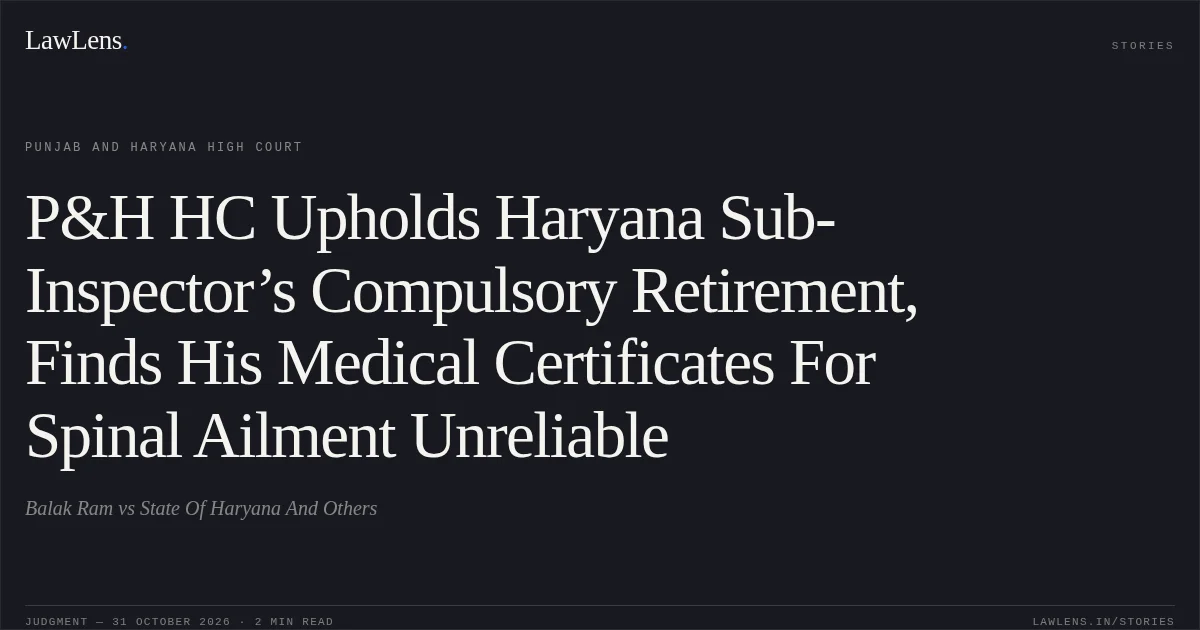
Balak Ram, a Sub-Inspector in the Haryana Food, Civil Supplies and Consumer Affairs Department, was charged with unauthorised absence and failure to attend assigned mandi duties.
pp. 2–8, 10–11He attributed his absence to a spinal ailment and relied on medical certificates.
pp. 2–8, 10–11Following a departmental inquiry, which found the charges proved, the competent authority ordered his compulsory retirement under Rule 4(b)(v) of the Haryana Civil Services (Punishment and Appeal) Rules, 2016.
pp. 2–8, 10–11He challenged that order under Articles 226 and 227, alleging inadequate opportunity to defend himself, failure to consider his medical explanation, and disproportionate punishment.
pp. 2–8, 10–11The High Court dismissed the petition.
p. 1702Issues
i.1. Whether the compulsory-retirement order was liable to be quashed for procedural unfairness or breach of natural justice in the departmental inquiry.
pp. 5–8, 14–15ii.2. Whether the inquiry findings and compulsory-retirement penalty warranted interference under Articles 226 and 227, including on the grounds that the medical explanation was not considered and the penalty was disproportionate.
pp. 13–18, 22–2503Law Applied
Rule 7 of the Haryana Civil Services (Punishment and Appeal) Rules, 2016 governed the disciplinary charges, while Rule 4(b)(v) was the provision under which the authority imposed compulsory retirement.
pp. 9–10, 16Rule 4 of the Haryana Government Employees Conduct Rules, 2016 was invoked in relation to the employee’s duty to maintain the conduct expected of a government servant.
p. 11Judicial review of departmental inquiries under Articles 226 and 227 is limited: the High Court does not sit as an appellate authority and may interfere where, for example, there is a breach of natural justice, denial of reasonable opportunity, findings based on no evidence, or punishment wholly disproportionate to the proved misconduct.
pp. 15–16, 22–23The Court relied on Indian Oil Corporation Ltd. v. Ashok Kumar Arora for that limited-review principle.
p. 15Provisions in the judgment · 1 · Linked ones open on LawLens
Code of Civil Procedure, 1908 Section 151
04Reasoning
The Court found the medical material unreliable: the first certificate was undated, came from a urology-focused hospital and was issued by a urologist, and described lumbar back pain rather than the spinal-cord dislocation pleaded; the second certificate was also undated, and no supporting treatment records were produced.
pp. 11–13The petitioner did not establish that these certificates had been placed before the Inquiry Officer.
pp. 11–13The inquiry record showed that he attended the proceedings, received the relevant documents, and stated that he would contest the matter himself; the Court therefore rejected his claim that he lacked an adequate opportunity to defend himself.
p. 14It also considered the inquiry report and the disciplinary order, which recorded the reasons for finding habitual absence and imposing the penalty.
pp. 14–16In the absence of demonstrated procedural error, no-evidence findings, or a wholly disproportionate penalty, the limited scope of judicial review did not justify intervention.
pp. 14–1605Holding
The High Court held that the petitioner had not established grounds to interfere with the inquiry or the compulsory-retirement order.
p. 17It dismissed the writ petition and disposed of any pending applications.
p. 17Original Court PDF
Balak RamvsState Of Haryana And Others
Click to open original judgment
Original judgment, available to read, download and summarize on LawLens.in