Facts
The appellant, Pulkit, along with three others, was tried for the murder of Ashok Bakdiya in 2008.
Source reference: para. 3While the others were convicted of murder, the appellant was convicted under Section 302 read with Section 120B of the IPC for criminal conspiracy.
Source reference: para. 3The prosecution relied on circumstances including a prior dispute/motive, an alleged request for a 'recce' of the deceased, overhead conversations at a public place, and a disclosure statement leading to the seizure of a mobile phone used to contact a co-accused after the crime.
Source reference: para. 5The High Court of Madhya Pradesh dismissed the appellant's appeal, though it discarded the testimony of two key witnesses (PW3 and PW5) who alleged police coercion.
Source reference: para. 6The appellant challenged this before the Supreme Court, arguing a lack of evidence regarding a prior agreement or meeting of minds.
Source reference: para. 7Issues
1. Whether the prosecution established a complete chain of circumstantial evidence to prove the charge of criminal conspiracy under Section 120B IPC beyond reasonable doubt?
Source reference: para. 11-122. Whether the disclosure statement and subsequent seizure of a mobile phone and Call Detail Records (CDR) constituted admissible and conclusive evidence of the appellant’s involvement?
Source reference: para. 17-18Law Applied
The Court applied Section 120B of the Indian Penal Code (IPC) regarding criminal conspiracy, requiring proof of an agreement to do an illegal act.
Source reference: para. 11It relied on the foundational principles of circumstantial evidence established in Sharad Birdhichand Sarda v. State of Maharashtra, which mandates that circumstances must be "conclusive in nature" and exclude every hypothesis except the guilt of the accused.
Source reference: para. 12Section 27 of the Indian Evidence Act, 1872, limiting the admissibility of custodial statements only to the "discovery of a fact".
Source reference: para. 17Requirements for electronic evidence admissibility under Section 65B of the Evidence Act.
Source reference: para. 18Reasoning
The Court found that once the High Court discarded the testimonies of PW3 and PW5 due to illegal detention, the remaining evidence was insufficient.
Source reference: para. 15The "motive" cited—a slapping incident six months prior—was deemed too remote and insufficient to sustain a conviction on its own.
Source reference: para. 14The Court characterized PW9 (who allegedly overheard the conspiracy) as a "chance witness" whose testimony lacked conclusive details.
Source reference: para. 16Regarding the disclosure statement, the Court noted that the identity of the co-accused was already known to the police, rendering the "discovery" moot.
Source reference: para. 17The CDR evidence was dismissed because the mobile was registered to a third party (Kailash), there was no proof the co-accused possessed the specific phone, and significantly, there were no records showing contact prior to the occurrence to prove a pre-arranged conspiracy.
Source reference: para. 18Holding
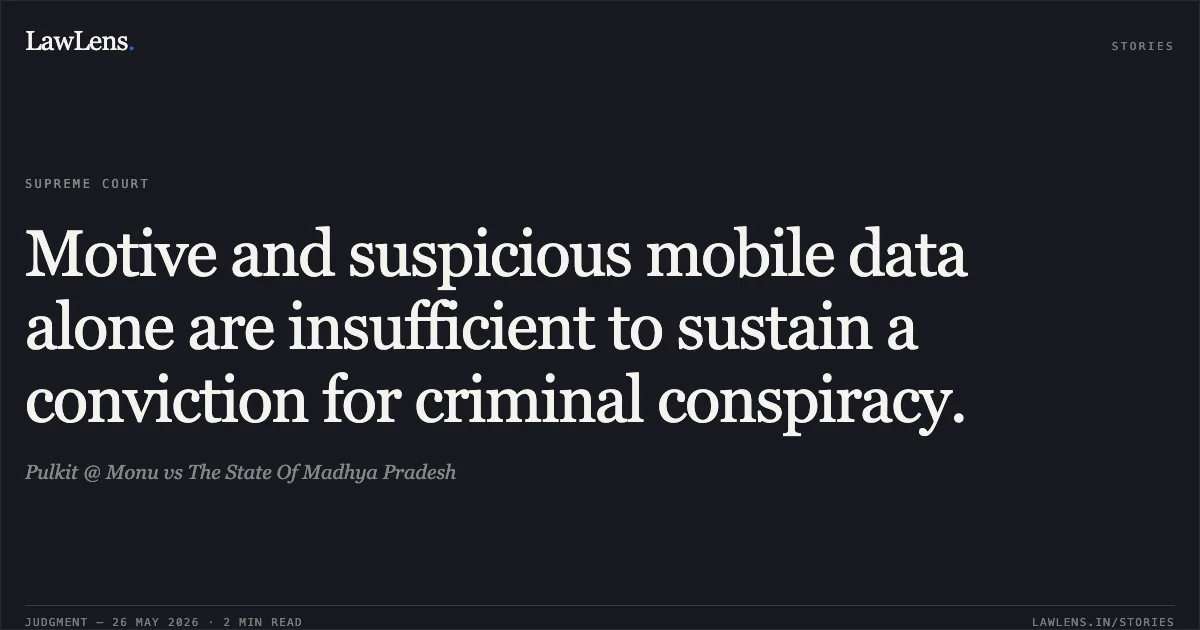
The Supreme Court held that the circumstances were neither proved beyond reasonable doubt nor of a conclusive nature to point solely to the guilt of the appellant.
The Court answered that the chain of circumstances was incomplete and failed to rule out the hypothesis of innocence.
Source reference: para. 19The Court set aside the judgments of the Trial Court and High Court, allowed the appeal, and acquitted the appellant of all charges.
Source reference: para. 21-22Acts & Sections Cited
3 provisions across 2 statutes referred to in this judgment. Each provision opens on LawLens.
Indian Penal Code, 18602
Arms Act, 19591
Original Court PDF
Pulkit @ MonuvsThe State Of Madhya Pradesh
Click to open original judgment
Original judgment, available to read, download and summarize on LawLens.in


