Facts
The appellant was convicted by the Sessions Judge, Jorhat, in Sessions Case No. 169(J-J)/2014 for murdering his brother, Samra Sawtal, by striking him with a naga dao while the deceased was sleeping at home.
Source reference: p. 2, para. 3The incident occurred on 21 September 2014, and the appellant’s daughter, PW-1, lodged the FIR, leading to registration of Borholla P.S. Case No. 82/2014 under Section 302 of the Indian Penal Code (IPC).
Source reference: p. 2, para. 3The Trial Court examined seven prosecution witnesses, convicted the appellant, and sentenced him to life imprisonment with a fine of ₹10,000, with a further six months’ rigorous imprisonment in default of payment.
Source reference: p. 2, paras. 2–4In appeal, the appellant challenged the conviction and sentence.
Source reference: p. 2, paras. 2–4PW-1, the appellant’s daughter, and PW-2, his son, claimed to have witnessed the appellant attack the deceased with a dao.
Source reference: p. 2, para. 5Other witnesses corroborated the immediate disclosure of the incident and observed the deceased’s injuries.
Source reference: pp. 2–3, paras. 6–9The post-mortem revealed two chop wounds, including a deep injury to the back of the head, which was sufficient to cause death in the ordinary course of nature and was homicidal in character.
Source reference: pp. 3–4, para. 8The Investigating Officer seized the naga dao allegedly used in the offence.
Source reference: p. 4, para. 10The appellant denied the allegations in his examination under Section 313 of the Code of Criminal Procedure, 1973 (CrPC), but offered no specific explanation.
Source reference: p. 4, para. 11Issues
1. Whether the prosecution proved beyond reasonable doubt that the appellant intentionally caused the death of his brother, thereby committing murder punishable under Section 302 IPC?
Source reference: pp. 2–5, paras. 3–132. Whether the absence of an established motive, and the possibility that the appellant was intoxicated, created reasonable doubt warranting interference with the conviction?
Source reference: p. 5, para. 123. Whether the conviction and sentence imposed by the Trial Court required appellate interference?
Source reference: p. 5, para. 13Law Applied
The Court applied Section 302 IPC, which prescribes punishment for murder, read with the offence of murder under Section 300 IPC.
Source reference: p. 2, para. 2It applied Section 374 CrPC concerning an appeal against conviction.
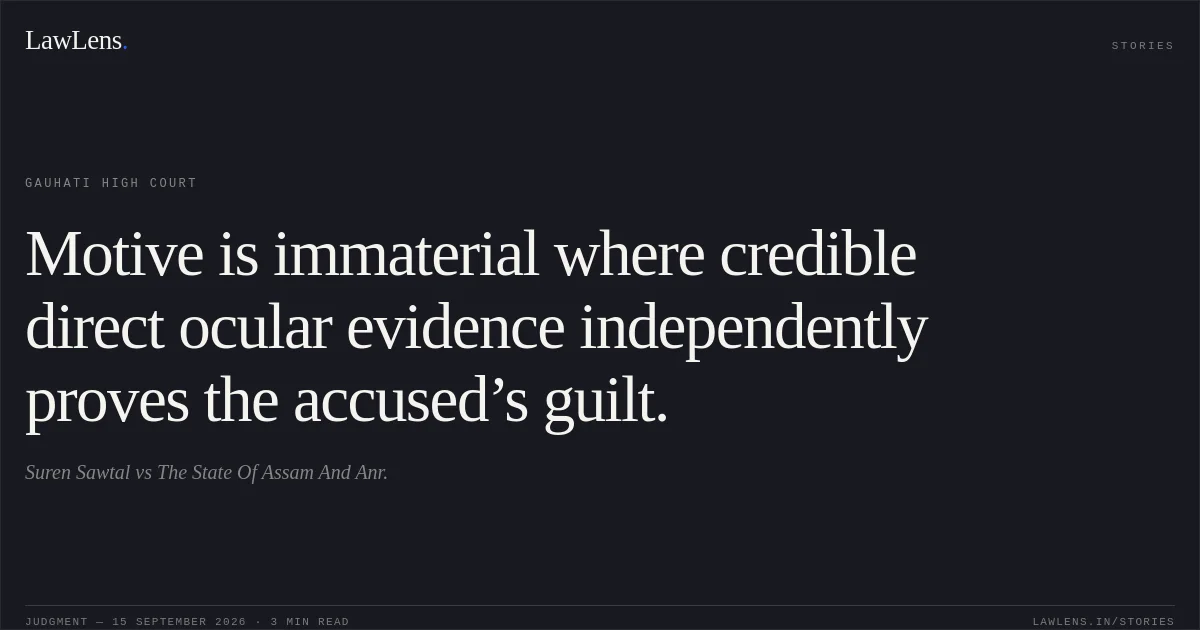
Source reference: p. 2, para. 2The Court relied on the principle that credible and consistent direct ocular testimony can establish guilt even in the absence of proof of motive, and that motive assumes greater significance primarily in cases based on circumstantial evidence.
Source reference: p. 5, para. 12The Court also referred to Section 86 IPC, observing that voluntary intoxication does not ordinarily exempt an accused from criminal liability where the requisite knowledge may be attributed to him.
Source reference: p. 5, para. 12Medical evidence corroborating the eyewitness account was treated as material evidence supporting the prosecution case.
Source reference: pp. 3–4, para. 8Reasoning
The Court found PW-1 and PW-2 to be eyewitnesses whose testimony remained consistent in material particulars and was not discredited in cross-examination.
Source reference: p. 2, para. 5Their evidence was corroborated by PW-3, PW-4, and PW-6, who received immediate disclosures regarding the assault and observed the deceased’s bleeding injuries.
Source reference: pp. 2–4, paras. 6–9The post-mortem evidence established that the deceased had sustained deep chop wounds caused by a heavy sharp-edged weapon and that the head injury was sufficient to cause death in the ordinary course of nature.
Source reference: pp. 3–4, para. 8The seizure of the naga dao further supported the prosecution case.
Source reference: p. 4, para. 10Although no motive was proved, the Court held that motive was not decisive in view of the direct ocular evidence.
Source reference: p. 5, para. 12The suggestion that the appellant’s habitual drunkenness explained the offence did not assist him, particularly because intoxication did not negate liability under Section 86 IPC.
Source reference: p. 5, para. 12The appellant’s bare denial under Section 313 CrPC did not create reasonable doubt.
Source reference: p. 4, para. 11Holding
The Gauhati High Court held that the prosecution proved beyond reasonable doubt that the appellant murdered his brother with a naga dao.
The absence of a proved motive and the alleged intoxication did not undermine the reliable eyewitness and medical evidence.
Source reference: p. 5, para. 12The Court found no ground to interfere with the conviction under Section 302 IPC or the sentence of life imprisonment and fine imposed by the Trial Court, and accordingly dismissed the appeal.
Source reference: p. 5, para. 13The Trial Court Record was directed to be returned, and the Legal Aid Counsel’s fees were ordered to be paid according to the applicable norms.
Source reference: p. 5, paras. 14–15Acts & Sections Cited
5 provisions across 2 statutes referred to in this judgment. Each provision opens on LawLens.
Code of Criminal Procedure, 19732
Indian Penal Code, 18603
Original Court PDF
Suren SawtalvsThe State Of Assam And Anr.
Click to open original judgment
Original judgment, available to read, download and summarize on LawLens.in