Facts
Pale Ram died in a motor-vehicle accident on 1 September 2000 caused by the rash and negligent driving of Truck No. HR-38-E-0063 by respondent No.1. The truck was owned by respondent No.2 and insured with respondent No.3, the insurance company.
Source reference: p.1His wife, three children, and mother instituted a claim petition under Section 166 of the Motor Vehicles Act, 1988.
Source reference: p.1The Motor Accident Claims Tribunal, Panipat, awarded ₹2,53,850 with interest at 9% per annum from the date of filing of the claim petition.
Source reference: pp.1–2The claimants appealed seeking enhancement, principally on the grounds that the deceased’s income had been assessed inadequately, future prospects had not been added, an excessive deduction had been made for personal expenses, and the amount under conventional heads was inadequate.
Source reference: p.3The High Court noted that the original record had been destroyed in a fire and therefore decided the appeal on the basis of the facts and evidence recorded in the Tribunal’s award.
Source reference: p.1Issues
1. Whether the claimants were entitled to enhancement of compensation awarded for the death of Pale Ram in the motor accident?
Source reference: pp.2–3, para. 72. Whether the deceased’s income, future prospects, deduction for personal expenses, multiplier, and amounts under conventional heads had been correctly assessed by the Tribunal?
Source reference: pp.3–5, paras. 8–153. Whether the enhanced compensation was payable jointly and severally by the driver, owner, and insurer, with the primary liability to satisfy the award resting on the insurance company?
Source reference: p.7, para. 17Law Applied
The Court applied Section 166 of the Motor Vehicles Act, 1988, governing claims for compensation arising from motor-vehicle accidents.
Source reference: no citationIt relied on the principle of “just compensation,” holding that compensation must be reasonable and based on established data rather than arbitrariness, windfall, misplaced sympathy, or speculation, as explained in Syed Basheer Ahamed v. Mohd. Jameel.
Source reference: p.3, para. 10Under Sarla Verma v. Delhi Transport Corporation, a deduction of one-fourth of income is appropriate where the deceased leaves five dependants, and the multiplier of 15 applies to a deceased aged 40 years.
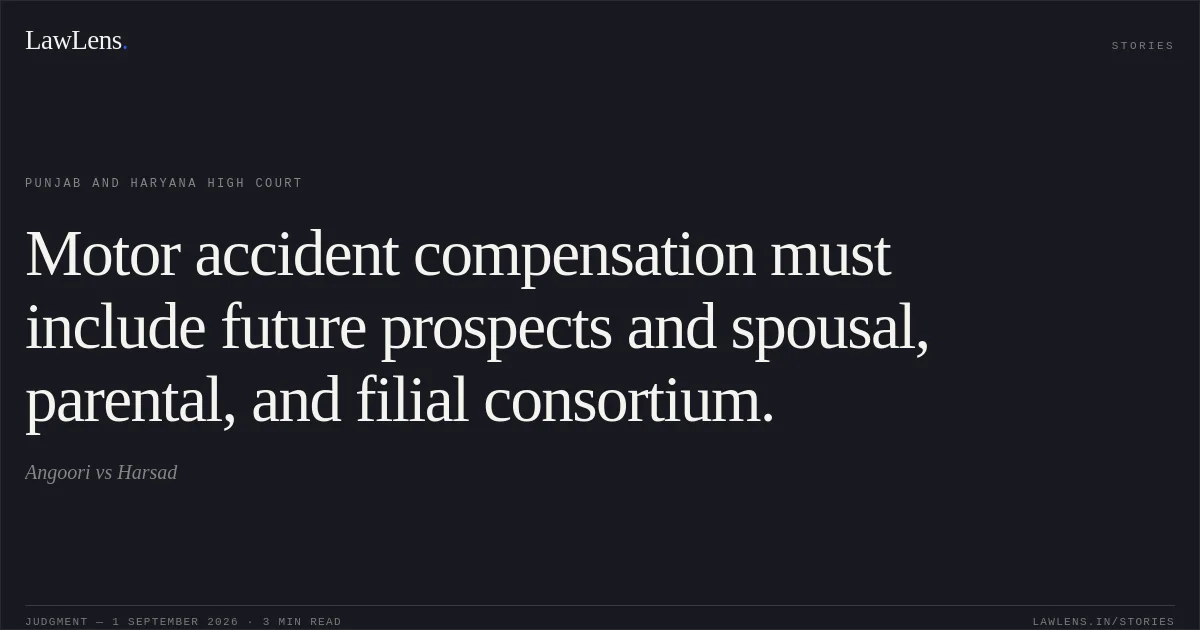
Source reference: pp.4–5, paras. 13–14Under National Insurance Co. Ltd. v. Pranay Sethi, 25% of established income is to be added towards future prospects for a deceased aged 40 years, and specified amounts are awardable under conventional heads.
Source reference: pp.3–5, paras. 8, 12 and 15The Court further relied on Magma General Insurance Co. Ltd. v. Nanu Ram and United India Insurance Co. Ltd. v. Satinder Kaur for awarding parental consortium to the children and filial consortium to the mother.
Source reference: pp.3, 5–6, paras. 8 and 15Reasoning
The finding that the accident resulted from the rash and negligent driving of respondent No.1 had not been challenged and was therefore left undisturbed.
Source reference: p.2, para. 7The Court accepted the salary certificate and testimony of the employer’s accountant showing the deceased’s monthly income as ₹1,905, rounded to ₹1,900.
Source reference: p.4, para. 11Since the deceased was 40 years old, 25% was added for future prospects, resulting in a monthly income of ₹2,375.
Source reference: p.4, para. 12As there were five dependants, the Court deducted one-fourth, or ₹593, towards personal expenses, leaving a monthly dependency loss of ₹1,782 and an annual loss of ₹21,384.
Source reference: p.5, para. 13Applying the multiplier of 15, the loss of dependency was calculated at ₹3,20,760.
Source reference: p.5, para. 14The Court then awarded ₹70,000 to the widow under conventional heads and ₹40,000 each to the three children and the mother for parental and filial consortium, respectively, bringing the total compensation to ₹5,50,760.
Source reference: pp.5–6, paras. 15–16Holding
The appeal was partly allowed.
The total compensation was enhanced from ₹2,53,850 to ₹5,50,760.
Source reference: p.7, para. 17The enhanced amount was therefore ₹2,96,910, rounded off to ₹2,97,000, payable with interest at 9% per annum from 22 September 2000, the date of filing of the claim petition, until realization.
Source reference: p.7, para. 17Respondents No.1 to 3 were held jointly and severally liable, with the primary responsibility to satisfy the award placed upon the insurance company.
Source reference: p.7, para. 17From the enhanced compensation, ₹45,000 each, together with proportionate interest, was directed to be paid to the children and the mother, with the balance payable to the widow.
Source reference: p.7, para. 17Pending miscellaneous applications were also disposed of, and the Registry was directed to communicate the authenticated judgment to the insurer in accordance with the Supreme Court’s directions in Bajaj Allianz General Insurance Co. v. Union of India.
Source reference: p.7, paras. 18–19Acts & Sections Cited
1 provisions across 1 statute referred to in this judgment. Each provision opens on LawLens.
Motor Vehicles Act, 19881
Original Court PDF
AngoorivsHarsad
Click to open original judgment
Original judgment, available to read, download and summarize on LawLens.in