01Facts
The deceased, Jeevanlal Mandavi, died in a motor-vehicle accident on 15 December 2019. His widow, son and mother sought compensation under Section 166 of the Motor Vehicles Act, 1988.
¶ 1–3 · pp. 1–2The Motor Accident Claims Tribunal awarded Rs. 11,95,000, but found that the offending bus was being driven without a valid permit and fastened liability on its owner. The claimants appealed under Section 173, seeking enhancement and an order requiring the insurer to pay the compensation first and recover it from the owner.
¶ 1–3, 12 · pp. 1–2, 402Issues
i.1. Whether the Tribunal’s award should be enhanced by granting separate consortium to each of the three claimants.
¶ 8–11 · pp. 3–4ii.2. Whether, despite the breach arising from the absence of a valid permit, the insurer should first satisfy the award and then recover the amount from the owner.
¶ 12–13 · pp. 4–503Law Applied
Under Sections 166 and 173 of the Motor Vehicles Act, a claimant may seek compensation before the Tribunal and appeal its award.
¶ 7 · p. 2In assessing compensation, National Insurance Co. Ltd. v. Pranay Sethi, (2017) 16 SCC 680, and Sarla Verma v. Delhi Transport Corporation, (2009) 6 SCC 121, guide the assessment of future prospects, personal-expense deductions and the multiplier; Magma General Insurance Co. Ltd. v. Nanu Ram, (2018) 18 SCC 130, was relied on for consortium. The Court applied the principle that consortium is separately payable to each eligible claimant.
¶ 7, 9–10 · pp. 2–4Further, under Amrit Paul Singh v. Tata AIG General Insurance Co. Ltd., (2018) 7 SCC 558, where an insured vehicle is involved in an accident but a policy breach is established, the insurer may be directed to pay the third-party claimants first and recover the amount from the owner.
¶ 13 · pp. 4–5Provisions in the judgment · 2 · Linked ones open on LawLens
Motor Vehicles Act, 1988 Section 173Section 166
04Reasoning
The Court upheld the Tribunal’s assessment of the deceased’s monthly income at Rs. 8,600, as there was no reliable evidence supporting the claimed income of Rs. 30,000. It also found no basis to disturb the 25% addition for future prospects, one-third deduction for personal expenses, multiplier of 14, or the amounts for loss of estate and funeral expenses.
¶ 6–8 · pp. 2–3However, the Tribunal’s single consortium award of Rs. 44,000 could not stand: with three claimants, each was entitled to Rs. 44,000, increasing consortium to Rs. 1,32,000 and total compensation to Rs. 12,83,000. Although the bus lacked a valid permit and the owner was liable for the breach, the vehicle was insured; to protect the third-party claimants, the Court applied the pay-and-recover principle.
¶ 9–13 · pp. 3–505Holding
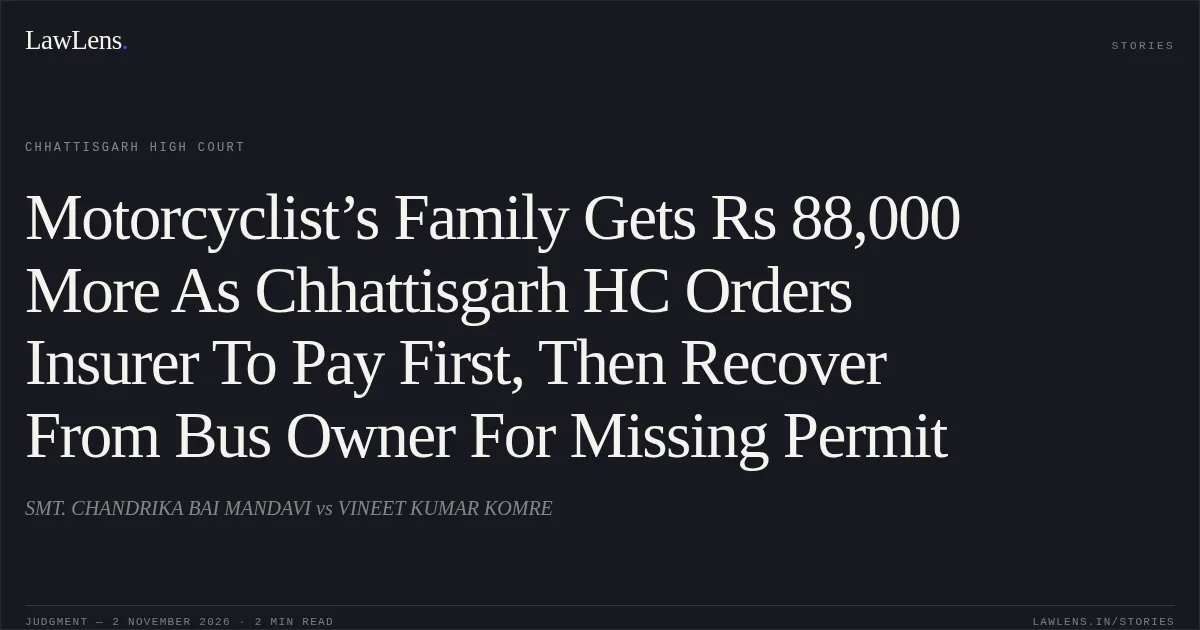
The appeal was allowed in part. Compensation was enhanced from Rs. 11,95,000 to Rs. 12,83,000, leaving an additional Rs. 88,000 payable with interest at 6% per annum from the date of the claim application until realization.
¶ 11, 13–14 · pp. 4–5The insurer was directed to pay the compensation to the claimants first and then recover it from the owner. The remaining terms of the Tribunal’s award were left undisturbed.
¶ 13–14 · pp. 4–5Original Court PDF
SMT. CHANDRIKA BAI MANDAVIvsVINEET KUMAR KOMRE
Click to open original judgment
Original judgment, available to read, download and summarize on LawLens.in