01Facts
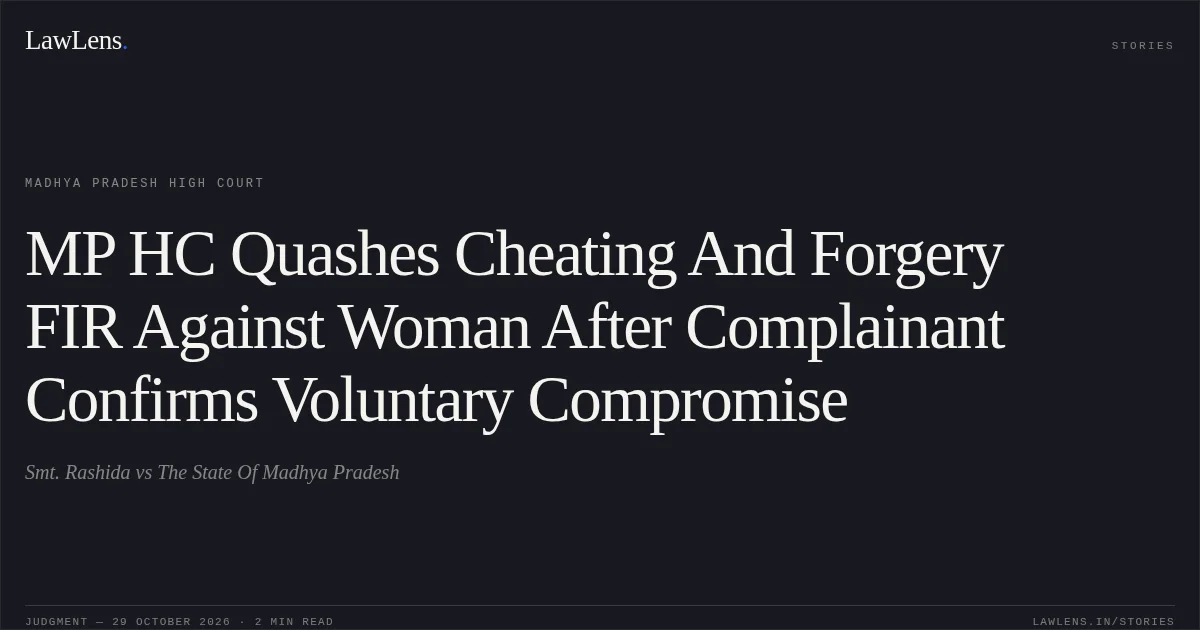
The petitioner sought to quash FIR Crime No. 440/2023, registered at the instance of respondent No. 2 for offences under Sections 420, 467, 468 and 471 of the IPC, and all consequential proceedings, relying on a compromise between the parties.
¶ 1The compromise was verified by the concerned Registrar, who reported that it had been entered into voluntarily, without threat, inducement or coercion.
¶ 2Respondent No. 2 consented to quashing, while the State opposed the petition.
¶ 4–502Issues
i.Whether the High Court should exercise its power under Section 528 of the BNSS to quash the FIR and consequential proceedings for non-compoundable offences on the basis of the parties’ compromise.
¶ 1, 3, 11ii.Whether, in the circumstances of this case, quashing would serve the interests of justice.
¶ 1103Law Applied
Section 528 of the BNSS empowers the High Court to quash criminal proceedings to secure the ends of justice. Relying on Gian Singh v. State of Punjab, Narinder Singh v. State of Punjab, Ramavtar v. State of M.P., and other cited authorities, the Court noted that proceedings for non-compoundable offences may be quashed on compromise in appropriate cases.
¶ 7Under State of Madhya Pradesh v. Laxmi Narayan, such power may be exercised where the dispute is predominantly private or civil in character and has been fully resolved, but ordinarily not for heinous or serious offences having a substantial societal impact.
¶ 9Kapil Gupta v. State of NCT of Delhi further requires consideration of the sufficiency of evidence, the likelihood of conviction, the effect of settlement on the parties’ relationship, and the stage of proceedings.
¶ 8Provisions in the judgment · 8 · Linked ones open on LawLens
Bharatiya Nagarik Suraksha Sanhita, 2023 Section 528
Indian Penal Code, 1860 Section 420Section 467Section 468Section 471Section 376
Code of Criminal Procedure, 1973 Section 482Section 320
04Reasoning
The Court relied on the verified, voluntary compromise and respondent No. 2’s consent to quashing.
¶ 2, 4It found that the dispute was between the parties, that they had restored good relations, and that the prospect of conviction was remote in light of the compromise. Considering the cited principles and the potential for renewed discord if the dispute remained pending, the Court concluded that quashing was appropriate in the interests of justice.
¶ 1105Holding
The Court allowed the petition under Section 528 of the BNSS and quashed FIR Crime No. 440/2023 for offences under Sections 420, 467, 468 and 471 of the IPC, together with all consequential proceedings, insofar as they related to the petitioner.
¶ 12–13The petition was disposed of accordingly.
¶ 12–13Original Court PDF
Smt. RashidavsThe State Of Madhya Pradesh
Click to open original judgment
Original judgment, available to read, download and summarize on LawLens.in