01Facts
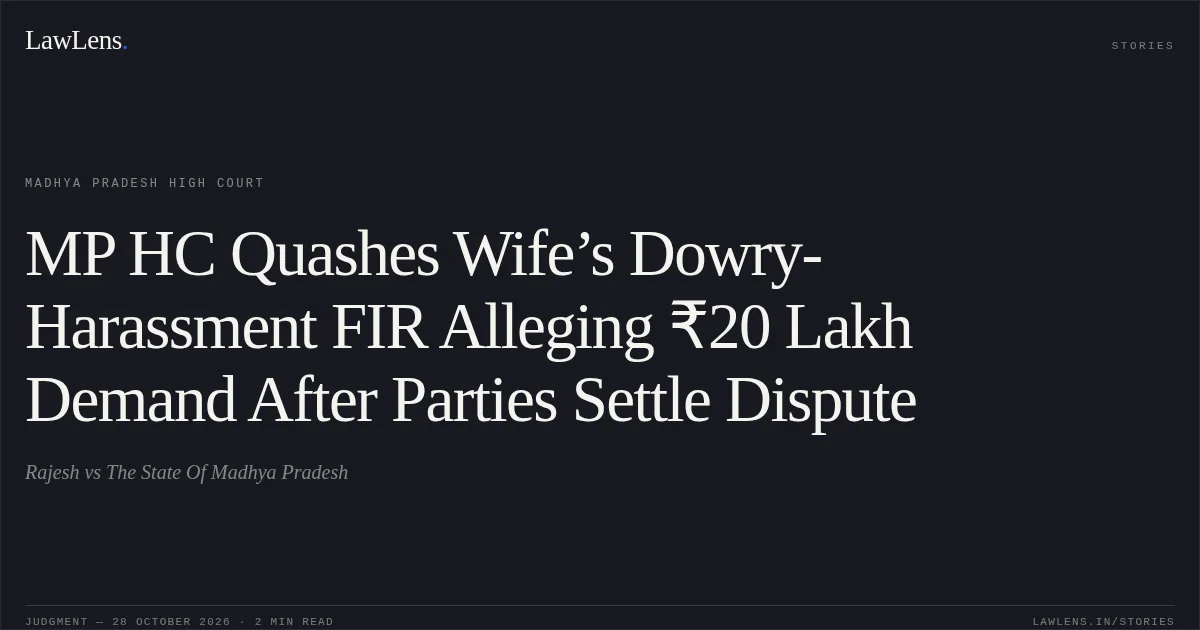
Monika Thakur alleged that, following her marriage to co-accused Yash Thakur on 15 December 2022, her husband and in-laws harassed her for dowry, demanded ₹20,00,000, and that her husband assaulted her.
¶ 2She further alleged that she was driven from the matrimonial home and threatened when the demand was not met.
¶ 2Police registered Crime No. 38/2024 at Police Station Bhairavgarh, Ujjain, under Sections 498A, 506 and 34 of the IPC and Sections 3/4 of the Dowry Prohibition Act.
¶ 2The petitioners sought quashing of the FIR and subsequent proceedings under Section 528 of the Bharatiya Nagarik Suraksha Sanhita, 2023, relying on an amicable settlement.
¶ 1The compromise was verified by the Principal Registrar, and respondent No. 2 did not object to quashing.
¶ 3–4, 602Issues
i.Whether the High Court should quash the FIR and consequential proceedings for alleged matrimonial and dowry-related offences on the basis of the parties’ settlement, although the offences are non-compoundable.
¶ 3, 5–6ii.Whether, in light of the verified compromise and respondent No. 2’s lack of objection, continuing the criminal proceedings would serve the ends of justice.
¶ 4, 603Law Applied
Section 528 of the Bharatiya Nagarik Suraksha Sanhita, 2023, provides the basis invoked for the High Court’s inherent jurisdiction to quash proceedings.
The Court applied Gian Singh v. State of Punjab, (2012) 10 SCC 303, which distinguishes quashing under the High Court’s inherent powers from compounding under Section 320 of the Code of Criminal Procedure.
¶ 5Under Gian Singh, the High Court may quash non-compoundable offences where the dispute is predominantly personal or matrimonial, the parties have settled it, and continuation of the proceedings would be futile or defeat the ends of justice; settlement ordinarily cannot justify quashing grave offences or offences with serious societal impact.
¶ 5Provisions in the judgment · 6 · Linked ones open on LawLens
Bharatiya Nagarik Suraksha Sanhita, 2023 Section 528
Indian Penal Code, 1860 Section 506Section 34
Dowry Prohibition Act, 1961 Section 3Section 4
Code of Criminal Procedure, 1973 Section 320
04Reasoning
The allegations arose from a matrimonial and dowry dispute, and the parties had amicably resolved their dispute through a compromise verified by the Principal Registrar.
¶ 2–4Respondent No. 2 had no objection to quashing the FIR and consequential proceedings.
¶ 6Applying Gian Singh, the Court considered that the dispute was one in which settlement could support the exercise of inherent jurisdiction and concluded that continuing the proceedings would serve no purpose and would not advance the ends of justice.
¶ 5–605Holding
The Court allowed the petition and quashed Crime No. 38/2024, registered under Sections 498A, 506 and 34 of the IPC and Sections 3/4 of the Dowry Prohibition Act, together with all consequential proceedings pending against the petitioners.
¶ 6–7The petition was disposed of on the terms of the compromise.
¶ 6–7Original Court PDF
RajeshvsThe State Of Madhya Pradesh
Click to open original judgment
Original judgment, available to read, download and summarize on LawLens.in