01Facts
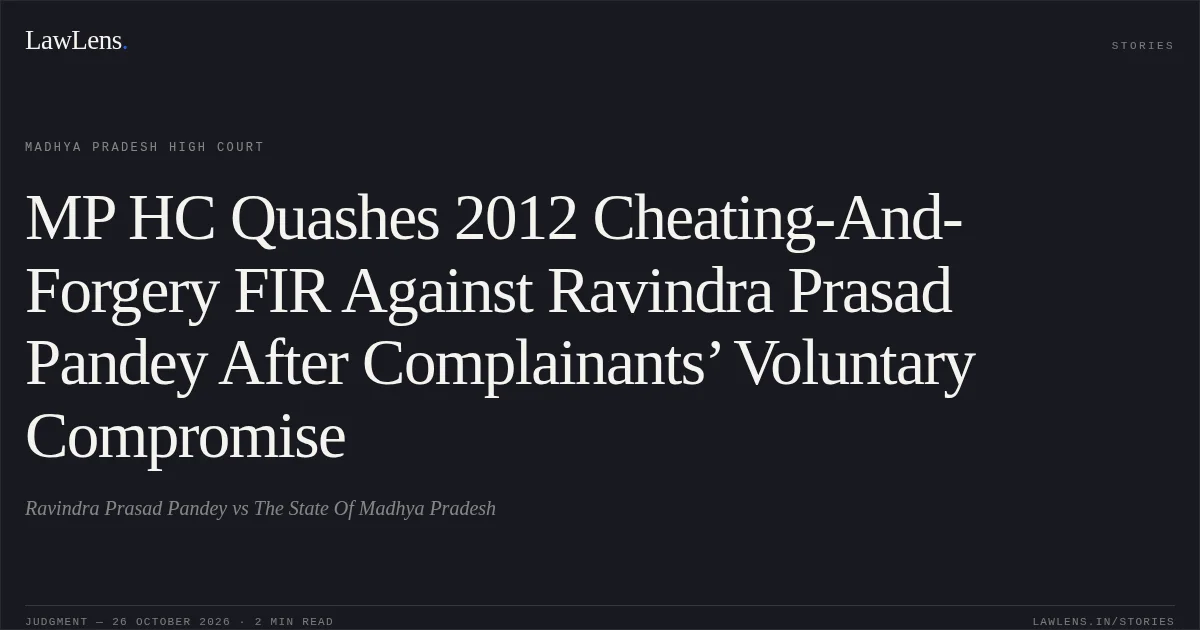
The petitioner sought quashing under Section 528 of the Bharatiya Nagarik Suraksha Sanhita, 2023, of Crime No. 526/2012 registered at Police Station Bahodapur, Gwalior, for offences under Sections 406, 420, 467, 468, 471 and 419 of the Indian Penal Code, together with the consequential proceedings in S.T. No. 150/2021.
¶ 1The petitioner and respondent-complainants sought to resolve the dispute by compromise. Their applications and affidavits were verified by the Principal Registrar, who reported that the compromise was voluntary and free from threat, inducement or coercion.
¶ 2–3The State opposed the petition, while the complainants supported it.
¶ 5–6The Court also noted that proceedings concerning two co-accused had previously been quashed.
¶ 1102Issues
i.Whether the FIR and consequential proceedings for the alleged non-compoundable IPC offences could be quashed on the basis of the parties’ compromise.
¶ 1, 9–10ii.Whether the compromise was voluntary and sufficient, in the circumstances, to justify quashing the proceedings against the petitioner.
¶ 2–3, 10–1303Law Applied
The Court relied on the High Court’s inherent jurisdiction, referring to Section 528 of the BNSS in the petition’s description and to Section 482 of the Code of Criminal Procedure in its reasoning, to prevent abuse of process and secure the ends of justice.
¶ 1, 10It applied the principle that criminal proceedings for non-compoundable offences may, in appropriate cases, be quashed on compromise where continuation would serve no useful purpose.
¶ 9In support, it cited Jagdish Channa v. State of Haryana, Madan Mohan Abbot v. State of Punjab, Shiji v. Radhika, Narinder Singh v. State of Punjab, B.S. Joshi v. State of Haryana, Gian Singh v. State of Punjab and Parbatbhai Ahir v. State of Gujarat.
¶ 9Provisions in the judgment · 8 · Linked ones open on LawLens
Bharatiya Nagarik Suraksha Sanhita, 2023 Section 528
Indian Penal Code, 1860 Section 406Section 420Section 467Section 468Section 471Section 419
Code of Criminal Procedure, 1973 Section 482
04Reasoning
The Court accepted the Registrar’s verification that the parties had entered into the compromise voluntarily and noted that the complainants supported the petitioner’s request.
¶ 3–6Applying the cited authorities, it concluded that continuation of the trial would be a futile exercise and would serve no purpose.
¶ 10It also noted the prior quashing of proceedings against two co-accused.
¶ 11On that basis, it allowed the compromise applications and quashed the proceedings against the petitioner.
¶ 12–1305Holding
The Court allowed the petition and quashed Crime No. 526/2012 and the consequential proceedings in S.T. No. 150/2021, insofar as they concerned Ravindra Prasad Pandey, on the basis of the compromise.
¶ 12–14Original Court PDF
Ravindra Prasad PandeyvsThe State Of Madhya Pradesh
Click to open original judgment
Original judgment, available to read, download and summarize on LawLens.in