01Facts
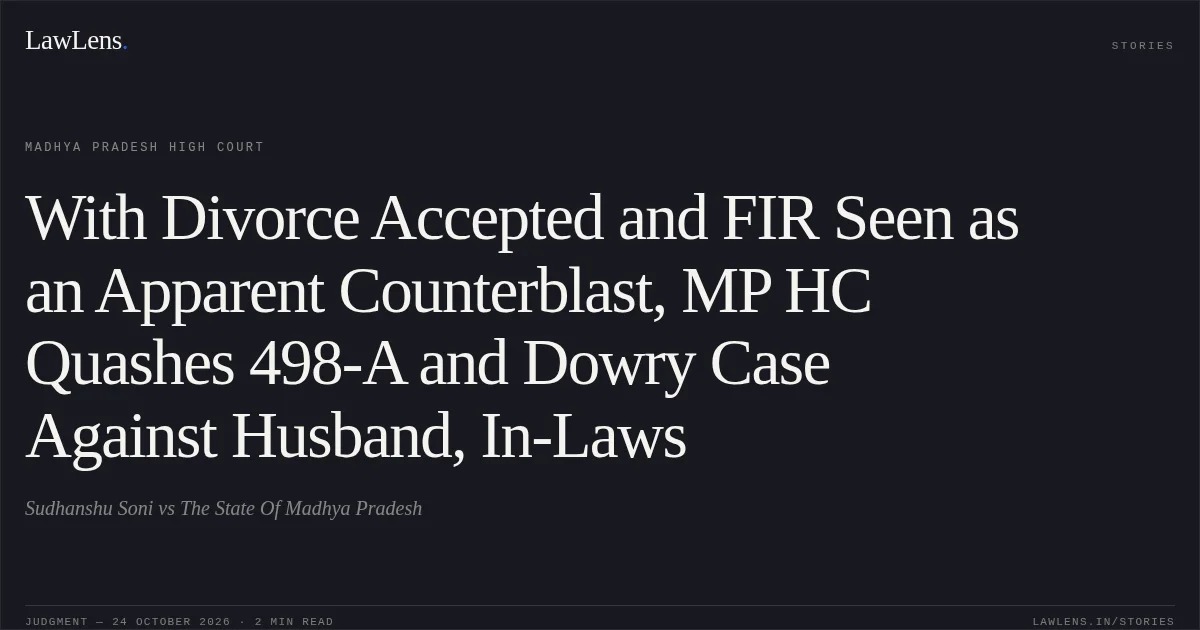
The petitioners—the husband and his parents—sought quashing of an FIR registered under Section 498-A of the Indian Penal Code and Sections 3 and 4 of the Dowry Prohibition Act, 1961.
¶ 1The parties married in 2009 and began living separately in 2018.
¶ 2The petitioners contended that the wife lodged the FIR after the husband filed a divorce petition and that it was a counterblast; the FIR was registered on 8 December 2018, after notices in the divorce petition had issued.
¶ 2, 8During the quashing proceedings, the wife obtained an ex parte divorce decree on 15 November 2021. The husband did not challenge it and stated that he accepted the divorce.
¶ 3, 9The wife’s remarriage was disputed.
¶ 4–502Issues
i.1. Whether the FIR and consequential proceedings under Section 498-A IPC and Sections 3 and 4 of the Dowry Prohibition Act should be quashed in light of the circumstances suggesting that the FIR followed the husband’s divorce petition.
¶ 8ii.2. Whether the parties’ divorce and accepted separation justified quashing the criminal proceedings against the husband and his parents.
¶ 9, 11–1203Law Applied
Section 498-A IPC addresses cruelty by a husband or his relatives, while Sections 3 and 4 of the Dowry Prohibition Act address giving or taking dowry and demanding dowry.
¶ 10The Supreme Court’s decision in Kahkashan Kausar @ Sonam v. State of Bihar, 2022 SCC OnLine SC 162, cautions against allowing matrimonial complaints based on general or omnibus allegations to result in misuse of criminal process, particularly against relatives without a prima facie case.
¶ 10The Court also relied on Mangeram v. State of M.P. & Anr., 2025 INSC 962, for the principle that, in the circumstances of an accepted and inevitable separation, continuing criminal proceedings against the husband’s family members may serve no useful purpose and may prolong bitterness, contrary to the ends of justice.
¶ 1104Reasoning
The Court noted that the FIR was lodged after notices were issued in the husband’s divorce petition, lending some support to the petitioners’ contention that it was a counterblast.
¶ 8It also considered that the parties had been living separately since 2018, their marriage had ended by a divorce decree that the husband accepted, and their separation was therefore no longer in dispute.
¶ 7, 9, 11Applying the principles in Kahkashan Kausar and Mangeram, the Court concluded that continuing the prosecution in these circumstances would prolong bitterness and serve no useful purpose.
¶ 10–1105Holding
The Court allowed the petition and quashed the FIR registered under Section 498-A IPC and Sections 3 and 4 of the Dowry Prohibition Act, together with all consequential proceedings arising from it.
¶ 12Original Court PDF
Sudhanshu SonivsThe State Of Madhya Pradesh
Click to open original judgment
Original judgment, available to read, download and summarize on LawLens.in