01Facts
Govindram sued for a declaration that his name be entered in the municipal property-tax register as occupier and taxpayer of House No. 60, Janta Market, Mandsaur.
¶ 2–3The trial court dismissed the suit, but the First Appellate Court declared Govindram entitled to registration and also declared that the Municipal Council was entitled to recover deficit development tax and compounding fees from him.
¶ 2–3, 13–14The Council had filed no counterclaim, and neither party appealed the appellate decree.
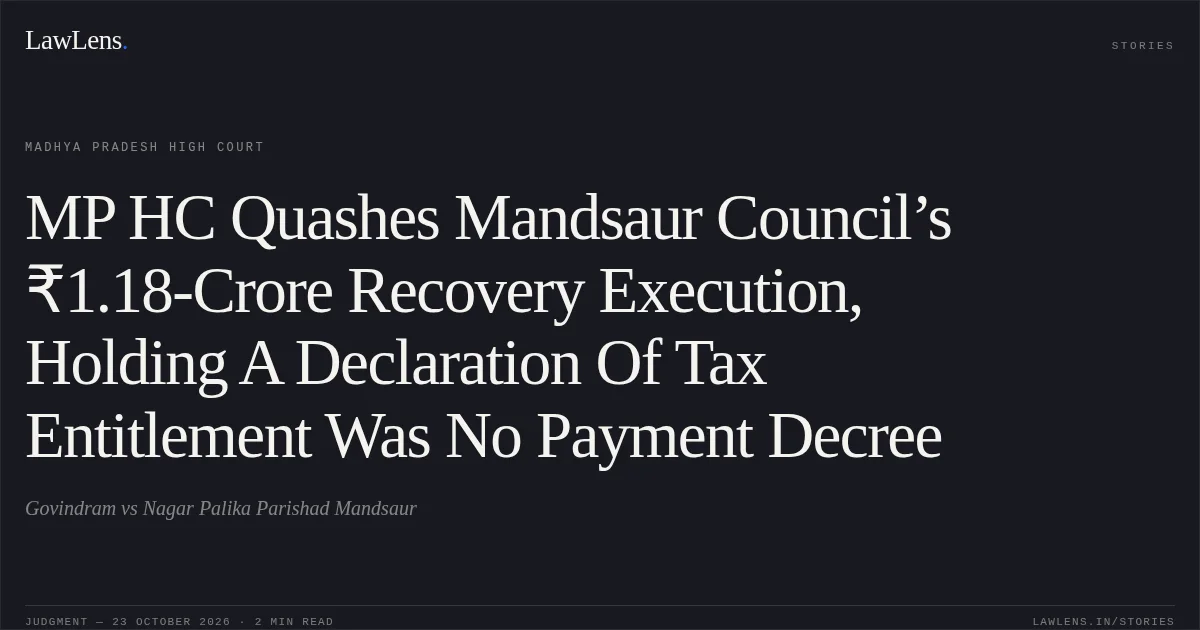
¶ 2–3, 13–14After Govindram’s execution for entry of his name was satisfied, the Council filed a separate execution seeking recovery of ₹1,18,54,484.
¶ 4–6, 13The executing court rejected Govindram’s objection that the declaratory decree was not executable, prompting this revision.
¶ 4–6, 1302Issues
i.Whether a decree merely declaring the Municipal Council’s entitlement to development tax and compounding fees, without a counterclaim or a direction for payment, is executable to recover money from Govindram.
¶ 14–15ii.Whether the executing court could order recovery of an amount not expressly granted by the decree.
¶ 7–9, 15–1603Law Applied
Section 51 read with Order XXI Rule 10 of the Code of Civil Procedure, 1908, governs execution of decrees; a declaratory decree that does not direct a judgment-debtor to do or refrain from doing a specific act is not executable.
¶ 15–17An executing court must act within the terms of the decree and cannot add consequential relief or order recovery that the decree does not grant.
¶ 15–17The Court applied Prakash Chand Khurana v. Harnam Singh, 1973 (2) SCC 484; State of Punjab v. Buta Singh, 1995 Supp (3) SCC 684; and State of Madhya Pradesh v. Mangilal Sharma, 1998 (2) SCC 510, which affirm these principles.
¶ 15–17Provisions in the judgment · 3 · Linked ones open on LawLens
Code of Civil Procedure, 1908 Section 115Section 51
Specific Relief Act, 1963 Section 34
04Reasoning
The appellate decree declared the Council’s entitlement to receive the taxes and fees but did not direct Govindram to pay a specified sum or otherwise command payment.
¶ 14–18Because the Council had filed no counterclaim and paid no court fees, the decree could not be treated as one granting monetary recovery.
¶ 14–18Permitting execution for ₹1,18,54,484 would therefore add relief beyond the decree and exceed the executing court’s jurisdiction.
¶ 14–18The fact that the decree had attained finality did not make its declaratory terms executable.
¶ 14–1805Holding
The Court held that the Council could not execute the declaratory decree to recover the claimed amount.
¶ 18–20It allowed the civil revision, set aside the executing court’s order dated 09.05.2024, and quashed Execution Case No. 24-A/2019.
¶ 18–20No order as to costs.
¶ 18–20Original Court PDF
GovindramvsNagar Palika Parishad Mandsaur
Click to open original judgment
Original judgment, available to read, download and summarize on LawLens.in