01Facts
The petitioner was appointed on a contractual basis as a Technical Member under the Rajiv Gandhi Jal Grahan Kshetra Prabandhan Mission on 16 July 2012.
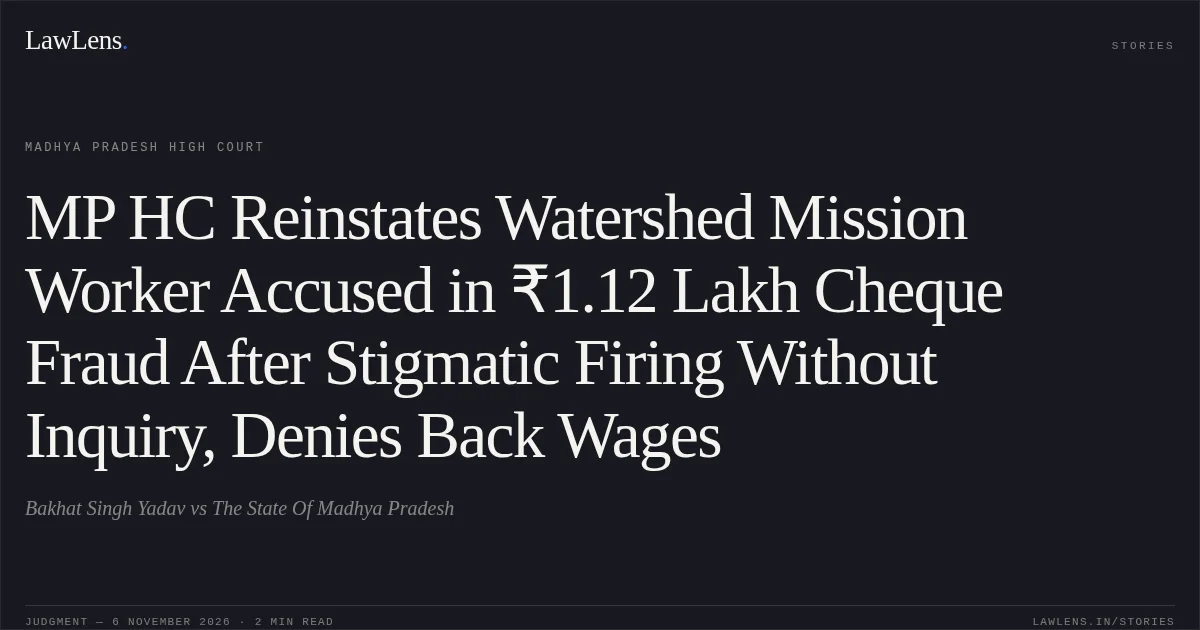
¶ 2After issuing a show-cause notice alleging irregularities, the authorities received the petitioner’s reply but terminated his services on 19 November 2014. The termination order alleged his involvement in preparing fabricated documents that resulted in an inflated payment to a contractor.
¶ 5–6The petitioner challenged the termination, contending that it was stigmatic and had been made without a regular departmental inquiry.
¶ 2, 5–6After earlier proceedings, the appellate authority rejected his appeal on 21 October 2026; the petitioner then sought to quash both the termination and appellate orders.
¶ 202Issues
i.1. Whether the petitioner’s contractual services could be terminated by a stigmatic order alleging misconduct without a regular departmental inquiry and proper opportunity to respond.
¶ 6–9ii.2. Whether the appellate authority’s rejection of the appeal could stand where the original termination order was passed without the required inquiry and consideration of the petitioner’s reply.
¶ 14–16, 1903Law Applied
Under Article 226 and the principles of natural justice, a termination founded on alleged misconduct and carrying stigma cannot be made without a proper inquiry and an effective opportunity to answer the allegations, even where the employee is temporary or contractual.
¶ 8–13Khem Chand v. Union of India describes a reasonable opportunity as including notice of the charges, an opportunity to meet the evidence, and an opportunity to make a representation.
¶ 8Under Parshotam Lal Dhingra v. Union of India, the substance and consequences of an order—not merely its form or terminology—determine whether it is punitive.
¶ 18Kranti Associates Pvt. Ltd. v. Masood Ahmed Khan and Oryx Fisheries Pvt. Ltd. v. Union of India affirm that decisions affecting rights must give reasons, and that reasons supplied on appeal do not cure their absence from the original decision.
¶ 14–1504Reasoning
The termination order expressly attributed the alleged fabricated documents and resulting payment to the petitioner, making it stigmatic and founded on alleged misconduct, rather than an innocuous contractual termination.
¶ 5, 9, 16No charge-sheet or regular departmental inquiry had been conducted, and the Court found that the petitioner’s reply had not been considered.
¶ 6, 16Applying the principles governing punitive termination and procedural fairness, the Court held that the contractual nature of the appointment did not justify dispensing with an inquiry in these circumstances. The appellate authority’s order could not cure the defects in the original termination.
¶ 15, 1905Holding
The Court allowed the petition and set aside both the termination order dated 19 November 2014 and the appellate rejection order dated 21 October 2026.
¶ 19The respondents were directed to reinstate the petitioner within three months of receiving a certified copy of the order. Back wages were denied under the principle of “no work, no pay,” but notional seniority at par with similarly situated persons was granted. The State remained at liberty to proceed against the petitioner in accordance with law.
¶ 20Original Court PDF
Bakhat Singh YadavvsThe State Of Madhya Pradesh
Click to open original judgment
Original judgment, available to read, download and summarize on LawLens.in