01Facts
The petitioner, a member of the Meena community, received a Scheduled Tribe certificate in 1991 while Meena was notified as an ST in Sironj Sub-Division, District Vidisha.
pp. 2–4Before appointing him as Deputy Superintendent of Police in 1999, the State conducted verification and confirmed the certificate’s genuineness.
pp. 2–4After a 2016 cancellation was set aside, the matter was remanded for fresh, independent scrutiny.
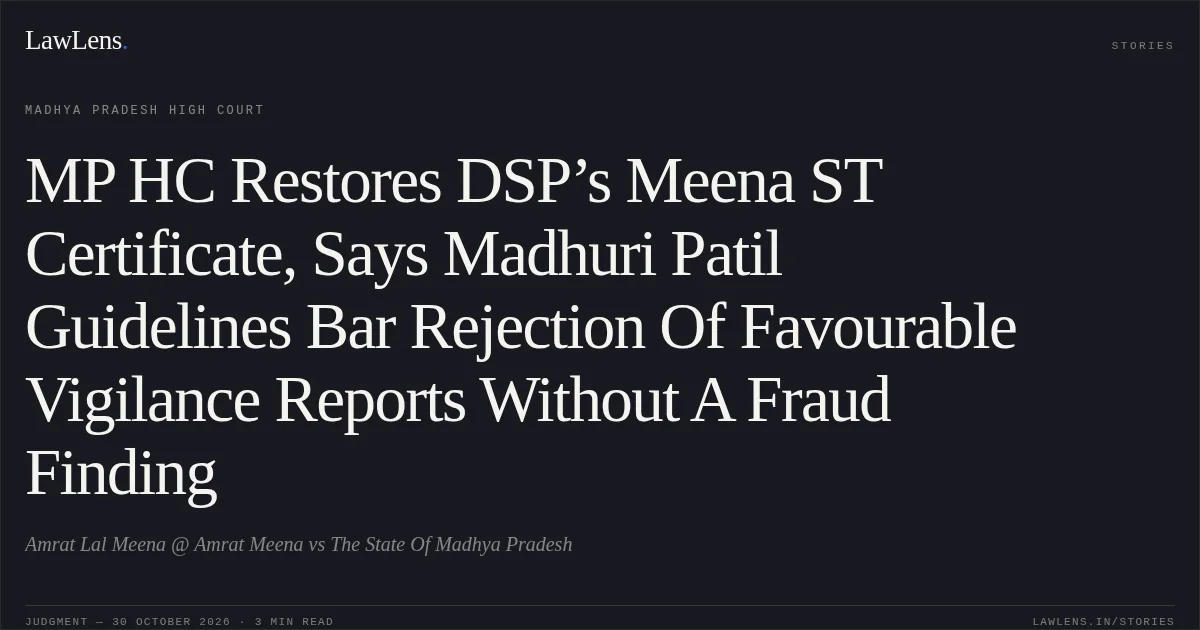
p. 6In 2025, the Superintendents of Police of Vidisha and Guna submitted fresh field reports in the petitioner’s favour, but the Scrutiny Committee rejected them and cancelled the certificate again on 9 December 2025.
pp. 6–9The petitioner challenged that order under Article 226.
p. 202Issues
i.Whether third-party complainants without a legally protected interest could intervene in the petitioner’s writ petition.
pp. 11–14ii.Whether the Scrutiny Committee could reject two favourable vigilance reports and cancel the certificate without finding that either report was procured, false, or fraudulently obtained.
pp. 14–20iii.Whether the Committee’s reliance on earlier inquiry material, and its failure to address the petitioner’s jurisdictional objection, vitiated the impugned order.
pp. 22–3003Law Applied
Under Kumari Madhuri Patil v. Addl. Commissioner, Tribal Development, (1994) 6 SCC 241, paras. 13.5–13.7, the Vigilance Cell investigates a caste-status claim; where its report supports the claim, no further action is required unless the report or particulars are shown to have been procured or to be false or fraudulently obtained.
pp. 15–17Clause 3 of Appendix-1 to the Madhya Pradesh GAD Order dated 8 September 1997 likewise directs that no action is necessary when the vigilance report favours the applicant.
pp. 17–19Dayaram v. Sudhir Batham, (2012) 1 SCC 333, explains that scrutiny committees verify caste certificates and that certificates issued after proper inquiry do not ordinarily require further verification; a regular official act is presumed to have been properly performed, subject to rebuttal by appropriate evidence.
pp. 24–27Under Ravi Yashwant Bhoir v. District Collector, Raigad, (2012) 4 SCC 407, an order may be vitiated by malice in law where an authority acts in conscious disregard of legal safeguards or affected rights.
pp. 27–28A complainant without a legal injury cannot claim status as an adversarial party in a writ proceeding.
pp. 12–14Provisions in the judgment · 1
Indian Evidence Act, 1872 Section 114
04Reasoning
The Court held that both fresh field inquiries, commissioned by the Committee after remand, supported the petitioner, and the Committee made no finding that either report was procured or fraudulent.
pp. 19–20Its rejection of the reports for relying on oral evidence and lacking unavailable historical records did not satisfy the limited exception in Guideline 13.7 and Clause 3; the petitioner had produced official confirmation that relevant revenue records had been destroyed or were unavailable.
pp. 20–22The Committee also relied on pre-remand CID material despite the direction to conduct fresh, independent scrutiny, and failed to give reasons addressing the petitioner’s specific jurisdictional objection.
pp. 22–24, 28–29The Court therefore found the decision-making process contrary to the governing procedure and affected by non-application of mind and malice in law.
pp. 27–30The proposed intervenors had shown no personal legal injury and lacked standing to participate as adversarial parties.
pp. 12–1405Holding
The Court dismissed the three intervention applications for lack of locus standi.
p. 14It allowed the writ petition, quashed the Scrutiny Committee’s order dated 9 December 2025 and consequential proceedings, and restored and affirmed the petitioner’s caste certificate dated 29 October 1991. No further remand was ordered; there was no order as to costs.
pp. 30–31Original Court PDF
Amrat Lal Meena @ Amrat MeenavsThe State Of Madhya Pradesh
Click to open original judgment
Original judgment, available to read, download and summarize on LawLens.in