01Facts
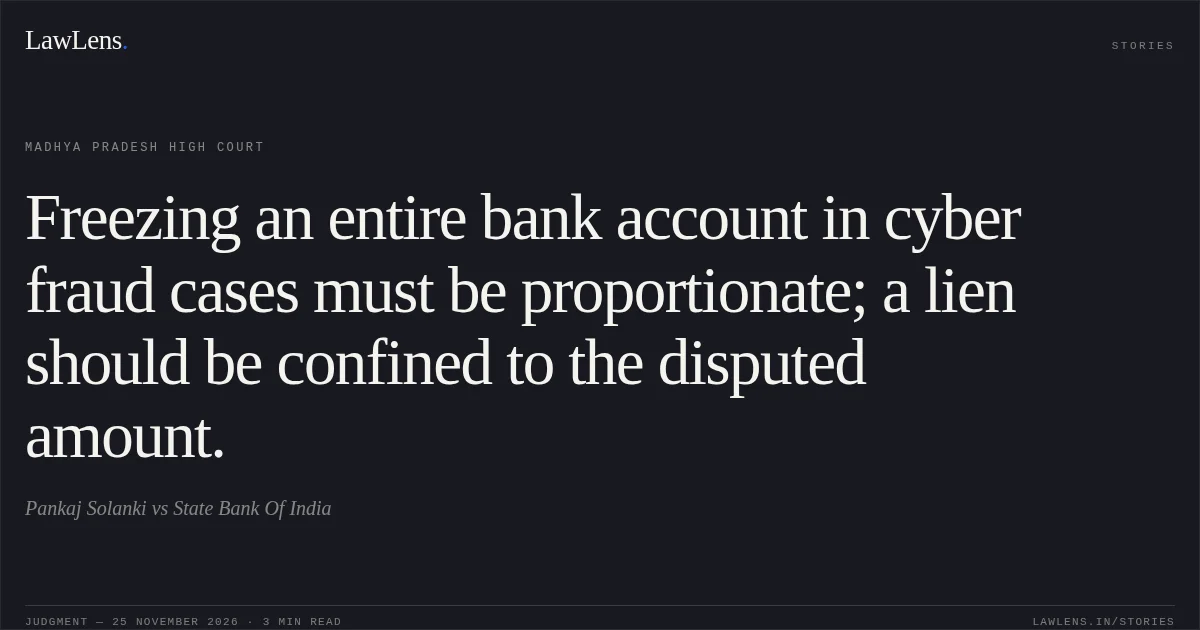
The petitioner sought relief under Article 226 of the Constitution for the de-freezing of his State Bank of India account.
¶ 1He relied on Malcolm Murayis & Ors. v. State Bank of India & Ors. and on the guidelines concerning cybercrime-related account freezes discussed in Archana v. State of Madhya Pradesh & Ors.
¶ 2–4The Court recorded that the disputed amount in the present case was ₹4,140 and that the petitioner’s bank account remained frozen.
¶ 602Issues
i.Whether the petitioner’s account should be de-frozen while the disputed amount of ₹4,140 is separately secured.
¶ 5–6ii.Whether the disputed amount should remain secured pending action by the competent Judicial Magistrate, and what should follow if no such order is passed within the specified period.
¶ 603Law Applied
The Court applied Article 226 and followed Malcolm Murayis, which directed that disputed funds be kept in fixed deposits pending appropriate proceedings, with release to the account holder if the competent Magistrate did not pass an order within three months.
¶ 3It also applied the approach in Archana, including the Standard Operating Procedure dated 10 April 2026 and its proportionality principles: account restraints should be no broader than necessary to secure the suspected proceeds, and the legitimate operation of an account should not be unnecessarily impeded.
¶ 4 (quoting Archana · ¶ 11–18)The Court further directed the police agency to proceed under the relevant provisions of the BNSS or other applicable law.
¶ 6Provisions in the judgment · 1 · Linked ones open on LawLens
Code of Criminal Procedure, 1973 Section 102
04Reasoning
The Court considered Malcolm Murayis and Archana applicable mutatis mutandis.
¶ 5Applying their approach to the amount identified in this case, it concluded that ₹4,140 could be preserved in a fixed deposit without continuing to freeze the petitioner’s entire account.
¶ 6This balanced the need to secure the disputed sum against the petitioner’s ability to operate the account, while allowing the police agency time to seek the competent Magistrate’s orders.
¶ 605Holding
The petition was disposed of with directions to keep ₹4,140 in a fixed deposit and to unfreeze the petitioner’s account so that he could operate it.
¶ 6The fixed deposit may be liquidated only after orders are passed by the competent Judicial Magistrate within three months; if no such order is passed within that period, the petitioner may withdraw the amount, under intimation to the police agency.
¶ 6The Bank may take appropriate action in accordance with law if it receives a complaint concerning another transaction.
¶ 6Original Court PDF
Yash ShilawatvsState Bank Of India
Click to open original judgment
Original judgment, available to read, download and summarize on LawLens.in