01Facts
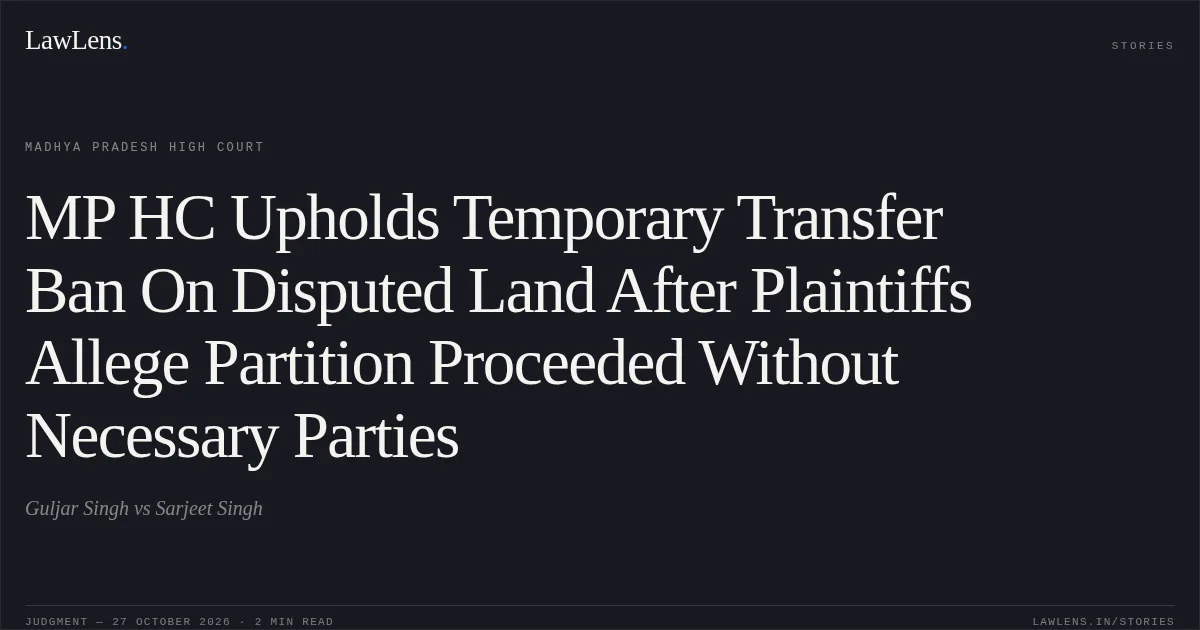
The plaintiffs sued for declarations that the suit land was jointly owned and that a partition order dated 2 May 2025, passed by the Naib Tehsildar, was void; they also sought a permanent injunction against alienation.
¶ 2They alleged that partition proceedings had been conducted without necessary parties and that the resulting revenue mutations were based on an illegal order.
¶ 2The trial court rejected their application for temporary injunction, relying on the mutation entries and finding no prima facie case.
¶ 4On appeal, the Second District Judge reversed that decision and restrained the defendants from alienating or transferring the property during the suit.
¶ 5The defendants challenged the appellate order under Article 227.
¶ 102Issues
i.1. Whether the appellate court was justified in restraining the defendants from alienating the suit property during the pendency of the suit.
¶ 5, 8–11ii.2. Whether the trial court properly rejected temporary relief by relying on revenue mutations made pursuant to the challenged partition order.
¶ 4, 803Law Applied
Under Order XXXIX Rules 1 and 2 of the Code of Civil Procedure, temporary injunctive relief may be granted where the plaintiff raises a triable issue; a prima facie case does not require proof of a complete or conclusive case at the interim stage.
¶ 9In Maharwal Khewaji Trust (Regd.) v. Baldev Dass, (2004) 8 SCC 488, the Supreme Court held that, absent an adequate basis to permit a change in the nature of the property, courts should ordinarily prevent alienation or transfer that could cause loss to the party ultimately succeeding or lead to multiplicity of proceedings.
¶ 7The High Court’s supervisory jurisdiction under Article 227 was invoked to review the appellate order.
¶ 1, 1104Reasoning
The plaintiffs’ claims of joint ownership and their challenge to the partition order raised a triable issue.
¶ 8–9The trial court therefore erred in treating mutations made pursuant to that challenged order as sufficient grounds to reject interim relief.
¶ 8–9Alienation could frustrate the suit and generate further litigation, whereas restraining alienation would not cause irreparable hardship to the defendants.
¶ 9The appellate order was limited to alienation and did not affect possession; any interference with the defendants’ possession could be addressed by an application before the trial court.
¶ 1005Holding
The High Court held that the appellate court’s order restraining alienation was just and proper and disclosed no ground for interference under Article 227.
¶ 11The petition was dismissed, and the appellate order was upheld.
¶ 11Original Court PDF
Guljar SinghvsSarjeet Singh
Click to open original judgment
Original judgment, available to read, download and summarize on LawLens.in