Facts
The petitioners were companies engaged in the manufacture, bottling and supply of liquor in Madhya Pradesh under various licences, including D-1, F.L.-9, B-3, C.S.-1 and C.S.-1B licences.
Source reference: pp. 24–29; paras A-1 to A-4Although certain directors, employees and transport personnel were convicted, neither petitioner-company was arraigned as an accused or convicted in the criminal proceedings.
Source reference: pp. 24–29; paras A-1 to A-4The Excise Commissioner issued a show-cause notice dated 26 February 2024 proposing cancellation of the petitioners’ licences under Section 31 of the Madhya Pradesh Excise Act, 1915, relying upon the convictions.
Source reference: pp. 27–32; paras A-3 to A-8On 4 February 2026, the Commissioner suspended all the petitioners’ licences for the remaining period of 2025–26.
Source reference: pp. 27–32; paras A-3 to A-8After the licensing year expired on 31 March 2026, the Division Bench directed the authorities to consider the petitioners’ applications for renewal independently and without being prejudiced by the earlier order of suspension.
Source reference: p. 32; para A-8On 18 June 2026, within approximately twenty-four hours, the Excise Commissioner passed a 175-page order rejecting renewal of all licences.
Source reference: pp. 32–43; paras A-9 to A-21The petitioners’ technical bids were rejected for want of an operational licence.
Source reference: pp. 43–52; paras A-23 to A-29Issues
Whether the Excise Commissioner could reject renewal of the petitioners’ licences by relying on Sections 31 and 44 of the Madhya Pradesh Excise Act, 1915, particularly when the petitioner-companies had not been prosecuted or convicted and the licensing year covered by the earlier suspension had already expired?
Source reference: pp. 32–38; paras A-8 to A-15Whether the alleged suppression of information, government dues, pending excise proceedings, and deficiencies in fire, electrical and other statutory compliances justified refusal of renewal under Rule 3(11) of the Madhya Pradesh Distillery Rules, 1995 and the applicable excise rules?
Source reference: pp. 36–43; paras A-13 to A-21Whether invocation of Section 44 of the Excise Act by the Excise Commissioner, in an administrative renewal proceeding, could impose liability on the petitioner-companies for offences allegedly committed by their employees or other persons when the companies were not parties to the criminal trial?
Source reference: pp. 34–36; paras A-10 and A-11Whether the tender condition requiring a live or working D-1 licence, and the subsequent rejection of the petitioners’ bids and issuance of supply orders to other distillers, were arbitrary, mala fide or liable to be quashed?
Source reference: pp. 43–52; paras A-23 to A-29Whether the concluded tender process and supply orders should be set aside merely because the petitioners were excluded from participation?
Source reference: pp. 50–52; paras A-27 to A-29Law Applied
The Court applied Section 31 of the Madhya Pradesh Excise Act, 1915, which permits suspension or cancellation of a licence for specified breaches, non-payment of dues, or convictions of the holder or certain persons connected with the licence; Section 31(2) permits cancellation of other licences only through a specific statutory exercise.
Source reference: pp. 29–31; paras A-6 and A-7Section 44 creates criminal liability for a licensee where specified excise offences are committed by a person employed by and acting on behalf of the licensee, subject to the defence of due and reasonable precautions; the Court held that such liability must be adjudicated in criminal proceedings and cannot be imposed summarily by the Excise Commissioner.
Source reference: pp. 34–36; paras A-10 and A-11Rule 3(11) of the Madhya Pradesh Distillery Rules, 1995 provides that a D-1 licence “shall be renewed every year” subject to observance of the Act, rules and licence conditions.
Source reference: pp. 37–39; paras A-12 to A-15The Court relied on Article 14, holding that although there is no fundamental right to trade in liquor, the State must act fairly, reasonably and non-arbitrarily in granting, renewing, suspending or cancelling liquor licences, as recognised in Har Shankar v. Excise and Taxation Commissioner, Khoday Distilleries Ltd. v. State of Karnataka and State of M.P. v. Nandlal Jaiswal.
Source reference: pp. 28–30It also relied on the principles of natural justice and meaningful consideration of a reply, including Mandeep Singh v. State of Punjab, and on the separate legal personality of companies under Salomon v. Salomon & Co., Balwant Rai Saluja v. Air India Ltd. and Vodafone International Holdings BV v. Union of India.
Source reference: pp. 9–16, 34–36In tender matters, the Court recognised the limited scope of judicial review and the State’s discretion to prescribe eligibility criteria, while applying the requirement that the process must not be arbitrary, mala fide or tailor-made, as reflected in Jagdish Mandal, Tata Cellular, Khoday Distilleries and related precedents.
Source reference: pp. 13–16, 20–24, 43–52Reasoning
The Court held that the earlier suspension order could not independently justify refusal of renewal because the relevant licensing period had expired and the Division Bench had directed fresh consideration without prejudice from the earlier proceedings.
Source reference: p. 32; para A-8The Commissioner had also exceeded the statutory framework by invoking Sections 31 and 44—provisions principally concerned with suspension, cancellation and criminal liability—to reject renewal without establishing a legally sustainable ground under Rule 3(11).
Source reference: pp. 32–38; paras A-9 to A-15Section 44 could not be used administratively to attribute criminal liability to companies that were neither accused nor convicted in the criminal trial, particularly when the statutory defence of due and reasonable precautions had never been available to them.
Source reference: pp. 34–36; paras A-10 and A-11The Court further found that the rejection order was passed with undue haste: a 175-page order was issued within approximately twenty-four hours of the petitioners’ reply, creating a strong inference that the reply had not been meaningfully considered and that the authority had approached the matter with a closed mind.
Source reference: pp. 32–35; para A-9The Court found that several grounds relied upon by the Commissioner—stayed tax or excise demands, pending proceedings, alleged deficiencies in fire and electrical documentation and other curable compliances—had not been applied consistently to other distilleries and were not shown to constitute mandatory grounds for refusing renewal.
Source reference: pp. 39–43; paras A-16 to A-21The separate corporate identity of the two petitioners further meant that alleged acts of persons connected with one entity could not automatically justify cancellation or non-renewal of licences held by the other.
Source reference: pp. 31–32, 40–43; paras A-8 and A-19As to the tender, the Court accepted that the petitioners did not possess an operational licence when the tender bids were submitted.
Source reference: pp. 49–52; paras A-27 to A-29Since the tender had culminated in concluded supply contracts and interference could disrupt the State’s liquor-supply system, the Court declined to quash the tender or supply orders, leaving the petitioners at liberty to claim damages or losses against the State.
Source reference: pp. 49–52; paras A-27 to A-29Holding
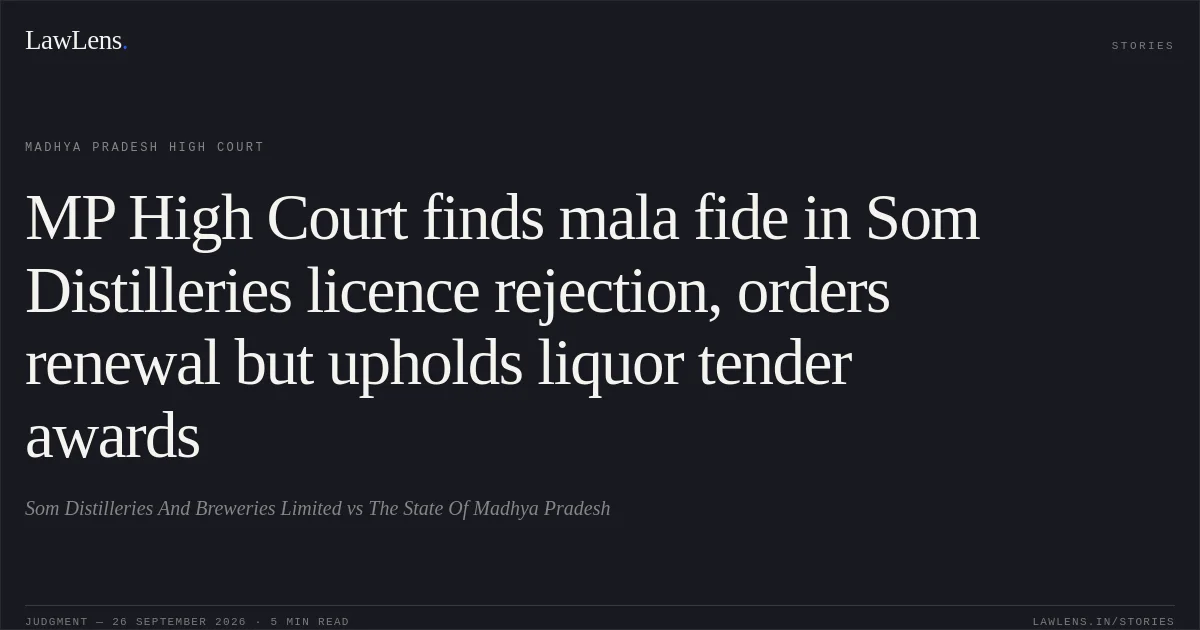
The writ petitions were partly allowed.
In W.P. No. 22400 of 2026, the order dated 18 June 2026 rejecting renewal of the D-1 and F.L.-9 licences was quashed, and the Excise Commissioner was directed to renew those licences within fifteen days.
Source reference: p. 52; para A-30(1)The State was directed to pay costs of ₹1,00,000.
Source reference: p. 52; para A-30(1)The challenges to the tender conditions, rejection of the bid and supply orders were dismissed, with liberty to claim damages or losses in accordance with law.
Source reference: p. 52; para A-30(1)In W.P. No. 25859 of 2026, the order dated 18 June 2026 was likewise quashed, and the State was directed to renew the petitioner’s B-3, F.L.-9, F.L.-9A and connected licences within fifteen days, with costs of ₹1,00,000 payable by the Government of Madhya Pradesh.
Source reference: pp. 52–53; para A-30(2)Acts & Sections Cited
6 provisions across 2 statutes referred to in this judgment. Each provision opens on LawLens.
Indian Penal Code, 18605
Code of Criminal Procedure, 19731
Original Court PDF
Som Distilleries And Breweries LimitedvsThe State Of Madhya Pradesh
Click to open original judgment
Original judgment, available to read, download and summarize on LawLens.in