Facts
The appellant was prosecuted under Section 376 IPC for allegedly raping the prosecutrix on 25 January 2008 after taking her to a field with the assistance of co-accused Pankaj Kalita.
Source reference: paras. 3–5; pp. 2–3The prosecutrix lodged the complaint on 3 February 2008, following an unsuccessful village meeting concerning the appellant’s refusal to marry her; an FIR was thereafter registered under Section 376 IPC.
Source reference: paras. 3–5; pp. 2–3The Sessions Court, Nalbari, convicted the appellant under Section 376 IPC and sentenced him to 10 years’ rigorous imprisonment and a fine of ₹5,000, by judgment dated 19 December 2018.
Source reference: para. 2; p. 2During trial, the prosecution examined the prosecutrix, her mother, the medical officer, the investigating officer and the Magistrate who recorded her statement under Section 164 CrPC; the co-accused died during the trial.
Source reference: para. 7; p. 3In appeal under Section 374(2) CrPC, the appellant challenged the reliability of the prosecutrix’s testimony, the delay in lodging the FIR, the absence of medical corroboration, and material inconsistencies between her Section 164 statement and trial testimony.
Source reference: paras. 8–9; pp. 3–4Issues
1. Whether the delay of eight days in lodging the FIR was sufficiently explained and could be treated as non-fatal to the prosecution case?
Source reference: paras. 11–14; pp. 4–52. Whether the prosecutrix’s testimony was sufficiently consistent and reliable to sustain a conviction under Section 376 IPC in the absence of independent eyewitnesses and substantive medical corroboration?
Source reference: paras. 15–18, 27–31; pp. 5–93. Whether the omission of the co-accused’s identity and role in the Section 164 CrPC statement, when compared with the prosecutrix’s subsequent trial testimony, constituted a material contradiction?
Source reference: paras. 22–30; pp. 7–94. Whether the appellant was entitled to the benefit of doubt in view of the inconsistencies, medical evidence, and the prosecutrix’s statement that she would withdraw the case if the appellant married her?
Source reference: paras. 32–35; pp. 9–10Law Applied
The Court applied Section 376 IPC concerning the offence of rape and Section 374(2) CrPC governing appeals against conviction.
Source reference: para. 2; p. 2It recognized that a conviction for rape may rest upon the sole testimony of the prosecutrix, but only where that testimony is cogent, consistent, wholly reliable and free from material infirmities.
Source reference: paras. 8, 28–30; pp. 3–9Relying on State of Punjab v. Gurmit Singh , AIR 1996 SC 1393, and Satpal Singh v. State of Haryana , (2010) 8 SCC 714, the Court held that delay in reporting a sexual offence is not necessarily fatal if satisfactorily explained.
Source reference: paras. 11–14; pp. 4–5Relying on Rai Sandeep v. State (NCT of Delhi) , (2012) 8 SCC 21, it applied the “sterling witness” standard, requiring consistency and freedom from material contradictions before basing conviction solely on the prosecutrix’s evidence.
Source reference: para. 28; p. 8The Court further applied the settled principle that where two reasonable views are possible, the view favourable to the accused must be adopted.
Source reference: para. 33; p. 10Reasoning
The Court accepted that the delay in lodging the FIR was explained by the village meeting and the appellant’s alleged refusal to marry the prosecutrix, and therefore did not treat the delay as fatal.
Source reference: para. 14; p. 5However, the medical evidence did not disclose injuries or signs of recent forceful sexual intercourse; although the hymen was torn, the report did not establish whether the tear was old or recent.
Source reference: paras. 15–16; p. 5More importantly, the prosecutrix’s Section 164 CrPC statement referred only to the appellant and omitted the co-accused entirely, whereas her trial testimony introduced the co-accused as the person who gagged and restrained her.
Source reference: paras. 22–30; pp. 7–9The Court held that this omission altered the character of the alleged occurrence and was a material contradiction, not a minor discrepancy.
Source reference: paras. 22–30; pp. 7–9No independent villagers or other persons allegedly present at the scene or village meeting were examined, and the mother’s evidence was only hearsay.
Source reference: paras. 19, 21, 26, 34; pp. 6–10The prosecutrix’s statement that she would withdraw the case if the appellant married her further raised a reasonable possibility of false implication arising from the appellant’s refusal to marry her.
Source reference: para. 32; p. 10Applying the requirement of a wholly reliable “sterling witness” and the benefit-of-doubt principle, the Court found it unsafe to sustain the conviction solely on her evidence.
Source reference: paras. 28–35; pp. 8–10Holding
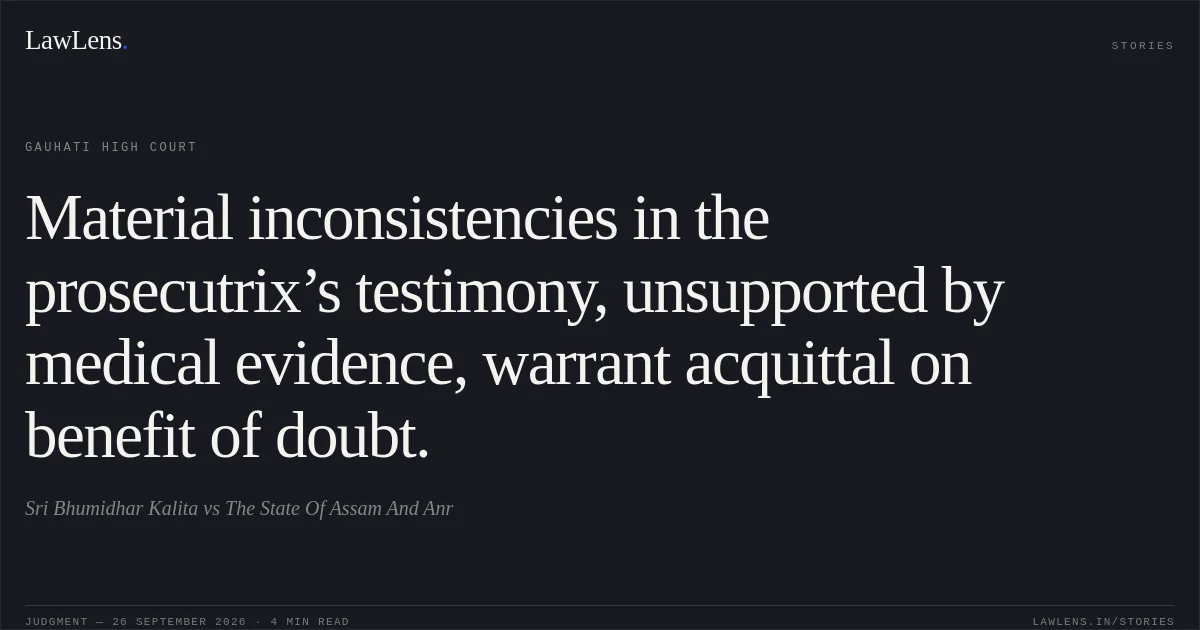
The Court held that although the FIR delay was adequately explained, the prosecution failed to establish the appellant’s guilt beyond reasonable doubt because the prosecutrix’s evidence contained a material and unexplained inconsistency regarding the co-accused, lacked adequate medical or independent corroboration, and admitted an alternative explanation connected with the appellant’s refusal to marry her.
The judgment of conviction and sentence dated 19 December 2018 in Sessions Case No. 33 of 2009 was set aside.
Source reference: paras. 35–37; p. 10–11The criminal appeal was allowed, and the appellant was directed to be released forthwith unless required in any other case.
Source reference: paras. 35–37; p. 10–11Acts & Sections Cited
3 provisions across 2 statutes referred to in this judgment. Each provision opens on LawLens.
Code of Criminal Procedure, 19732
Indian Penal Code, 18601
Original Court PDF
Sri Bhumidhar KalitavsThe State Of Assam And Anr
Click to open original judgment
Original judgment, available to read, download and summarize on LawLens.in