Facts
The appellant was prosecuted for allegedly enticing and forcibly taking a 14-year-old schoolgirl to his house on 1 April 2019, sexually assaulting her, and thereafter leaving her on the verandah.
Source reference: pp.2–3, paras 2–5The victim’s mother lodged an FIR under Sections 365/506 IPC read with Section 4 of the POCSO Act; the appellant was ultimately charged under Sections 366 IPC and 4 POCSO, with an alternative charge under Section 376 IPC.
Source reference: pp.2–3, paras 2–5The prosecution examined seven witnesses, including the victim, her relatives, the medical officer and the investigating officer; the defence relied on alibi evidence through the appellant’s mother.
Source reference: p.3, para 6The Additional Sessions Judge, Cachar, convicted the appellant under Section 4 POCSO and Section 366 IPC, sentencing him to ten years’ rigorous imprisonment under POCSO and two years’ rigorous imprisonment under Section 366 IPC, with concurrent sentences.
Source reference: p.2, para 2; p.4, para 7Issues
Whether the prosecution proved beyond reasonable doubt that the appellant committed penetrative sexual assault upon the victim so as to sustain conviction under Section 4 of the POCSO Act, particularly when the FIR and the earliest version did not allege rape or sexual assault and the medical evidence disclosed no recent intercourse or injury.
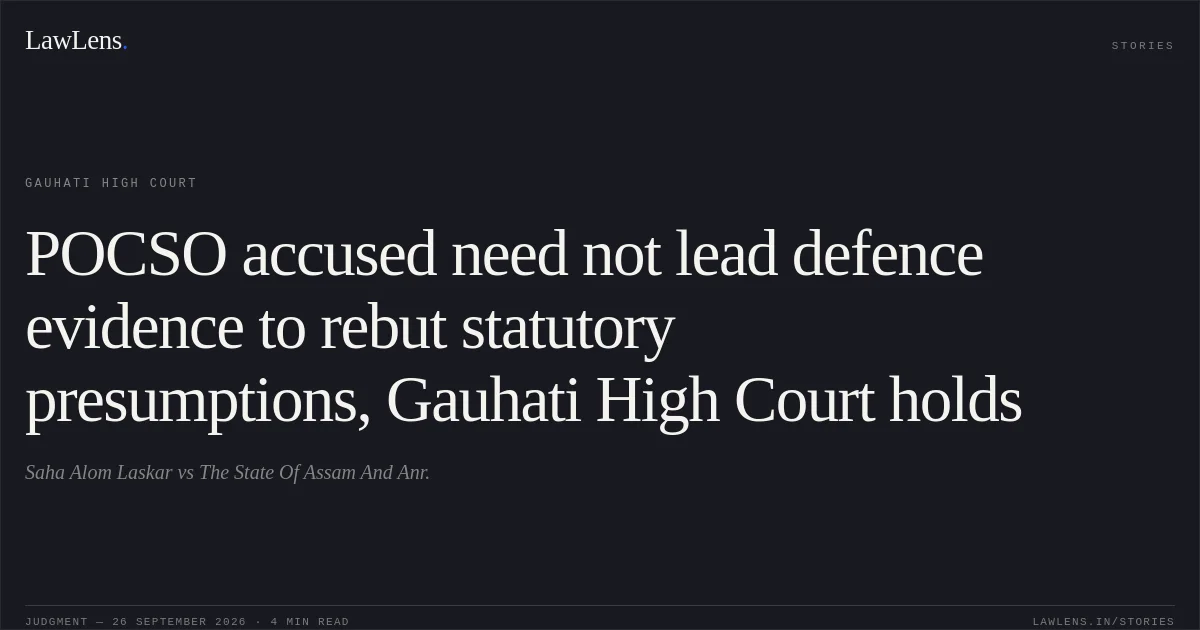
Source reference: pp.14–15, paras 38–41Whether the statutory presumptions under Sections 29 and 30 of the POCSO Act could sustain the conviction without the prosecution first establishing credible foundational facts and whether those presumptions stood rebutted on a preponderance of probabilities.
Source reference: pp.16–19, paras 45–47Whether the prosecution established that the victim was a “child” within the meaning of Section 2(d) of the POCSO Act, so as to attract the Act and its presumptions.
Source reference: p.20, paras 48–49Whether the conviction under Section 366 IPC was sustainable on the evidence regarding the alleged taking or enticement of the victim.
Source reference: pp.14–20, paras 35–50Law Applied
The Court applied Section 4 of the POCSO Act concerning punishment for penetrative sexual assault and Section 2(d) defining a “child”; Sections 29 and 30 POCSO were treated as rebuttable presumptions that operate only after the prosecution establishes foundational facts and do not dispense with proof of guilt beyond reasonable doubt.
Source reference: pp.16–19, paras 45–47Relying on Deepak IN JC v. State, Govt. of NCT of Delhi, 2026 INSC 1008, the Court held that the accused may rebut the presumptions through cross-examination and need not invariably lead defence evidence; the presumptions cannot override fair-trial principles or justify conviction where the prosecution evidence lacks credibility.
Source reference: pp.16–19, paras 45–47The Court also relied on Amar Nath Jha v. Nand Kishore Singh, (2018) 9 SCC 137, and B.N. John v. State of Uttar Pradesh, 2025 LiveLaw (SC) 4, for the principle that although an FIR is not an encyclopaedia, omission of essential ingredients of the alleged offence may materially undermine the prosecution case.
Source reference: p.15, para 42It further applied the principle that an ossification-based age assessment carries a permissible margin of variation, stated by the Court to be two years.
Source reference: p.20, paras 48–49Reasoning
The Court found material inconsistencies and omissions in the prosecution case.
Source reference: no citationThe victim’s paternal uncle, who was allegedly the first relative to whom she spoke, testified only that she had been forcibly taken to the accused’s house and did not mention any rape or sexual assault.
Source reference: p.14, paras 35–36The victim’s mother omitted any allegation of rape or sexual assault from the FIR, and the investigating officer confirmed that she had not stated in her police statement that the victim reported rape when brought home.
Source reference: pp.14–15, paras 38–41The medical officer found no evidence of recent sexual intercourse or bodily or genital injury.
Source reference: p.11, paras 28–29The Court also considered the circumstances surrounding the victim’s presence in the accused’s house, including the evidence that the accused’s mother called the police, and found the prosecution version improbable and insufficiently corroborated.
Source reference: p.15, paras 43–44Applying Deepak IN JC, the Court held that the defence had rebutted the Section 29 presumption on a preponderance of probabilities through the prosecution evidence and the alibi-related circumstances; the prosecution could not rely on the presumption to cure evidentiary deficiencies.
Source reference: pp.16–20, paras 45–47On age, although the judgment records the medical evidence as placing the victim above 14 and below 16 years, it subsequently proceeds on the basis of an age range of 16–18 years and adds two years to the outer limit, concluding that the victim was to be treated as 18 years old and therefore outside the POCSO definition of “child”.
Source reference: p.11, para 29; p.20, paras 48–49Consequently, the Court held that neither the POCSO conviction nor the connected conviction under Section 366 IPC could be sustained.
Source reference: no citationHolding
The appeal was allowed.
The High Court set aside the judgment of conviction and sentence under Section 4 of the POCSO Act and Section 366 IPC, holding that the prosecution evidence was insufficient, the Section 29 presumption stood rebutted, and the victim was not shown to fall within the statutory definition of a child for POCSO purposes.
Source reference: p.20, paras 47–50The appellant was ordered to be set at liberty forthwith, and the trial court record was directed to be returned.
Source reference: p.20, para 50Acts & Sections Cited
21 provisions across 5 statutes referred to in this judgment. Each provision opens on LawLens.
Protection of Children from Sexual Offences Act, 2012
Indian Penal Code, 18605
Code of Criminal Procedure, 19734
Juvenile Justice (Care and Protection of Children) Act, 2015.1
Narcotic Drugs and Psychotropic Substances Act, 19852
Original Court PDF
Saha Alom LaskarvsThe State Of Assam And Anr.
Click to open original judgment
Original judgment, available to read, download and summarize on LawLens.in