Facts
Respondent No. 2, the petitioner’s wife, alleged that she had married the petitioner approximately two and a half years earlier according to Hindu rites and that, while the marriage subsisted, the petitioner married Barnali Rongpi on 6 May 2019 without obtaining a divorce. She further alleged that the petitioner threatened her in connection with the dissolution of their marriage.
Source reference: p.3Pursuant to her complaint, the Magistrate directed registration of an FIR under Section 156(3) CrPC. Nagaon P.S. Case No. 1374/2019 was consequently registered under Sections 494, 294, 506 and 447 IPC. The police filed charge-sheet under the same provisions, showing the petitioner as an absconder, and PR Case No. 2154/2021 was registered before the Chief Judicial Magistrate, Nagaon.
Source reference: pp.3–4By order dated 14 August 2025, the trial court framed charges against the petitioner under Sections 494 and 506 IPC, principally relying on a document indicating registration of marriage between the petitioner and Barnali Rongpi on 6 May 2019.
Source reference: p.13The petitioner invoked Section 528 BNSS seeking quashing of the entire proceeding and setting aside of the order framing charge.
Source reference: pp.4–8Issues
Whether the materials collected during investigation disclosed sufficient prima facie or grave suspicion to justify framing charges against the petitioner under Section 494 IPC for marrying Barnali Rongpi during the subsistence of his alleged first marriage?
Source reference: paras. 9–16; pp.10–15Whether the alleged omissions in the investigation—particularly the failure to seize the original marriage document and examine temple witnesses—rendered the charge under Section 494 IPC legally unsustainable at the stage of framing charge?
Source reference: paras. 12–16; pp.14–15Whether the allegations and materials disclosed the ingredients of criminal intimidation under Section 506 IPC so as to warrant framing of charge?
Source reference: paras. 4(iv)–(v), 11; pp.5–6, 13Whether the High Court should exercise its inherent jurisdiction under Section 528 BNSS to quash the criminal proceeding and the order framing charge?
Source reference: para. 2; p.2Law Applied
The Court applied Sections 494 and 506 IPC, concerning marrying again during the lifetime of a spouse and criminal intimidation, respectively, and Section 528 BNSS concerning the High Court’s inherent jurisdiction.
Source reference: para. 2; p.2On the scope of judicial scrutiny at the stage of framing charge, the Court relied on P. Vijayan v. State of Kerala, (2010) 2 SCC 398, holding that the court must sift the prosecution material to determine whether sufficient ground and grave suspicion exist, but cannot conduct a mini-trial or assess the probative value of evidence.
Source reference: para. 10; pp.10–12The same principles were reiterated from Sajjan Kumar v. CBI, (2010) 9 SCC 368, and Union of India v. Prafulla Kumar Samal, (1979) 3 SCC 4: prosecution material is generally taken at face value; discharge is justified only where, even if accepted, it does not disclose the offence; and the trial judge is not a mere post office, though the defence cannot ordinarily be evaluated at that stage.
Source reference: paras. 10.1–10.2; pp.12–13Relying on CBI v. R.S. Pai, (2002) 5 SCC 82, the Court held that Section 173(5) CrPC is directory, and relevant documents inadvertently omitted by the investigating officer may subsequently be produced with the court’s permission.
Source reference: para. 14; p.14The Court distinguished Priya Bala Ghosh v. Suresh Chandra Ghosh, (1971) 1 SCC 864, as a decision concerned with proof at the conclusion of trial rather than the sufficiency of material for framing charge.
Source reference: para. 17; p.15Reasoning
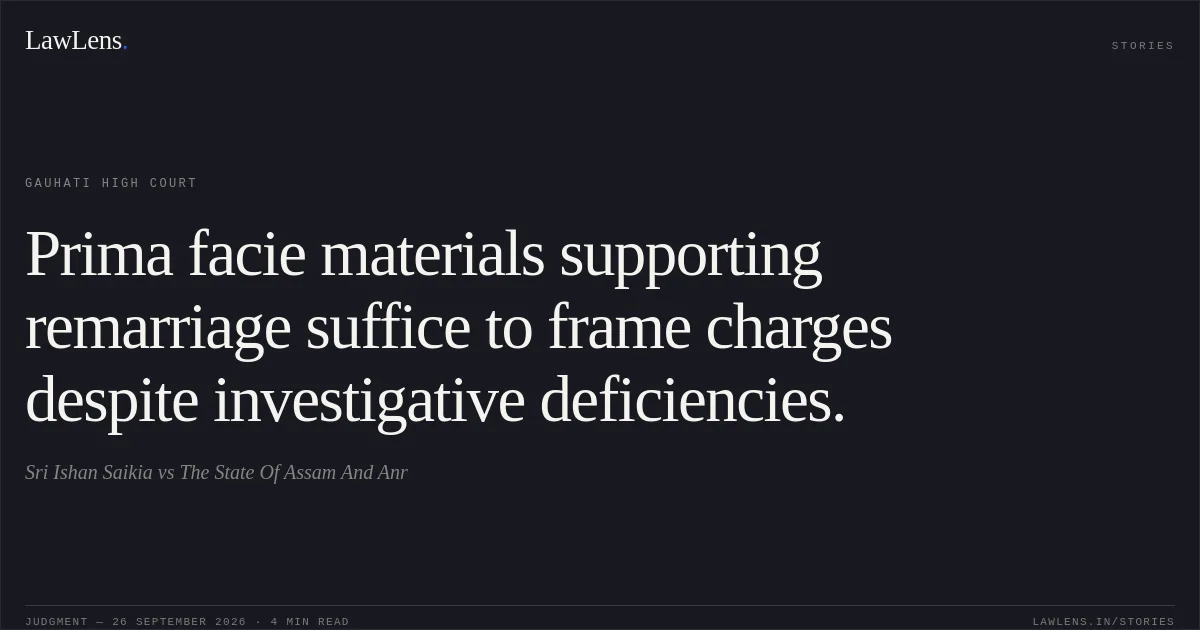
The Court held that the trial court had before it a document indicating that the petitioner’s marriage with Barnali Rongpi was registered on 6 May 2019, which, together with the complainant’s allegations, was sufficient to raise a prima facie case and grave suspicion under Section 494 IPC.
Source reference: paras. 11, 16; pp.13–15The petitioner’s objections—that the original document was not seized, the temple was not visited, and temple witnesses were not examined—concerned evidentiary reliability and matters to be tested during trial, not grounds for quashing at the charge stage.
Source reference: paras. 12, 15–16; pp.14–15The Court also took note of the respondent’s assertions regarding the voter-list entry and the child’s birth certificate, observing that these materials prima facie supported the alleged marital relationship and could be brought on record during trial with the court’s permission.
Source reference: para. 14; p.14Since the court at this stage was required to assess whether the prosecution material, if accepted, could establish the alleged offences—not to conclusively determine the validity of the second marriage or test witnesses—the decision in Priya Bala Ghosh did not justify quashing the proceeding.
Source reference: paras. 16–17; p.15The Court consequently found no legal infirmity in the framing of charges under Sections 494 and 506 IPC.
Source reference: no citationHolding
The High Court answered the issues against the petitioner. It held that the prosecution materials disclosed sufficient grounds to proceed and that the alleged investigative deficiencies did not invalidate the order framing charge.
The petition under Section 528 BNSS was dismissed, the proceedings in PR Case No. 2154/2021 and the order dated 14 August 2025 framing charges under Sections 494 and 506 IPC were left undisturbed, and the parties were directed to bear their own costs.
Source reference: para. 18; p.15Any interim order was vacated.
Source reference: para. 19; p.15Acts & Sections Cited
10 provisions across 3 statutes referred to in this judgment. Each provision opens on LawLens.
Bharatiya Nagarik Suraksha Sanhita, 20231
Indian Penal Code, 18605
Code of Criminal Procedure, 19734
Original Court PDF
Sri Ishan SaikiavsThe State Of Assam And Anr
Click to open original judgment
Original judgment, available to read, download and summarize on LawLens.in