Facts
On 16 February 2022, the petitioner, a police officer posted at Lailapur Police Post, intercepted a truck carrying 125 bags—approximately 10,000 kg—of suspected Burmese supari at Lailapur Check Point, Assam, and apprehended Respondent No. 2 and two others for allegedly transporting the goods without valid documents.
Source reference: para. 3–4On the petitioner’s FIR, Dholai P.S. Case No. 58/2022 was registered under Sections 120(B), 420, 379 and 411 IPC; investigation culminated in a charge-sheet and cognizance against Respondent No. 2 and the other accused.
Source reference: para. 5–6Respondent No. 2 thereafter filed Complaint Case No. 126/2022 against the petitioner and other police officials, alleging that the supari was legally imported and documented, and that the police had unlawfully confined him, seized the goods, and falsely implicated him.
Source reference: para. 7–8The Magistrate recorded the complainant’s and witnesses’ statements, took cognizance of offences under Sections 166, 211, 241, 342, 465 and 469 IPC, and issued summons to the petitioner and others.
Source reference: para. 9–10The petitioner challenged the complaint and cognizance order under Sections 482 and 401 CrPC, principally contending that the alleged acts were performed in discharge of official duty and that prior sanction under Section 197 CrPC was mandatory.
Source reference: para. 2, 11Issues
Whether the acts alleged against the petitioner—interception, seizure, apprehension and lodging of the FIR—were committed while acting or purporting to act in the discharge of official duty, thereby attracting the protection of Section 197 CrPC.
Source reference: para. 17–20, 23–25Whether the Magistrate could take cognizance of the complaint against the petitioner in the absence of prior sanction under Section 197 CrPC.
Source reference: para. 11, 18–20, 24Whether the impugned cognizance order and criminal proceedings against the petitioner were liable to be quashed at the pre-trial stage.
Source reference: para. 24–27Law Applied
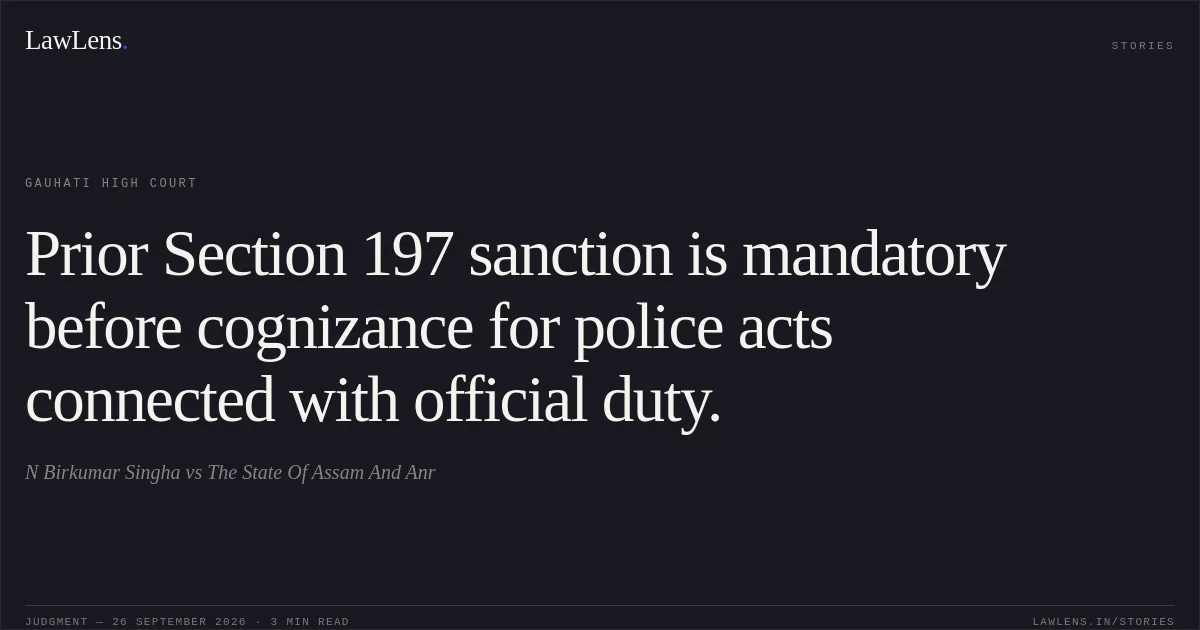
Section 197 CrPC bars a court from taking cognizance of an alleged offence committed by a protected public servant while acting or purporting to act in the discharge of official duty, unless prior governmental sanction has been obtained.
Source reference: para. 17–19The protection applies where there is a reasonable connection between the alleged act and the official duty, even if the public servant exceeded the strict limits of that duty; however, acts wholly unconnected with official functions are not protected.
Source reference: para. 21The Court relied on Rajen Singh, APS v. State of Assam, which held that the relevant test is whether the act falls within the scope and range of official duty and is not merely a cloak for an objectionable act.
Source reference: para. 21Diganta Barah v. State of Assam, relying on Indra Devi v. State of Rajasthan, Matajog Dubey v. H.C. Bhari, S. Moitra v. State of West Bengal, and Prakash Singh Badal v. State of Punjab, which establish that the act must have a reasonable relationship with official duty, and that sanction protects public servants from vexatious prosecution.
Source reference: para. 22The question of sanction may be determined at the threshold where the alleged acts are demonstrably connected with official functions.
Source reference: para. 24–25Reasoning
The petitioner’s interception of the vehicle, seizure of the suspected contraband, apprehension of the occupants and lodging of the FIR were all measures undertaken in the course of police investigation and enforcement duties.
Source reference: para. 23Even accepting Respondent No. 2’s version that the supari was legally imported and supported by documents, the alleged misconduct remained directly connected with the petitioner’s official function of checking suspected contraband and initiating criminal proceedings.
Source reference: para. 23–24Applying the reasonable-connection test under Section 197 CrPC, the Court held that the alleged acts could not be treated as wholly unrelated to official duty.
Source reference: no citationConsequently, the Magistrate was precluded from taking cognizance without prior sanction.
Source reference: no citationThe argument that the issue of sanction should be deferred until trial was rejected because the objection had been raised before commencement of trial and the official-duty connection was apparent on the admitted circumstances.
Source reference: para. 24–25Holding
The Court held that the petitioner was acting or purporting to act in discharge of his official duties and was therefore entitled to the protection of Section 197 CrPC.
Since no valid prior sanction had been obtained, the Magistrate could not lawfully take cognizance of the alleged offences against him.
Source reference: para. 26The cognizance order and consequential proceedings were accordingly set aside insofar as the petitioner was concerned, while the applicability of the individual penal provisions was left open for determination at the appropriate stage and forum.
Source reference: para. 26The petition was allowed.
Source reference: para. 27Acts & Sections Cited
13 provisions across 2 statutes referred to in this judgment. Each provision opens on LawLens.
Code of Criminal Procedure, 19733
Original Court PDF
N Birkumar SinghavsThe State Of Assam And Anr
Click to open original judgment
Original judgment, available to read, download and summarize on LawLens.in