Facts
The applicant sought bail under Section 483 of the Bharatiya Nagarik Suraksha Sanhita, 2023, in Crime No. 376/2022 registered at Police Station Barod, Agar Malwa, for offences under Sections 376, 376(2)(h), 450 and 506(i) of the IPC.
Source reference: para. 1He had been in custody since 27 November 2022. This was his third bail application; earlier applications had been withdrawn or rejected, and the High Court had directed the trial court to conclude the trial expeditiously, preferably within six months from 11 August 2025.
Source reference: paras. 1–3The prosecution alleged that the applicant committed penetrative sexual assault upon the prosecutrix after trespassing into her house.
Source reference: para. 2Although charges had been framed on 31 March 2023, only three witnesses had been examined and no witness had been examined after the High Court’s direction dated 11 August 2025. Eight prosecution witnesses remained to be examined.
Source reference: para. 3The Court further found that samples containing semen and sperm, forwarded to RFSL, Jhumarghat, Indore, had not been sent for DNA examination despite directions of the Supreme Court and the High Court. Permission for DNA examination was sought only on 14 August 2026.
Source reference: paras. 6–7The Court also noted that the notice issued to the prosecutrix invited her to appear and record “no objection” to the bail application, thereby prejudicing her interests and suggesting police support for the bail request.
Source reference: paras. 14–15Issues
Whether the applicant was entitled to bail under Section 483 of the BNSS, 2023, considering his prolonged custody, substantial delay in trial, and non-compliance with the earlier direction for speedy conclusion of the proceedings.
Source reference: paras. 1–4, 12Whether the investigating and prosecuting authorities had failed in their statutory and supervisory duties by not forwarding the biological samples for DNA examination despite the presence of semen and sperm and binding judicial directions.
Source reference: paras. 6–11Whether the notice issued to the prosecutrix, requiring her to appear and record “no objection” to the bail application, was improper and required corrective administrative directions.
Source reference: paras. 14–18Law Applied
The Court applied Section 483 of the BNSS, 2023, concerning the High Court’s power to grant bail; Section 309 of the CrPC, 1973, which requires criminal trials to proceed from day to day and mandates completion of trials concerning offences under Section 376 IPC within two months from filing of the charge-sheet, and the corresponding Section 346 of the BNSS, 2023.
Source reference: para. 4It relied on Durgesh v. State of Madhya Pradesh, M.Cr.C. No. 52891/2022, for the principle that biological samples in rape cases, particularly where POCSO offences are involved, should be sent for DNA examination in accordance with Section 53A of the CrPC and the decision in Chotkau v. State of Uttar Pradesh, 2022 SCC OnLine SC 1313.
Source reference: para. 5It also relied on Joshinder Yadav v. State of Bihar, AIR 2014 SC 1043, which emphasised the prosecution’s duty to promptly send samples for forensic examination and obtain scientific evidence.
Source reference: para. 10Further, State of Gujarat v. Kishan Bhai, AIR 2004 SCW 557, was relied upon for the principle that culpable investigative or prosecutorial lapses must be identified and may invite departmental consequences and institutional corrective measures.
Source reference: para. 11Reasoning
The Court treated the applicant’s prolonged incarceration and the stagnation of the trial as significant circumstances favouring bail. Despite the earlier direction for expeditious disposal, only three witnesses had been examined and there had been no effective progress after 11 August 2025, contrary to the legislative mandate of Sections 309 CrPC and 346 BNSS.
Source reference: paras. 3–4, 9, 12The Court also found serious investigative and supervisory lapses: the forensic report disclosed semen and sperm, yet the samples were not forwarded for DNA analysis for more than three years. The explanation based on the transfer of the investigating officer and the omission of the police-station in-charge was found inadequate, particularly because scientific evidence is material in sexual-offence investigations and the failure persisted despite judicial directions.
Source reference: paras. 6–10These failures, together with the trial delay and the applicant’s custody, justified the grant of bail, without determination of the merits of the prosecution case.
Source reference: para. 12Separately, the Court held that the language of the notice to the prosecutrix was prejudicial because it conveyed that the police station was interested in obtaining her “no objection”; it therefore directed corrective action and sought accountability from the Director General of Police.
Source reference: paras. 14–18Holding
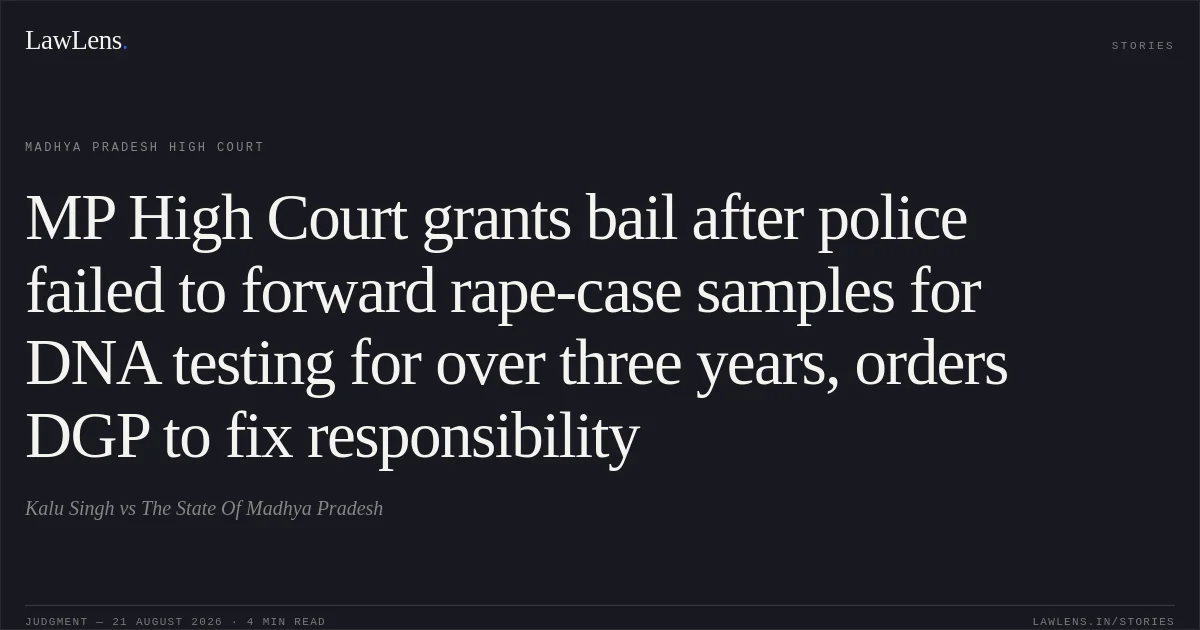
The High Court allowed the third bail application and directed that Kalu Singh be released on bail upon furnishing a personal bond of ₹50,000 with one surety in the like amount to the satisfaction of the trial court, subject to his appearance on all dates fixed during the pendency of the trial.
The Court directed that a copy of the order be sent to the Director General of Police, Madhya Pradesh, Bhopal, to examine and fix responsibility for the failure to forward the samples for DNA examination and for the lapses of the supervising authorities, including the then in-charge of Police Station Barod.
Source reference: paras. 17–18Acts & Sections Cited
8 provisions across 3 statutes referred to in this judgment. Each provision opens on LawLens.
Bharatiya Nagarik Suraksha Sanhita, 20233
Indian Penal Code, 18603
Code of Criminal Procedure, 19732
Original Court PDF
Kalu SinghvsThe State Of Madhya Pradesh
Click to open original judgment
Original judgment, available to read, download and summarize on LawLens.in