Facts
The petitioner purchased approximately 1.293 hectares of land at Village Tejpur Gadbadi, Indore, from Prem Chouhan and Pawan Shrimal through registered sale deeds dated 10 and 11 December 2015.
Source reference: paras. 3, 7–8The vendors had purchased the land from Jyoti Nagar Grih Nirman Sanstha pursuant to sale permission granted on 30 March 2007.
Source reference: paras. 3, 7–8The land was diverted for development on 30 May 2016, and building permissions were granted to the petitioner on 19 January 2017, 14 May 2018 and 7 November 2019.
Source reference: paras. 3, 7–8RERA permission was also granted on 22 May 2020, and the petitioner constructed a four-storeyed commercial building.
Source reference: paras. 3, 7–8In 2021, the authorities cancelled the 2007 sale permission, issued directions to stop construction, temporarily revived the permission, and subsequently cancelled it again.
Source reference: paras. 3, 7–8Issues
Whether Section 72-B(g) of the Madhya Pradesh Cooperative Societies Act, 1960 could be applied retrospectively to invalidate sale permission granted on 30 March 2007, before the provision came into force.
Source reference: paras. 8–10Whether the cancellation of the sale permission and consequential development/building permissions, after a delay of approximately fourteen years and without adequate notice or hearing to the petitioner, violated principles of natural justice and constitutional protection of property.
Source reference: paras. 8, 11Whether the High Court should exercise writ jurisdiction under Article 226 despite the availability of an alternative statutory remedy.
Source reference: paras. 9, 11Law Applied
Section 72-B(g), as amended, was held to impose a new substantive liability requiring Registrar’s permission for transfer of land by a cooperative society; such a provision operates prospectively and cannot ordinarily affect completed transactions predating the amendment.
Source reference: para. 9(i)–(ii)Applying Hitendra Vishnu Thakur v. State of Maharashtra, the Court reiterated that a statute affecting substantive rights is presumed prospective unless retrospective operation is expressed or necessarily implied, and that even procedural provisions should not retrospectively create new disabilities or obligations in respect of completed transactions.
Source reference: para. 10The Court also relied on Government of Andhra Pradesh v. Ch. Gandhi concerning prospective operation and the relevance of fairness in construing retrospectivity.
Source reference: para. 10It applied the principles of natural justice, Article 14, and Article 300-A of the Constitution, holding that administrative action affecting property rights must be lawful, fair and preceded by an opportunity of hearing.
Source reference: para. 11The alternative-remedy rule is discretionary and does not bar Article 226 jurisdiction where there is breach of natural justice, lack of jurisdiction, arbitrariness, or a pure question of law; nor should a petitioner be relegated after the writ petition has been entertained and remained pending for several years.
Source reference: para. 9(iii)–(iv)The Court further relied on M/s Shriram Builders v. Cooperative Department for the principle that a permission acted upon and effectively exhausted after substantial development cannot ordinarily be revoked after a long lapse of time.
Source reference: para. 9(v)Reasoning
The Court found that the original sale permission was granted in 2007, before the statutory amendment imposing the Registrar’s-permission requirement.
Source reference: paras. 8–10The petitioner was a bona fide purchaser who acquired the property through registered deeds, obtained diversion and repeated building permissions, secured RERA approval, and made substantial construction and investment.
Source reference: paras. 8–10Consequently, applying Section 72-B(g) to undo the completed 2007 transaction would retrospectively impose a substantive disability and was legally impermissible.
Source reference: paras. 8–10The authorities had acted after approximately fourteen years, without following a proper procedure or giving the petitioner an effective opportunity of hearing, and had repeatedly cancelled and revived the same permission through inconsistent orders.
Source reference: paras. 8, 11The Court considered this conduct arbitrary, procedurally unfair and suspicious, particularly because the permission had already been acted upon and the petitioner had constructed up to four floors pursuant to governmental approvals.
Source reference: paras. 8, 11Since the case involved a largely legal question, violation of natural justice, prolonged pendency, and an interim order already operating, the availability of an alternative remedy did not justify relegating the petitioner to statutory proceedings.
Source reference: paras. 9, 11Holding
The writ petition was allowed.
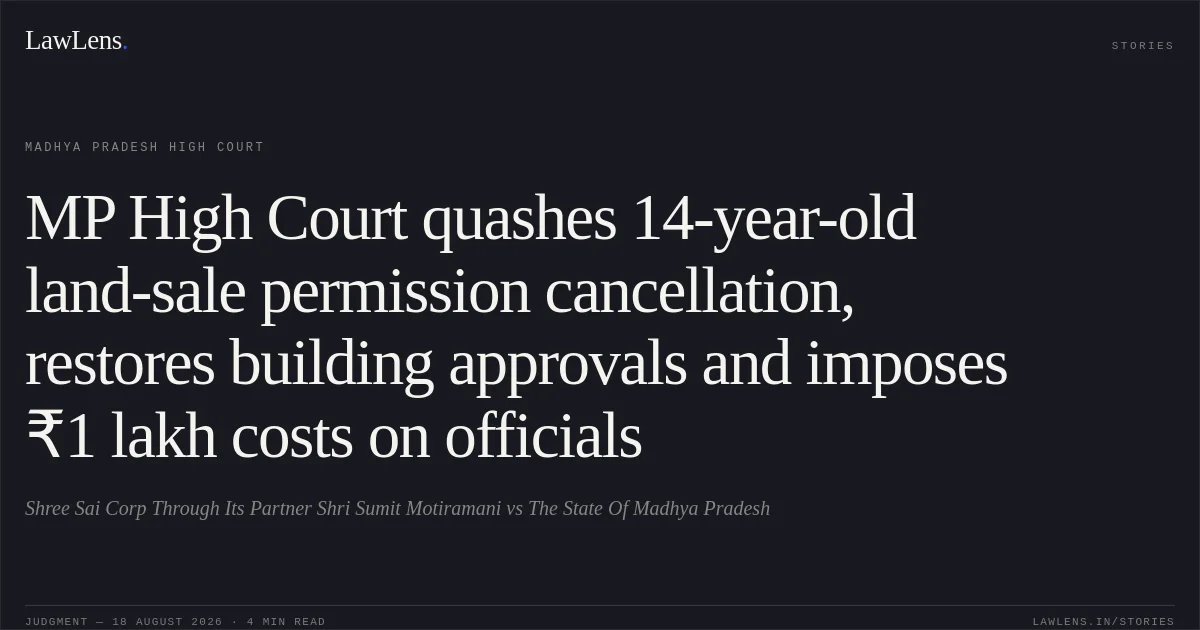
The Court held that Section 72-B(g) could not be applied retrospectively to the 2007 sale permission and quashed the cancellation order dated 15 February 2021, the subsequent consequential actions, and the order dated 30 March 2021.
Source reference: para. 11The cancellation of the petitioner’s development permission dated 27 March 2021 and building permission dated 4 October 2021 was set aside, and the permissions were directed to be restored.
Source reference: para. 11The concerned authorities were directed to renew the RERA and other consequential permissions, preferably within one month, and to grant the respective permissions within fifteen days, subject to compliance with law.
Source reference: para. 11The petitioner was permitted to resume construction in accordance with applicable legal requirements.
Source reference: para. 11Costs of ₹1,00,000 were imposed on the respondents holding the relevant posts, to be deposited with the Madhya Pradesh Legal Services Authority within three weeks; the State was directed to deposit the amount first and recover it from the concerned authorities.
Source reference: para. 12Acts & Sections Cited
4 provisions across 2 statutes referred to in this judgment. Linked provisions open on LawLens.
M.P. Co-Operative Societies Act, 19603
Adhiniyam of 1983 (alias, unresolved)1
Original Court PDF
Shree Sai Corp Through Its Partner Shri Sumit MotiramanivsThe State Of Madhya Pradesh
Click to open original judgment
Original judgment, available to read, download and summarize on LawLens.in