Facts
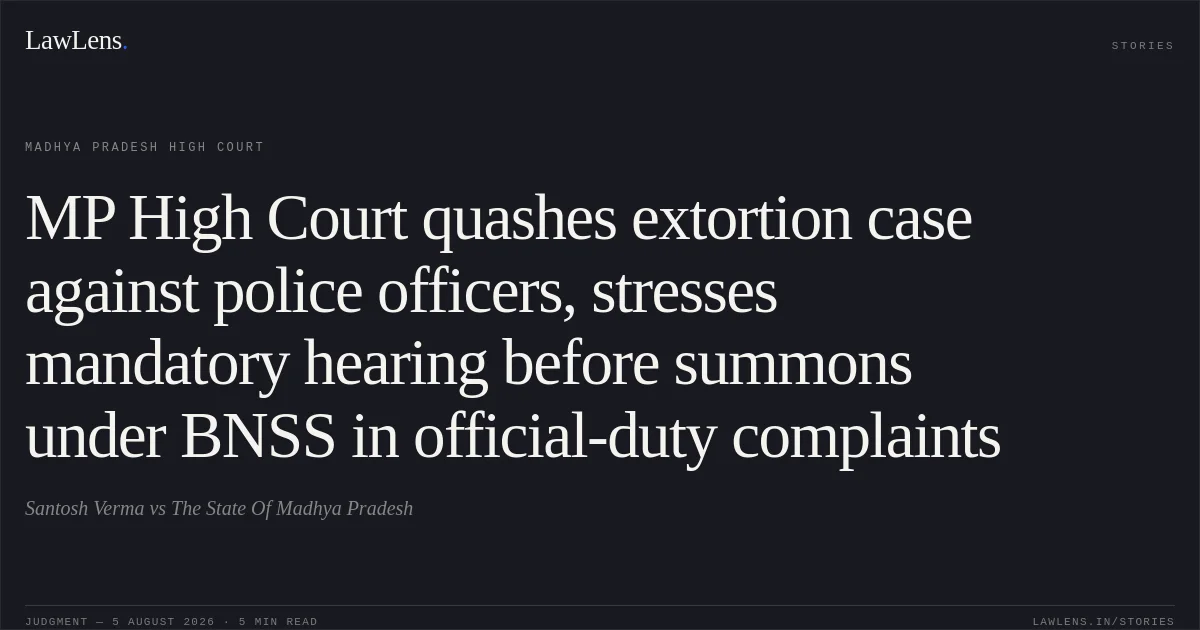
The petitions arose from a common private complaint filed by respondent No. 2 against four police officials involved in the investigation of Crime No. 787/2023 registered at Police Station Thatipur, Gwalior, concerning an alleged railway employment fraud.
Source reference: paras. 2–5The complainant alleged that the police officers demanded and received approximately ₹5,80,000, ₹9,75,000 and ₹15,00,000 in instalments, threatened false implication and a police encounter, illegally detained him and his relatives, and caused CCTV footage from the police station to disappear.
Source reference: paras. 2–5The Special Judge rejected the complainant’s application under Section 156(3) Cr.P.C. and directed that the matter proceed as a private complaint.
Source reference: paras. 4–6After recording statements under Sections 200 and 202 Cr.P.C. and examining documents and records relating to the earlier criminal case, the Special Judge, by order dated 11.05.2026, took cognizance of offences under Sections 392, 201 and 120-B IPC and Sections 11/13 of the MPDVPK Act against the petitioners.
Source reference: paras. 4–6The petitioners challenged the cognizance order under the inherent jurisdiction of the High Court, contending that the Special Judge had conducted a mini-trial, relied on untested materials from another criminal case, failed to establish the ingredients of the alleged offences, and proceeded without sanction under Section 197 Cr.P.C. or compliance with Section 223 BNSS.
Source reference: paras. 7–25Issues
1. Whether the Special Judge exceeded the limited jurisdiction available under Sections 200 and 202 Cr.P.C. by undertaking an elaborate appreciation of evidence and recording findings ordinarily reserved for trial?
Source reference: para. 38(i)–(ii)2. Whether the complaint and preliminary materials disclosed the essential ingredients of offences under Sections 392, 201 and 120-B IPC and Sections 11/13 of the MPDVPK Act?
Source reference: para. 38(iii)3. Whether previous sanction under Section 197 Cr.P.C. was a condition precedent to taking cognizance against the police officials?
Source reference: para. 38(iv)4. Whether reliance on records and investigative materials from Crime No. 787/2023 and Sessions Trial No. 172/2024 was legally permissible at the stage of issuing process?
Source reference: paras. 61–665. Whether failure to comply with the safeguards under Section 223 BNSS, including giving the proposed accused an opportunity of hearing, vitiated the cognizance order?
Source reference: paras. 25, 80–816. Whether continuation of the complaint proceedings amounted to abuse of the process of court warranting interference under Section 528 BNSS?
Source reference: para. 38(v)–(vi)Law Applied
The Court applied Sections 200–203 Cr.P.C., holding that an inquiry on a private complaint is limited to determining whether sufficient grounds exist for proceeding and cannot become a determination of guilt, relying on Chandra Deo Singh v. Prokash Chandra Bose, Nagawwa v. Veeranna Shivalingappa Konjalgi, Pepsi Foods Ltd. v. Special Judicial Magistrate, Mehmood Ul Rehman v. Khazir Mohammad Tunda, GHCL Employees Stock Option Trust v. India Infoline Ltd., and Birla Corporation Ltd. v. Adventz Investments.
Source reference: paras. 40–50Under Sections 390 and 392 IPC, robbery requires dishonest taking or extortion accompanied by immediate fear of death, hurt or wrongful restraint; Section 120-B IPC requires an agreement or meeting of minds to commit an illegal act; and Section 201 IPC requires knowledge of an offence and intentional disappearance of evidence to screen the offender.
Source reference: paras. 70–75The Court applied Section 197 Cr.P.C. on the principle that sanction depends on whether the alleged act bears a reasonable nexus with official duty, as explained in Matajog Dobey v. H.C. Bhari, P.K. Pradhan v. State of Sikkim, Devinder Singh v. State of Punjab and D. Devaraja v. Owais Sabeer Hussain.
Source reference: paras. 76–77It further relied on R.P. Kapur v. State of Punjab, State of Haryana v. Bhajan Lal, Amit Kapoor v. Ramesh Chander and Neeharika Infrastructure Pvt. Ltd. v. State of Maharashtra for the principle that inherent jurisdiction may be exercised to prevent abuse of process and secure the ends of justice.
Source reference: paras. 54–60Section 223 BNSS was treated as requiring, in complaints against public servants relating to official functions, a superior-officer report and an opportunity of hearing before issuance of process.
Source reference: paras. 80–81Reasoning
The Court held that the Special Judge had exceeded the permissible scope of Sections 200 and 202 Cr.P.C. by assessing witness credibility, treating the complainant’s version as corroborated, drawing conclusive inferences from the non-preservation of CCTV footage, attributing conspiracy to superior officers, and determining the culpability of individual petitioners.
Source reference: paras. 46–53The Court also found it impermissible to rely upon untested investigation papers, recovery memos and other materials from the pending proceedings arising out of Crime No. 787/2023, since such materials were not substantive evidence and had not been tested by cross-examination.
Source reference: paras. 61–66Even accepting the allegations at face value, the alleged payments made on different dates during an investigation did not prima facie disclose the immediate and contemporaneous violence or fear required for robbery under Sections 390–392 IPC.
Source reference: paras. 70–71The allegation that superior officers failed to act on complaints did not establish any agreement or meeting of minds necessary for criminal conspiracy under Section 120-B IPC.
Source reference: paras. 72–74Likewise, mere non-availability of CCTV footage did not establish intentional destruction of evidence, knowledge of an offence, or an intention to screen offenders under Section 201 IPC.
Source reference: para. 75The Court further held that the alleged acts were sufficiently connected with the officers’ investigative functions to make the issue of sanction under Section 197 Cr.P.C. a matter requiring proper consideration rather than summary rejection.
Source reference: paras. 76–77Finally, the Special Judge had relied on the BNSS framework and called for official reports but had not afforded the petitioners the hearing contemplated by Section 223 BNSS, causing procedural prejudice.
Source reference: paras. 80–81Holding
The High Court allowed all four petitions.
It quashed and set aside the common cognizance order dated 11.05.2026 and consequently quashed the complaint proceedings and all consequential process or summons issued against the petitioners for offences under Sections 392, 201 and 120-B IPC and Sections 11/13 of the MPDVPK Act.
Source reference: para. 83(1)–(2)The Court clarified that it had not adjudicated the truth of the complainant’s allegations or the merits of Crime No. 787/2023 and Sessions Trial No. 172/2024, which were to proceed independently and uninfluenced by the judgment.
Source reference: para. 83(3)–(4)No order as to costs was made.
Source reference: para. 84Acts & Sections Cited
20 provisions across 4 statutes referred to in this judgment. Each provision opens on LawLens.
Indian Penal Code, 1860
Code of Criminal Procedure, 19737
Information Technology Act, 20001
Bharatiya Nagarik Suraksha Sanhita, 20233
Original Court PDF
Santosh VermavsThe State Of Madhya Pradesh
Click to open original judgment
Original judgment, available to read, download and summarize on LawLens.in