Facts
The parties’ Franchise Agreement contained an arbitration clause providing that the “location” of arbitration would be within Delhi, that the proceedings would be held in Goa, and that a sole arbitrator would be appointed by mutual consent. A separate clause submitted disputes to the exclusive jurisdiction of courts in Goa.
Source reference: p. 2–4After the respondent’s proposed arbitrator was rejected, it applied to the Delhi High Court under Section 11(6) of the Arbitration and Conciliation Act, 1996. The High Court appointed an arbitrator, leaving the hearing venue to be selected in consultation with the parties.
Source reference: p. 3The appellant challenged that order, contending that Goa was the juridical seat and the Delhi High Court therefore lacked jurisdiction.
Source reference: p. 3–4Issues
Whether the juridical seat of arbitration under the Agreement was Goa or Delhi
Source reference: p. 12–15Whether the Delhi High Court had jurisdiction under Section 11(6) of the 1996 Act to appoint an arbitrator
Source reference: p. 3–4, 17–18Law Applied
Under Section 11(6) of the Arbitration and Conciliation Act, 1996, the competent court may appoint an arbitrator where the agreed appointment procedure fails.
Source reference: no citationThe juridical seat determines the courts with supervisory jurisdiction over the arbitration; under Indus Mobile Distribution Pvt. Ltd. v. Datawind Innovations Pvt. Ltd., the courts at the seat have exclusive jurisdiction for regulating arbitral proceedings.
Source reference: p. 7Applying the test stated in BGS SGS SOMA JV v. NHPC Ltd. and affirmed in Arif Azim Co. Ltd. v. Micromax Informatics FZE, a designated venue may be treated as the seat where the proceedings are anchored to that single place and there are no significant contrary indicia.
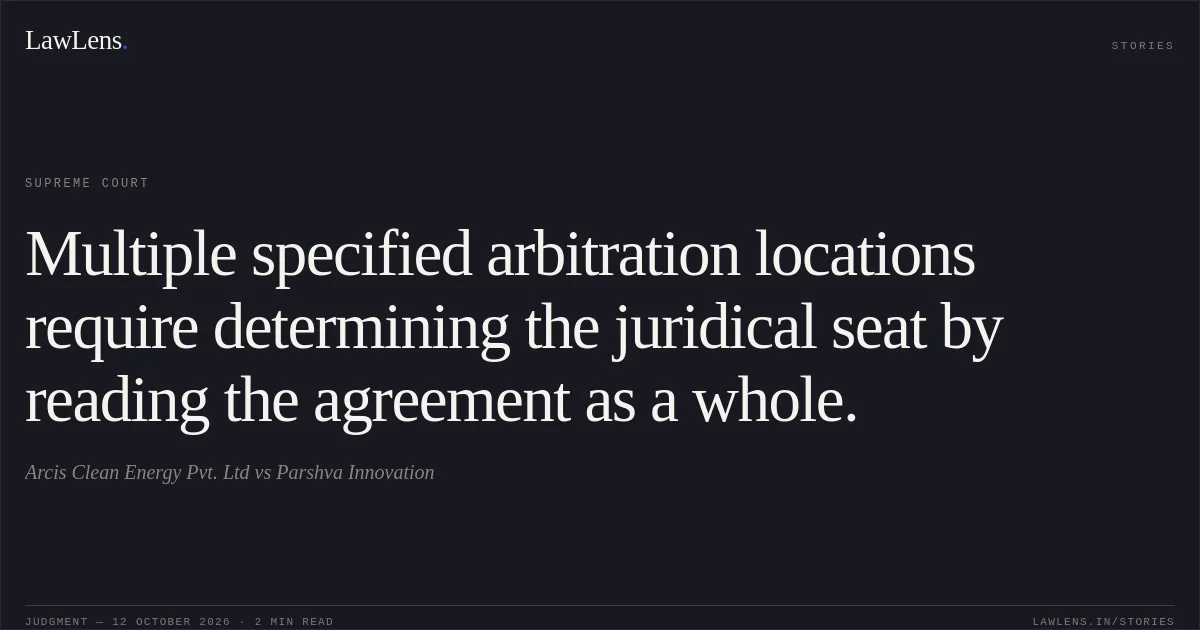
Source reference: p. 12–13Where an agreement identifies more than one place, the parties’ intention must be determined by construing the arbitration clause and the agreement as a whole; the mere expression “place of arbitration” is not conclusive, and other contractual clauses may inform the determination.
Source reference: p. 13–15Reasoning
The arbitration clause referred to both Delhi and Goa, so Delhi could not automatically be treated as the seat under the BGS SGS SOMA test.
Source reference: p. 13The Court harmonised the clause stating that the arbitration’s location would be within Delhi with the clause stating that proceedings would be held in Goa, and considered the separate clause conferring exclusive jurisdiction on Goa courts. Read together, these provisions showed that Goa was the juridical seat and Delhi was only a venue.
Source reference: p. 14–15The fact that the arbitration agreement is distinct from the main contract did not justify disregarding the governing-law and jurisdiction clause, particularly because the arbitration clause itself specified two places.
Source reference: p. 14–15Holding
The Court held that Goa was the juridical seat of arbitration and that the Delhi High Court lacked jurisdiction to entertain the respondent’s Section 11(6) application.
It allowed the appeal, set aside the High Court’s order, and left the parties at liberty to pursue appropriate proceedings before the jurisdictional High Court.
Source reference: p. 18Acts & Sections Cited
10 provisions across 3 statutes referred to in this judgment. Each provision opens on LawLens.
Arbitration and Conciliation Act, 19962
Code of Civil Procedure, 19086
Indian Contract Act, 18722
Original Court PDF
Arcis Clean Energy Pvt. LtdvsParshva Innovation
Click to open original judgment
Original judgment, available to read, download and summarize on LawLens.in