Facts
The petitioner claimed ownership and possession of land bearing Khasra Nos. 35/1/1 and 37/1-2, admeasuring 0.820 hectare at Village Bicholi Mardana, District Indore. He relied on a sanctioned layout and demarcation order dated 31 December 2014, contending that the land did not fall within the proposed Master Plan road.
Source reference: p. 1In April 2026, the Municipal Corporation informed him that approximately 5.69 metres of his land/construction obstructed the proposed widening of a 30-metre road under the Indore Development Plan, 2021.
Source reference: p. 2The petitioner submitted objections, but after an earlier order dated 7 July 2026 was challenged in W.P. No. 27725 of 2026, this Court directed a fresh hearing and a speaking order.
Source reference: p. 3Following a further hearing, the respondent issued the impugned order dated 3 August 2026 directing removal of the obstructing construction, while offering relaxation through FAR/TDR.
Source reference: p. 4The petitioner challenged that order under Article 226 of the Constitution, alleging lack of jurisdiction, violation of natural justice, expiry of the Development Plan, and infringement of Articles 14 and 300-A.
Source reference: p. 5Issues
1. Whether the Municipal Corporation’s Building Officer had jurisdiction under Sections 305 and 306 of the Madhya Pradesh Municipal Corporation Act, 1956, to direct removal of construction falling within the regular line of a proposed public street.
Source reference: pp. 6–12, 19–202. Whether the Indore Development Plan, 2021, continued to bind the Corporation and the landowner notwithstanding the petitioner’s contention that the Plan had expired.
Source reference: pp. 3–4, 7–9, 13–183. Whether implementation of the proposed road widening required separate acquisition proceedings under the 2013 Land Acquisition Act and payment of acquisition compensation before removal of the construction.
Source reference: pp. 4–5, 10–12, 15–174. Whether the impugned order was arbitrary or violated the petitioner’s rights under Articles 14 and 300-A, or the principles of natural justice.
Source reference: pp. 3–5, 10–13, 19–22Law Applied
Section 305 of the Madhya Pradesh Municipal Corporation Act, 1956 authorises the Corporation to require removal or setback of a building projecting beyond the regular line of an existing or future public street; the affected portion becomes part of the public street and vests in the Corporation, subject to reasonable compensation for damage or loss, with the statutory mechanism under Sections 306 and 387 available for determination of compensation.
Source reference: pp. 14–17, 19–20The Court relied principally on Ravindra Ramchandra Waghmare v. Indore Municipal Corporation, (2017) 1 SCC 667, holding that a final development plan is binding on development authorities, the Corporation, local authorities and landowners, and may be implemented through Section 305 without separate acquisition proceedings.
Source reference: pp. 8–12, 13–18It also relied on Indore Municipality v. K.N. Palsikar, AIR 1969 SC 579, for the principle of automatic vesting under Section 305, and Suresh Singh Kushwah v. Municipal Corporation, Gwalior, 2006 (3) MPLI 412, concerning removal of construction beyond the regular street line.
Source reference: pp. 10–12Sections 17, 19(5), 25, 49, 50 and 54 of the Madhya Pradesh Nagar Tatha Gram Nivesh Adhiniyam, 1973 recognise the binding nature and statutory implementation of development plans and town-development schemes.
Source reference: pp. 13–18, 20–22Reasoning
The Court held that the Corporation was not acting outside its jurisdiction merely because the road was identified under the Development Plan prepared under the 1973 Adhiniyam.
Source reference: pp. 13–18Applying Ravindra Ramchandra Waghmare, it found that the Development Plan was binding and that Section 305 provided an independent statutory basis for regulating the regular line of the public street and removing obstructing construction.
Source reference: pp. 19–20The petitioner’s argument that the Plan had expired was rejected; the Court accepted that the reference to “2021” indicated the planning horizon and did not, by itself, terminate the Plan’s operation until a new plan came into force.
Source reference: p. 7The Court further relied on the joint inspection and panchnama, which indicated that the petitioner’s construction encroached upon the land required for the road, and found no violation of natural justice because the petitioner or his representative had been given notice and an opportunity to submit objections and appear for hearing.
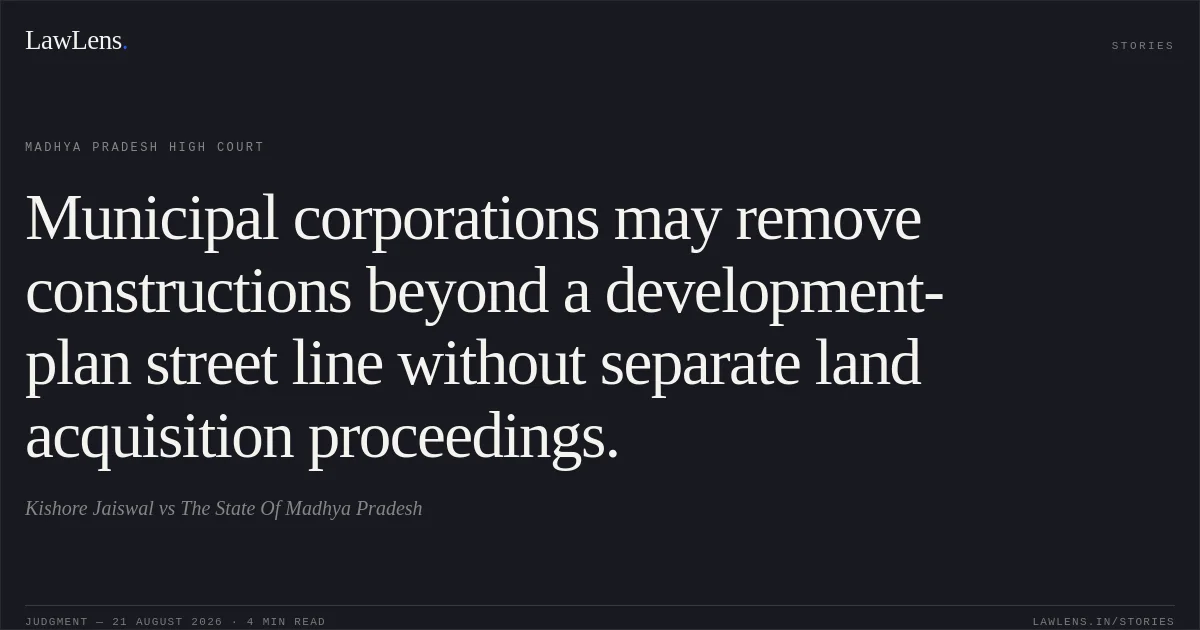
Source reference: pp. 12, 19–22Separate acquisition proceedings were held unnecessary where the statutory conditions under Section 305 were satisfied, since the provision itself contemplated deemed vesting and reasonable compensation under the municipal statute.
Source reference: pp. 15–17In view of the public interest involved in widening the road and the absence of apparent arbitrariness or illegality, the Court declined to interfere under Article 226.
Source reference: pp. 19–22Holding
The Court held that the impugned order dated 3 August 2026 was issued within the Corporation’s jurisdiction under Section 305 of the 1956 Act, was supported by the binding Indore Development Plan, and did not violate Articles 14 or 300-A or the principles of natural justice.
The requirement of separate acquisition proceedings under the 2013 Act was rejected, subject to the statutory entitlement to reasonable compensation under the municipal law.
Source reference: paras. 8–13; pp. 19–23The writ petition was dismissed, and no relief was granted to the petitioner.
Source reference: paras. 8–13; pp. 19–23Acts & Sections Cited
33 provisions across 4 statutes referred to in this judgment. Linked provisions open on LawLens.
M.P. Nagar Tatha Gram Nivesh Adhiniyam, 1973
M.P. Municipal Corporation Act, 1956
Land Acquisition Act, 18941
the 1960 Act (alias, unresolved)4
Original Court PDF
Kishore JaiswalvsThe State Of Madhya Pradesh
Click to open original judgment
Original judgment, available to read, download and summarize on LawLens.in